
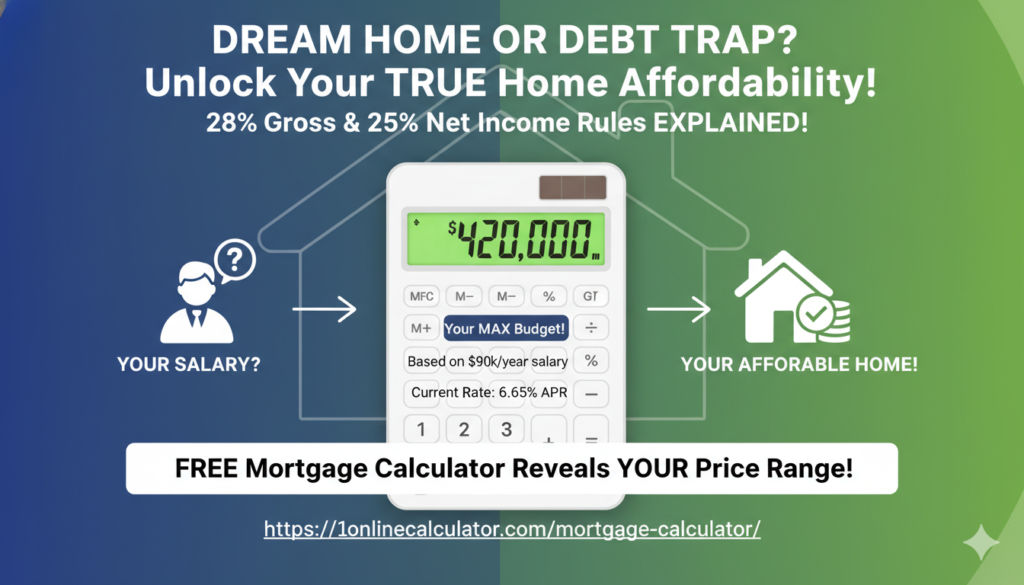
How Much House Can I Afford on My Salary? (2026 Guide)
Buying too much house is one of the most common and most costly financial mistakes in the US. Most buyers discover their budget by asking a lender what they qualify for — which tells them the maximum a bank will lend, not the maximum their income can comfortably support. These two numbers are frequently very different.
This guide shows exactly how to calculate a realistic home purchase budget based on your actual salary using the guidelines that financial planners — not mortgage salespeople — recommend.
Current Mortgage Rates — What You Are Working With in 2026
The current 30-year fixed mortgage rate averages 6.65%. At this rate, every $100,000 borrowed costs approximately $645 per month in principal and interest. This single figure drives all the affordability calculations below — when rates move, so does every affordability number.
Rule 1: The 28% Gross Income Guideline
The traditional mortgage underwriting guideline states that your monthly housing payment (principal + interest only, before taxes and insurance) should not exceed 28% of your monthly gross income.
On a $70,000 annual salary ($5,833/month gross): 28% = $1,633/month maximum payment. At 6.65% APR for 30 years, $1,633/month supports a loan of approximately $253,000. With 20% down: maximum home price = $253,000 / 0.80 = $316,000.
On a $100,000 annual salary ($8,333/month gross): 28% = $2,333/month maximum payment. At 6.65% APR, this supports a loan of approximately $362,000. With 20% down: maximum home price = $452,000.
Rule 2: The 25% Net Income Guideline (More Conservative)
Many financial advisors recommend the more conservative 25% of monthly take-home pay guideline. This ensures the mortgage fits your actual cashflow — not your pre-tax income.
On a $70,000 salary in Texas ($4,823/month take-home): 25% = $1,206/month. At 6.65%, this supports a loan of $187,000. With 20% down: maximum price = $234,000.
The difference between the 28% gross and 25% net approaches on the same $70,000 salary is approximately $82,000 in maximum home price. The conservative net income approach leaves more budget room for property taxes, homeowners insurance, HOA fees, maintenance, and savings.
Not sure of your real take-home pay? Use the free salary tax calculator first, then use the result in the mortgage affordability calculation.
How Much House Can You Afford at Different Salary Levels in 2026?
Using the 25% of take-home rule with 6.65% APR, 30-year mortgage, 20% down payment:
- $50,000 salary (~$3,400 take-home): max payment $850/mo → max loan $132,000 → max price $165,000
- $65,000 salary (~$4,250 take-home): max payment $1,063/mo → max loan $165,000 → max price $206,000
- $80,000 salary (~$5,100 take-home): max payment $1,275/mo → max loan $198,000 → max price $247,000
- $100,000 salary (~$6,100 take-home in avg state): max payment $1,525/mo → max loan $237,000 → max price $296,000
- $130,000 salary (~$7,700 take-home): max payment $1,925/mo → max loan $298,000 → max price $373,000
- $150,000 salary (~$8,700 take-home): max payment $2,175/mo → max loan $337,000 → max price $421,000
What Most Buyers Get Wrong About Mortgage Affordability
Using gross income instead of net income
Budget from your take-home pay. Mortgage payments come out of the money in your account — not your gross salary. Using 28% of gross consistently overstates what fits comfortably.
Ignoring the full PITI payment
The mortgage calculator shows principal and interest. The full monthly obligation includes property taxes (average 1.1% of home value annually), homeowners insurance (average 0.5%), and HOA fees if applicable. On a $300,000 home, these add approximately $400-$550/month to your payment. A $1,500/month principal and interest payment becomes $1,900-$2,050 total.
Not accounting for PMI
Private mortgage insurance is required on conventional loans when the down payment is less than 20%. PMI typically costs 0.5-1.5% of the loan annually — $750 to $2,250/year on a $150,000 loan. This adds $63 to $188/month and should be included in affordability calculations until sufficient equity removes the requirement.
Qualifying for more than you should borrow
Lenders will often approve borrowers for amounts significantly above what the 25% net income rule suggests. Lender approval does not confirm affordability — it confirms creditworthiness. The two concepts are different. Being approved for a $450,000 mortgage does not mean a $450,000 home fits your budget comfortably.
Use the free mortgage calculator to find the payment at the current 6.65% rate for any home price. Compare the 15 and 30-year options — the 15-year saves an average of $150,000-$200,000 in interest on a typical US loan despite the higher payment.
Frequently Asked Questions
Q: How much house can I afford on a $60,000 salary?
On a $60,000 salary with approximately $3,950/month take-home, the 25% guideline supports a maximum payment of $988/month. At 6.65% APR for 30 years, this supports a loan of approximately $153,000. With 20% down, your maximum home price is approximately $191,000. In most US markets, this limits you to condominiums, townhomes, or homes in lower-cost regions. First-time buyer programs (FHA, USDA, state assistance) can reduce the down payment requirement and stretch affordability.
Q: Does the mortgage amount qualify me for any home price?
No. Lenders calculate your maximum borrowing capacity using DTI (debt-to-income ratio) which considers all your monthly debt payments. If you have a car payment, student loans, or credit card minimums, these reduce the mortgage amount you qualify for. The 25% rule applies to the mortgage payment only — total debt service should stay under 35-40% of gross monthly income by most underwriting standards.
Q: How does the down payment affect what I can afford?
A larger down payment reduces the loan amount, the monthly payment, and eliminates PMI once you reach 20%. Every additional $10,000 in down payment reduces a 30-year mortgage payment at 6.65% by approximately $64/month. Building a larger down payment is one of the most effective ways to expand your affordable home price range.