
How Tariffs Are Raising Car Prices in 2026 — And What It Means for Your Auto Loan
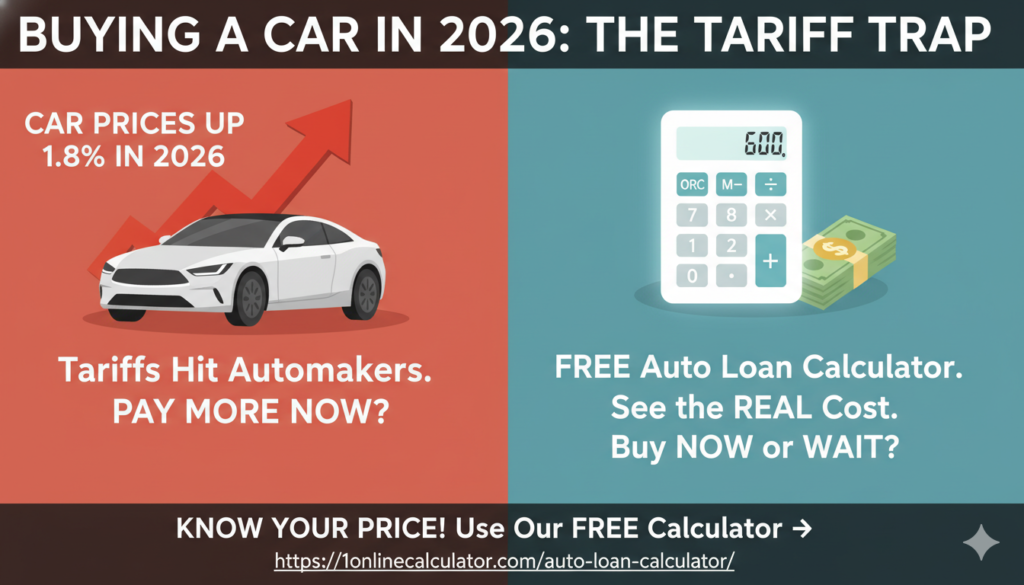
If you have been watching car prices and wondering whether now is the right time to buy, the short answer is that prices are rising — and the reason is tariffs. In April 2026, the average transaction price for a new vehicle rose 1.8% year over year, according to Kelley Blue Book, with the average new car now costing over $50,000. Ford raised prices on its Mexico-built vehicles on May 2nd. BMW announced it will raise prices on its 2026 lineup by nearly 2% on July 1st. Hyundai ended its complimentary maintenance program, effectively increasing the total cost of ownership.
For the vast majority of American car buyers — more than 80% of whom finance their purchases — these price increases do not just affect the sticker price. They directly affect the loan amount, the monthly payment, the total interest paid, and whether that car fits within a responsible budget. This guide explains exactly what is happening, how to calculate the real impact on your loan, and whether buying now, waiting, or refinancing your current car is the smarter financial move.
What Is Driving Car Prices Going Up in 2026?
The primary driver of 2026 price increases is a 25% tariff on imported vehicles and auto parts that took effect in early 2025. While the headline number sounds dramatic, the real-world impact is more nuanced — but still significant.
Not every vehicle is affected equally. A car assembled in the US still relies on globally sourced parts — the White House’s own fact sheet estimated that approximately 50% of parts content in US-made cars is foreign. Goldman Sachs analysts estimated the tariff impact at $3,000 to $8,000 for US-assembled vehicles and $5,000 to $15,000 for imported vehicles. Some of this cost is absorbed by manufacturers through reduced margins and adjusted incentive programs. The rest is passed to buyers.
How Much More Will You Actually Pay — The Loan Math
A price increase on the sticker does not feel real until you see what it does to the loan. Here is the math on a realistic scenario.
Before tariff price increases: $45,000 vehicle, 7% APR, 60 months. Monthly payment: $891. Total interest: $8,460. Total cost: $53,460.
After a $2,500 tariff-driven price increase: $47,500 vehicle, same 7% APR, 60 months. Monthly payment: $940. Total interest: $8,926. Total cost: $56,426.
The $2,500 price increase becomes a $2,966 increase in total cost once interest is factored in. And if the buyer extends to 72 months to keep the payment manageable, the total interest climbs further — to over $11,000 on the $47,500 vehicle. This compounding effect is exactly why the sticker price is the beginning of the calculation, not the end.
Use the free auto loan calculator to enter any vehicle price and see your exact monthly payment, total interest, and full amortization schedule for any loan term. The term comparison table shows how 48, 60, 72, and 84 months change your total cost at a glance.
Should I Buy a Car Now or Wait 2026?
This is the most-searched car question of 2026, and the honest answer is: it depends on your specific situation. Here are the three main scenarios and the right approach for each.
If you need a car now — buy now, strategically
Prices are not expected to fall in 2026. The mortgage rate forecast for June 2026 through May 2027 projects 30-year rates staying in the 6.0–6.4% range. Auto loan rates similarly are unlikely to drop significantly while the Fed holds rates steady. Waiting for a meaningful price reduction means waiting for a tariff policy reversal — which is unpredictable.
The strategic approach: focus on US-assembled vehicles, which face lower tariff exposure than imports. Prioritise models with higher residual values and manufacturer incentive programs. Get pre-approved by a credit union before visiting any dealership — credit union auto loan rates are typically 1–2 percentage points below dealer financing. And calculate the total cost before agreeing to any payment.
If your current car still works — keep it and refine your payment
The best financial decision for most Americans in 2026 is not buying a new car at elevated prices but refinancing their existing loan at a lower rate. If your credit score has improved since your original loan, or if you accepted dealer financing without comparison, refinancing could save $1,500–$3,000 in total interest with no new vehicle purchase required.
Use the free auto refinance calculator to see your exact monthly savings and break-even point for any new rate. If your credit has improved by 50+ points since origination, refinancing almost always makes financial sense.
If you are shopping for a used car
Used car prices have also risen as buyers shift away from expensive new vehicles. The tariff effect on used cars is indirect — more new-car avoidance increases demand for used vehicles, pushing those prices up. The average used car now costs approximately $28,000. The same loan math applies: a 1% rate improvement on a $28,000 used car saves approximately $900 in total interest over a 60-month term.
How to Protect Your Budget From Rising Car Prices
- Set a firm maximum price before browsing. Use the car affordability calculator to determine your ceiling based on real take-home pay — not gross salary — before looking at any vehicles.
- Get pre-approved by a credit union. Super prime borrowers (720+ credit) are currently qualifying for new car rates as low as 4.66% APR, compared to 7–10% for average dealer financing offers. On a $45,000 loan, a 3-point rate difference saves $4,200 in total interest.
- Focus on total cost, not monthly payment. Dealers will offer to extend terms to 72 or 84 months to make elevated prices feel affordable. The monthly payment drops but total interest climbs. Always calculate both numbers.
- Consider US-assembled vehicles. These face lower direct tariff exposure. Check the vehicle’s Monroney sticker for the country of final assembly — US-assembled vehicles will list a US state as the final assembly point.
- Time your purchase for model-year-end incentives. Manufacturers typically increase incentives in August–October to clear outgoing model-year inventory. Combining a price reduction from incentives with a credit union pre-approval is the most effective way to minimise total cost in a high-price environment.
Use the free car affordability calculator to find your maximum vehicle price based on your income and existing debts. Then use the auto loan calculator to verify the exact payment and total cost for any specific vehicle at any interest rate. See the full suite of auto finance tools at 1onlinecalculator.com/auto-finance-tools/
Current Auto Loan Rates — May 2026
According to Experian’s Q4 2025 data (most recent available), average auto loan rates by credit tier for new vehicles are: Super prime (781+): 4.66% APR. Prime (661–780): 6.89% APR. Near prime (601–660): 9.62% APR. Sub-prime (501–600): 12.85% APR. Deep sub-prime (300–500): 16.01% APR.
The spread between super prime and deep sub-prime on the same $47,500 vehicle is dramatic: super prime pays $883/month and $5,445 total interest over 60 months. Deep sub-prime pays $1,038/month and $14,780 total interest — $9,335 more for the same vehicle simply because of credit score.
Frequently Asked Questions
Q: How much are tariffs adding to new car prices in 2026?
The direct tariff impact varies by vehicle and manufacturer. US-assembled vehicles are estimated to be $3,000–$8,000 more expensive due to imported parts costs. Imported vehicles face $5,000–$15,000 in potential tariff-driven increases, though manufacturers are absorbing some of this through reduced margins. In practice, buyers are seeing average base MSRP increases of $691 on 2026 models, with fully-loaded trim increases averaging $1,126 according to CarEdge analysis.
Q: Should I buy a car now or wait for prices to drop?
Experts do not forecast significant 2026 price reductions. Tariff policies remain in place, and manufacturers have already implemented most price adjustments. Waiting for a policy reversal is unpredictable. If you need a car, buying now with credit union financing and focusing on US-assembled vehicles is the most cost-controlled approach. If your current car still works, refinancing your existing loan to a lower rate is typically more financially beneficial than purchasing at current elevated prices.
Q: Does a $2,000 car price increase really cost more than $2,000?
Yes — significantly more. A $2,000 price increase on a 60-month loan at 7% APR adds $2,593 to your total repayment cost when interest is included. On a 72-month loan at the same rate, the same $2,000 increase adds $2,760. The longer the term, the more a price increase ultimately costs you. This is why using an auto loan calculator to see total cost — not just monthly payment — is essential before agreeing to any financing.
Disclaimer: Price data and rate averages cited are from publicly available sources as of May 2026 including Kelley Blue Book, Experian, and Bankrate. Specific vehicle prices and loan rates vary by dealer, lender, location, and individual credit profile. Consult your lender for personalised rate information.