

How Much Should You Save Each Month? A Simple Formula & Examples
Do you ever look at your bank account and wonder, “Am I saving enough?” or “How much should I save each month?” You’re not alone. This is one of the most common questions in personal finance, yet finding a clear, actionable answer can feel overwhelming.
The truth is, there’s no single “right” number for everyone. Your ideal monthly savings amount depends on your income, expenses, goals, and life stage. But here’s the good news: there is a simple formula that works for everyone, and once you understand it, you can calculate your personal savings target in minutes.
This guide will walk you through exactly how to determine how much you should save each month, with practical examples, expert tips, and a free Savings Goal Calculator to do the math for you.
How much should I save each month? A common rule of thumb is to save 20% of your monthly take-home pay, using the 50/30/20 budget rule . However, your ideal savings amount depends on your income, expenses, and financial goals. Start by calculating your savings rate using this formula: (Amount Saved ÷ Gross Income) × 100 . A savings rate of 15-20% is a solid target for most people, but saving any amount is better than saving nothing at all .
Table of Contents
- What Is a Monthly Savings Goal?
- Why Saving Every Month Matters
- The Simple Formula to Calculate Monthly Savings
- How Much Should You Save Based on Income?
- Savings Recommendations for Different Age Groups
- The 50/30/20 Budget Rule
- How to Save More Every Month
- Common Savings Mistakes
- Real-Life Examples
- Savings Challenge
- Frequently Asked Questions
- Conclusion
What Is a Monthly Savings Goal?
A monthly savings goal is simply the amount of money you commit to setting aside from each paycheck or month of income. It’s not just a number you pick out of thin air—it’s a calculated target that moves you toward your financial objectives.
Your monthly savings goal should be:
- Specific: A concrete dollar amount, not “as much as I can”
- Calculated: Based on your income, expenses, and goals
- Realistic: Challenging but achievable with your current budget
- Trackable: You can measure your progress each month
The beauty of a monthly savings goal is that it transforms vague intentions into concrete action. Instead of hoping to save money, you have a clear target to hit.
Expert Tip #1: Treat your monthly savings goal like a non-negotiable bill. Just as you wouldn’t skip your rent or mortgage payment, don’t skip your savings contribution. This mindset shift is one of the most powerful changes you can make . Use our Free Budgeting Tools for Additional financial planning resources
Why Saving Every Month Matters
Saving consistently every month isn’t just about building a financial cushion—it’s about building a financial future. Here’s why monthly savings matter:
1. Compound Interest Works in Your Favor
When you save consistently, you give your money time to grow through compound interest. This means you earn interest not just on your principal, but also on the interest you’ve already earned . Over time, this creates a snowball effect that can dramatically accelerate your progress.
Example: If you save $200 per month for 30 years at an average 7% annual return, you’ll have approximately $226,000—even though you only contributed $72,000. The other $154,000 comes from compound growth.
2. You Build Financial Resilience
Life is unpredictable. Job loss, medical emergencies, car repairs, and home maintenance can happen to anyone. A consistent savings habit builds the emergency fund you need to handle these challenges without going into debt .
3. You Achieve Your Goals Faster
Whether you’re saving for a house down payment, a dream vacation, or retirement, regular monthly savings is the most reliable way to get there. You’re not waiting for a windfall or a miracle—you’re building progress one month at a time.
4. You Develop Financial Discipline
Saving every month builds a muscle. The more you do it, the easier it becomes. You learn to live within your means, prioritize spending, and make intentional financial decisions.
5. You Reduce Financial Stress
People who save regularly report lower financial stress. Knowing you have money set aside for emergencies and future goals provides peace of mind that no amount of spending can buy.
Expert Tip #2: Start now. Even if it’s just $50 per month. The habit of saving is more important than the amount you save. You can always increase your contributions later . Use our Compound Interest Calculator to Understand how your savings grow over time
The Simple Formula to Calculate Monthly Savings
Here’s the formula that answers the question “how much should I save each month?”:
The Basic Formula
Monthly Savings = (Financial Goal Amount ÷ Number of Months Until Goal)
Example: If you want to save $12,000 for an emergency fund in 24 months:
$12,000 ÷ 24 months = $500/month
The Advanced Formula (With Interest)
If you’re saving in an account that earns interest, use this formula to account for growth:
Monthly Contribution = Target Amount × (r ÷ ((1 + r)^n – 1))
Where:
- r = Monthly interest rate (annual rate ÷ 12)
- n = Total number of months
Example: You want $12,000 in 24 months at 4.7% APY. The monthly contribution would be approximately **$477/month**—slightly less than $500 because your money earns interest along the way .
How to Calculate Your Savings Rate
Another way to answer “how much should I save” is to calculate your savings rate as a percentage of your income :
Savings Rate = (Amount Saved ÷ Gross Income) × 100
Example: If you earn $5,000/month gross and save $750/month:
($750 ÷ $5,000) × 100 = 15% savings rate
Savings Rate Benchmarks
| Savings Rate | What It Means |
|---|---|
| 10% | Minimum recommended for retirement alone |
| 15-20% | Solid target for most people |
| 25%+ | Aggressive wealth-building pace |
| 50%+ | FIRE movement target (Financial Independence, Retire Early) |
Expert Tip #3: Don’t stress if you can’t hit 20% right away. A savings rate of 8% you can sustain is better than a rate of 25% that leads to burnout and spending binges . use this free Budget Spreadsheet to Track your income and expenses
How Much Should You Save Based on Income?
Your income level affects how much you can realistically save. Here’s a breakdown of potential monthly savings by income level.
| Monthly Gross Income | 10% Savings | 15% Savings | 20% Savings | 25% Savings |
|---|---|---|---|---|
| $2,500 | $250 | $375 | $500 | $625 |
| $3,500 | $350 | $525 | $700 | $875 |
| $4,500 | $450 | $675 | $900 | $1,125 |
| $5,000 | $500 | $750 | $1,000 | $1,250 |
| $6,500 | $650 | $975 | $1,300 | $1,625 |
| $8,000 | $800 | $1,200 | $1,600 | $2,000 |
| $10,000 | $1,000 | $1,500 | $2,000 | $2,500 |
What if you can’t save 20%?
Start with what you can. Even $50/month adds up to $600/year. As your income grows or expenses decrease, increase your savings rate .
Savings Recommendations for Different Age Groups
Your age and life stage significantly influence how much you should save each month. Here’s what financial experts recommend.
Savings in Your 20s
Early 20s (20-24): Start with 5% of your income to build the habit. It’s more important to start than to start big.
Mid to Late 20s (25-29): Aim for 10-25% of your monthly income. At this age, you may have fewer financial obligations, making it easier to save more.
Why it matters: Saving in your 20s gives compound interest maximum time to work. $200/month saved at age 25 is worth significantly more than $400/month saved at age 45 .
Monthly savings target example (25 years old, $50,000 salary):
- 10%: $417/month
- 15%: $625/month
- 20%: $833/month
Savings in Your 30s
Goal: Increase your savings rate to 20-25% of your income as your earning potential grows.
Why it matters: Your 30s are typically when you start building wealth. You may also have major expenses like buying a home or starting a family, so saving at a higher rate helps balance these competing priorities.
Monthly savings target example (35 years old, $65,000 salary):
- 20%: $1,083/month
- 25%: $1,354/month
Savings in Your 40s
Goal: Maintain a 20%+ savings rate while focusing on retirement readiness. At this age, experts recommend having 3-4 times your annual salary saved for retirement .
Why it matters: Your 40s are often peak earning years, but also peak spending years (mortgage, family expenses). Finding the balance is crucial.
Monthly savings target example (45 years old, $75,000 salary):
- 20%: $1,250/month
- 25%: $1,563/month
Savings in Your 50s and 60s
Goal: Double down on savings as retirement approaches. Aim to have 6-10 times your annual salary saved by age 60-67 .
Why it matters: Your 50s are the last chance to significantly boost retirement savings before you stop working.
Monthly savings target example (55 years old, $80,000 salary):
- 25%: $1,667/month
- 30%: $2,000/month
Retirement Savings by Age Table
Monthly Savings Needed for Retirement
| Age Started | Monthly Savings | Total by 67 (at 8% return) |
|---|---|---|
| 20 | $160 | $1,000,000 |
| 25 | $245 | $1,000,000 |
| 30 | $370 | $1,000,000 |
| 35 | $565 | $1,000,000 |
| 40 | $875 | $1,000,000 |
| 45 | $1,395 | $1,000,000 |
Expert Tip #4: The earlier you start, the less you need to save each month. A 20-year-old saving $160/month can reach the same retirement goal as a 40-year-old saving $875/month. Time is your greatest asset . use this free Salary Tax Calculator to calculate accurate take-home pay
The 50/30/20 Budget Rule
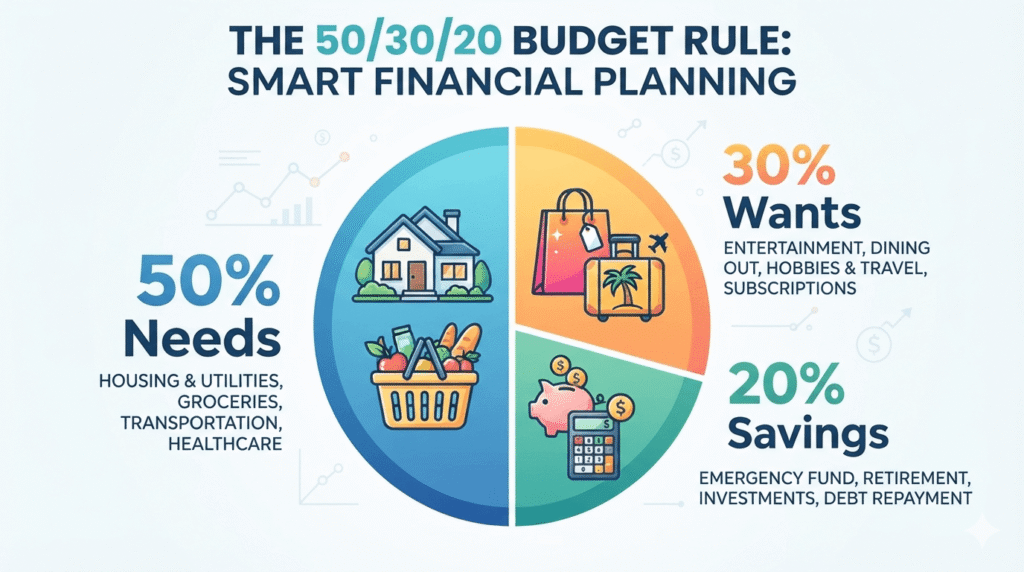
The 50/30/20 rule is one of the most popular budgeting frameworks—and for good reason. It’s simple, flexible, and works for most people .
How the 50/30/20 Rule Works
50% Needs: Essential living expenses like housing, food, utilities, transportation, insurance, and minimum debt payments.
30% Wants: Discretionary spending like dining out, entertainment, shopping, subscriptions, and vacations.
20% Savings & Debt Repayment: Money for retirement accounts, emergency fund, extra debt payments, and other financial goals.
Example: Applying the 50/30/20 Rule
Monthly take-home pay: $5,000
| Category | Percentage | Amount |
|---|---|---|
| Needs | 50% | $2,500 |
| Wants | 30% | $1,500 |
| Savings | 20% | $1,000 |
Should You Follow the 50/30/20 Rule?
The 50/30/20 Rule in Different Currencies
| Monthly Income | 50% Needs | 30% Wants | 20% Savings |
|---|---|---|---|
| $4,000 | $2,000 | $1,200 | $800 |
| €4,000 | €2,000 | €1,200 | €800 |
| £4,000 | £2,000 | £1,200 | £800 |
| AED 15,000 | AED 7,500 | AED 4,500 | AED 3,000 |
Expert Tip #5: Adjust the percentages to fit your life. The 50/30/20 rule is a starting point, not a rigid rule. If your rent is higher or you have student loans, you might need to shift percentages. What matters is that you save consistently . use these excellent Free Budgeting Tools for Additional financial planning resources
How to Save More Every Month
If you’re struggling to save as much as you’d like, here are proven strategies to increase your monthly savings.
1. Automate Your Savings
Set up automatic transfers from your checking account to your savings account on payday. When the money moves automatically, you don’t have to use willpower.
How to start: Most banks let you set up recurring transfers in minutes. Start with what you can, even $50 per paycheck.
2. Pay Yourself First
Treat savings like any other bill—it’s the first “payment” you make each month. Before you spend on anything else, transfer your savings.
3. Use a High-Yield Savings Account
The national average savings account rate is only 0.61% APY, but many high-yield accounts offer around 4% APY in 2026 . Moving your money to a HYSA can earn you significantly more interest with no extra risk.
| Account Type | Interest Rate | Balance After 1 Year (on $10,000) |
|---|---|---|
| Traditional Savings | 0.61% APY | $10,061 |
| High-Yield Savings | 4.0% APY | $10,400 |
Difference: $339 more in interest by using a HYSA.
4. Track Your Spending
For one month, write down every single expense. You’ll likely find spending you can reduce or eliminate .
Common savings opportunities:
- Dining out (save $100/month by cooking 2 more meals/week)
- Subscriptions (save $30/month by canceling unused ones)
- Coffee shops (save $50/month by brewing at home)
- Groceries (save $50/month by planning meals and using a list)
5. Reduce Major Fixed Expenses
Some of your biggest expenses—rent, insurance, phone, internet—can be reduced with a little effort.
Strategies:
- Negotiate your rent (or move to a cheaper place)
- Shop for cheaper car and home insurance
- Call your internet/phone provider and ask for discounts
- Refinance high-interest debt
6. Increase Your Income
Sometimes the easiest way to save more is to earn more.
Options:
- Ask for a raise
- Start a side hustle
- Work overtime
- Sell unused items
- Rent out a room or parking space
7. Use a Savings Challenge
Make saving fun with structured challenges. Popular options include:
52-Week Challenge: Save $1 in week 1, $2 in week 2, up to $52 in week 52 = $1,378 in a year.
**$5 Challenge:** Save every $5 bill you receive.
No-Spend Month: One month where you spend only on essentials. Save everything else.
Round-Up Challenge: Use an app that rounds up purchases to the nearest dollar and saves the difference.
8. Use Windfalls Wisely
When you receive a bonus, tax refund, or gift, put a significant portion into savings. A common strategy is 50% to savings, 30% to debt, 20% for fun.
Example: A $5,000 tax refund becomes $2,500 in savings, $1,500 toward debt, and $1,000 for you.
Expert Tip #6: Save your raises and promotions. When you get a pay increase, increase your automatic savings contribution before you adjust to the higher income. You won’t miss money you never see.
Expert Tip #7: Review your savings plan regularly. Your income, goals, and expenses change over time. A monthly or quarterly review ensures your savings rate stays aligned with your life . use Free Monthly Budget Planners as Primary tool for calculating monthly savings targets
Common Savings Mistakes
Avoid these common pitfalls that can derail your monthly savings plan.
Mistake #1: Not Having a Specific Goal
The problem: “I want to save more money” is too vague. You don’t know how much you need or when you’ll get there.
The solution: Set a specific target. “Save $10,000 for a down payment in 3 years” gives you direction and motivation.
Mistake #2: Setting an Unrealistic Savings Rate
The problem: You aim to save 30% of your income when your expenses allow only 10%. You fail, get frustrated, and give up.
The solution: Start with a rate you can sustain, even if it’s lower than you’d like. Increase it gradually .
Mistake #3: Not Automating Savings
The problem: You rely on willpower to save. Willpower is finite; by the end of the month, there’s nothing left to save.
The solution: Automate your savings on payday. The money moves before you can spend it .
Mistake #4: Using the Wrong Account
The problem: Your savings sit in a traditional account earning 0.01% interest. Inflation eats away at your purchasing power.
The solution: Use a high-yield savings account for short-term goals and investments for long-term goals.
Mistake #5: Not Having an Emergency Fund
The problem: When an emergency happens, you dip into your goal savings or go into debt.
The solution: Build an emergency fund of 3-6 months of expenses before focusing heavily on other goals .
Mistake #6: Forgetting About Inflation
The problem: Your savings goal doesn’t account for rising prices. The house you want for $300,000 today might cost $330,000 in 3 years.
The solution: Add an inflation buffer to long-term goals. Consider using investments that can outpace inflation.
Mistake #7: Not Tracking Progress
The problem: You save but don’t check your progress. You lose motivation and don’t notice when you’re falling behind.
The solution: Track your savings monthly. Use the Savings Goal Calculator to see your progress in real time.
Mistake #8: Saving Only at Month-End
The problem: You plan to save whatever is left at the end of the month. There’s never anything left.
The solution: Pay yourself first. Move your savings immediately on payday .
Mistake #9: Ignoring Small Amounts
The problem: You think $20 or $50 per month isn’t worth saving. So you don’t save at all.
The solution: Every dollar counts. $50/month is $600/year. $50/month for 30 years at 7% return is over $57,000 .
Mistake #10: Stopping Savings After Debt Is Paid
The problem: You stop saving when you finish paying off a goal or debt. The savings habit dies.
The solution: Keep the savings momentum going. Redirect the former debt payment or goal contribution to your next savings goal.
Real-Life Examples
Example 1: Student
Profile: Maya, 22, recent college graduate, starting first job at $45,000/year ($3,750/month gross)
Monthly Income: $3,750 gross, approximately $3,100 net after taxes
Monthly Expenses: $1,200 rent, $400 groceries, $200 utilities, $300 transportation, $200 student loan payment, $300 other = $2,600
Available for Savings: $3,100 – $2,600 = $500/month
Savings Rate: ($500 ÷ $3,750) × 100 = 13.3%
Goal: Build $6,000 emergency fund in 12 months
Monthly Savings Needed: $6,000 ÷ 12 = $500/month
Strategy: Automate $500/month transfer to HYSA. Track progress using the Savings Goal Calculator.
Result: Emergency fund completed in 1 year. Then redirect $500/month to retirement savings.
Example 2: Single Professional
Profile: Alex, 32, financial analyst, $70,000/year ($5,833/month gross)
Monthly Income: $5,833 gross, approximately $4,600 net
Monthly Expenses: $1,600 rent, $500 groceries/dining, $150 utilities, $200 transportation, $250 entertainment, $300 insurance, $200 other = $3,200
Available for Savings: $4,600 – $3,200 = $1,400/month
Savings Rate: ($1,400 ÷ $5,833) × 100 = 24%
Goals:
- Emergency fund: $15,000 (6 months expenses)
- Retirement: $1,000,000 by 62
Strategy:
Result: Emergency fund complete in just over 2 years. Retirement on track.
Example 3: Family
Profile: The Parkers, ages 38 and 39, two children (ages 6 and 8), household income $120,000/year ($10,000/month gross)
Monthly Income: $10,000 gross, approximately $7,800 net
Monthly Expenses: $2,500 mortgage, $800 groceries, $300 utilities, $400 transportation, $500 childcare, $600 insurance, $400 entertainment, $300 dining, $400 other = $6,200
Available for Savings: $7,800 – $6,200 = $1,600/month
Savings Rate: ($1,600 ÷ $10,000) × 100 = 16%
Goals:
- Emergency fund: $24,000 (6 months expenses)
- Children’s college: $40,000 each
- Retirement: $1.5 million by 65
Strategy:
- $500/month to emergency fund (complete in 48 months)
- $600/month to retirement (401k and Roth IRA)
- $500/month to children’s 529 plans
Result: Emergency fund complete in 4 years. College and retirement on track.
Example 4: Home Buyer
Profile: Jordan, 45, earning $85,000/year ($7,083/month gross), single, wants to buy first home
Monthly Income: $7,083 gross, approximately $5,600 net
Monthly Expenses: $1,500 rent, $400 groceries, $200 utilities, $300 transportation, $300 insurance, $200 entertainment, $300 other = $3,200
Available for Savings: $5,600 – $3,200 = $2,400/month
Savings Rate: ($2,400 ÷ $7,083) × 100 = 34%
Goal: $60,000 down payment + closing costs for $400,000 home (15% down)
Timeline: 3 years (36 months)
Monthly Savings Needed: $60,000 ÷ 36 = $1,667/month
Strategy:
- $1,667/month to HYSA for down payment
- $733/month to retirement
- Consider FHA loan option with 3.5% down if timeline is too tight
Result: Down payment complete in 3 years. Home purchase achieved without compromising retirement savings.
Example 5: Retirement Focus
Profile: David, 28, earning $55,000/year ($4,583/month gross), wants to retire at 65 with $2 million
Monthly Income: $4,583 gross, approximately $3,700 net
Monthly Expenses: $1,100 rent, $350 groceries, $150 utilities, $250 transportation, $200 entertainment, $100 insurance, $250 other = $2,400
Available for Savings: $3,700 – $2,400 = $1,300/month
Savings Rate: ($1,300 ÷ $4,583) × 100 = 28%
Goal: $2,000,000 by age 65
Monthly Savings Needed (8% return): $735/month
Strategy:
- $735/month to Roth IRA and 401k
- $565/month to other goals (emergency fund, future house down payment)
Result: Retirement target achievable. Extra savings provides flexibility for other goals.
Savings Challenge
Ready to boost your monthly savings? Try this 30-Day Savings Challenge:
Week 1: Track Every Expense
Write down everything you spend. You can’t change what you don’t measure.
Week 2: Find Your Savings Opportunities
Review Week 1’s spending. Identify 3-5 areas to cut back.
| Instead Of | Try This | Monthly Savings |
|---|---|---|
| Daily coffee shop | Home-brewed coffee | $50-100 |
| Eating out 4x/week | Eating out 2x/week | $100-200 |
| Premium streaming | Basic subscription | $10-30 |
| Shopping without list | Planned shopping | $50-100 |
| Brand-name groceries | Store brand | $30-60 |
Week 3: Automate Your Savings
Set up automatic transfers from checking to savings on payday.
Week 4: Start a No-Spend Weekend
One weekend with zero non-essential spending. Save what you would have spent.
Total Potential Monthly Savings: $240-490 or more
Expert Tip #8: Savings challenges work best when you share them with someone. Find an accountability partner who will check in with you weekly .
Expert Tip #9: Use the money you save from cutting expenses to increase your monthly savings rate. Don’t let lifestyle inflation eat up your wins.
Frequently Asked Questions
How much should I save each month from my paycheck?
What’s the 50/30/20 rule for savings?
How much should I save if I earn $50,000/year?
How much should I save each month for retirement?
How much should I save each month for an emergency fund?
Should I save or pay off debt first?
Is 10% savings per month enough?
How do I calculate how much to save each month?
How much should a 30-year-old save each month?
How much should a family of 4 save each month?
How much should I save each month for a house down payment?
What is a good monthly savings rate?
How much should I save each month in my 20s?
How much should I save each month in my 30s?
How much should I save each month in my 40s?
Is saving $100 per month enough?
How do I save money on a tight budget?
What percentage of my income should I save for a house?
How do I know if I’m saving enough?
Can I save too much each month?
It’s possible, but rare. If you’re saving so much that you can’t meet basic needs, scale back. Balance saving with enjoying life.
People Also Ask
1. What is the 50/30/20 rule for savings?
The 50/30/20 rule allocates 50% of income to needs, 30% to wants, and 20% to savings and debt repayment .
2. How much should a beginner save each month?
A beginner should start with 10% of income. This can be $100-$500/month depending on income .
3. What’s the formula for calculating monthly savings?
Monthly Savings = Goal Amount ÷ Number of Months. For interest-adjusted, use M = C × r / ((1 + r)^n – 1) .
4. How much should I save each month for a $1 million retirement?
At age 25 with 8% return, you’d need about $245/month. At 35, about $370/month. At 45, about $1,395/month .
5. Is saving $500 a month good?
Yes. $500/month is 10-20% of income for most people and can build significant wealth over time .
6. How much should I save each month for a $50,000 house down payment?
For a $50,000 down payment in 3 years at 4.7% interest, you’d need to save about $1,295/month .
7. What savings rate should I aim for in my 30s?
Aim for 20-25% of your income. This is a critical decade for building wealth .
8. How can I save money every month automatically?
Set up automatic transfers from checking to savings on payday. Most banks offer this feature .
9. What’s the best savings account for monthly savings?
High-yield savings accounts with 4%+ APY. They offer safety, liquidity, and competitive interest .
10. How much should I save each month if I have a low income?
Save what you can, even $50/month. The habit matters more than the amount. Increase as your income grows .
Conclusion
“How much should I save each month?” doesn’t have a one-size-fits-all answer—but that doesn’t mean you can’t find your number. By understanding your income, expenses, and goals, and using the 50/30/20 rule as a guide, you can calculate a monthly savings target that works for you.
Key takeaways:
- Aim for 15-20% of your income as a savings target
- Use the 50/30/20 rule as your budgeting framework
- Start with what you can and increase gradually
- Automate your savings to remove the willpower barrier
- Adjust based on your age and goals—your 20s, 30s, and 40s all look different
- Track your progress to stay motivated
The tools you need are right here. The Savings Goal Calculator on 1OnlineCalculator.com will show you exactly how much to save each month for any goal, accounting for your timeline and expected interest rate. The Compound Interest Calculator helps you understand the power of growth over time. The Budget Spreadsheet and Free Budgeting Tools can help you find room in your budget to save more.
Your next step: Open the Savings Goal Calculator now. Enter your goal—whether it’s an emergency fund, a house down payment, or retirement—and see exactly what you need to save each month. Then set up your automatic transfer and start building your future.
Every month you save is a month you’re building financial security. Every dollar you save brings your goals closer. Start today—even if it’s small. Your future self will thank you.