
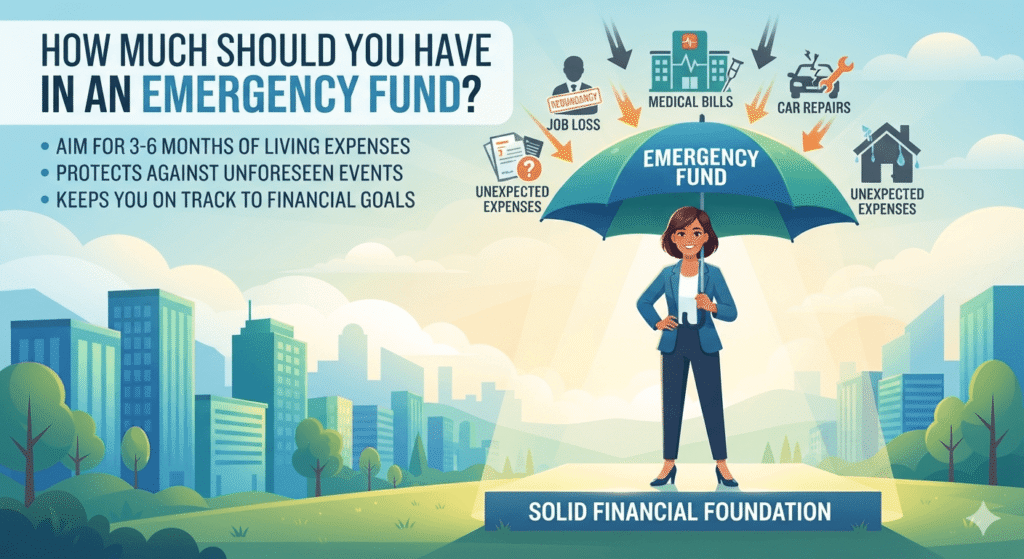
How Much Should I Have in an Emergency Fund?
Life has a way of throwing unexpected expenses your way—a sudden job loss, a medical emergency, a car that won’t start, or a roof that starts leaking. Without a financial safety net, these moments can quickly turn into financial crises.
An emergency fund is exactly what it sounds like: money you set aside specifically for unexpected, urgent expenses. It’s not for planned purchases, vacations, or “wants.” It’s your financial shield against life’s surprises.
But how much should you actually have in this fund? The answer isn’t the same for everyone. This guide will help you calculate your personal emergency fund target, understand the 3–6 month rule (and when to go beyond it), and give you a clear path to building your safety net.
Our Emergency Fund Calculator helps you determine your ideal savings target
How much should I have in an emergency fund? Financial experts generally recommend saving 3–6 months of essential living expenses in a liquid, FDIC-insured account. The exact amount depends on your income stability, family size, and financial obligations. Start with a $1,000 starter fund, then build toward 3 months, and consider 6–12 months if you have dependents or irregular income.
What Is an Emergency Fund?
An emergency fund is a cash reserve set aside specifically to cover unexpected, necessary expenses. Think of it as your financial safety net—money that’s there when you need it most.
Key characteristics of an emergency fund:
- Liquid: You can access the money quickly when needed
- Safe: It’s protected from market volatility
- Separate: It’s not mixed with your everyday spending money
- Purpose-specific: It’s reserved for genuine emergencies, not discretionary spending
What an emergency fund is NOT:
- A savings account for planned expenses (vacations, home renovations, new car)
- An investment account subject to market fluctuations
- Your regular checking account buffer
- Money you dip into for non-essential purchases
The distinction matters because it changes how you treat the money. An emergency fund is insurance, not a spending account.
Expert Tip #1: Keep your emergency fund in a separate account from your daily checking. When it’s out of sight, it’s much harder to spend impulsively.
How Much Should You Have in an Emergency Fund?
There’s no single number that works for everyone. The right amount depends on your personal circumstances. However, financial experts agree on a general framework.
The Standard Recommendation: 3–6 Months of Essential Expenses
Most financial experts recommend saving three to six months’ worth of essential living expenses in your emergency fund. This range gives you a buffer to cover basic needs if you lose your income or face a major unexpected expense.
What does “essential expenses” mean?
These are the expenses you couldn’t cut or reduce if you lost your income: housing, utilities, groceries, transportation, insurance, and minimum debt payments.
The $1,000 Starter Emergency Fund
If saving 3–6 months of expenses feels overwhelming, start smaller. Many financial experts recommend a starter emergency fund of $1,000 as a first goal. This amount can cover many common emergencies—a car repair, an urgent medical bill, or a necessary home repair—without derailing your budget completely.
Why start with $1,000:
- It’s achievable for most people
- It builds the savings habit
- It provides immediate protection against small emergencies
- It’s a stepping stone to larger goals
The 3-6-9-12 Rule for Emergency Funds
The 3-6-9 rule is a more nuanced framework that adjusts your target based on your specific situation:
| Situation | Recommended Months |
|---|---|
| Single, stable income | 3 months |
| Couple with dependents, stable income | 6 months |
| Single, irregular income | 9 months |
| Family with dependents, irregular income | 12 months |
This rule recognizes that your need for a financial buffer grows with your financial responsibilities and income uncertainty.
Factors that increase your emergency fund target:
Job stability: If you work in a volatile industry or have irregular income, aim for the higher end of the range (6–12 months).
Dependents: A family with children needs a larger buffer than a single person. More people means more potential expenses.
Health considerations: If you have ongoing health conditions, consider a larger fund to cover medical costs not fully covered by insurance.
Homeownership: Homeowners face more potential emergency expenses (roof repairs, HVAC failures, plumbing issues) than renters.
Single-income household: If you’re the sole earner for your family, your emergency fund should be larger than if you have a partner who also works.
Existing debt: If you have significant debt, you may need a larger fund to cover minimum payments during a period without income.
Expert Tip #2: Your emergency fund should match your worst-case scenario—not your most likely one. Think about what would happen if you lost your income for 6 months. That’s your starting point.
How to Calculate Your Emergency Fund
Calculating your emergency fund target is straightforward with the right approach.
The Basic Formula
Emergency Fund Target = Monthly Essential Expenses × Number of Months You Want to Cover
Example: If your monthly essential expenses are $3,000 and you want a 6-month fund:
$3,000 × 6 months = $18,000
A More Precise Approach
For a more accurate target, follow these steps:
Step 1: Track all your expenses for 1–2 months to understand your spending patterns.
Step 2: Separate essential expenses from non-essential ones.
Step 3: Total your essential monthly expenses.
Step 4: Choose your target months (3, 6, 9, or 12 based on your situation).
Step 5: Multiply your monthly essential expenses by your target months.
Step 6: Adjust upward if you have specific risks (health issues, unstable industry, etc.) or downward if you have other safety nets (family support, generous unemployment benefits).
Expert Tip #3: Review your emergency fund calculation annually. As your expenses change, your emergency fund target should change too.
What Counts as an Essential Expense?
Not all expenses are created equal. When calculating your emergency fund target, focus on the expenses you truly can’t avoid.
Essential Expenses (Include These)
| Category | Examples |
|---|---|
| Housing | Rent or mortgage payment, property taxes, home insurance |
| Utilities | Electricity, gas, water, trash, internet, phone |
| Food | Groceries, essential household supplies |
| Transportation | Car payment (if not paid off), gas, public transit, car insurance |
| Insurance | Health insurance premiums, life insurance |
| Healthcare | Medications, medical co-pays |
| Debt Payments | Minimum payments on credit cards, student loans, personal loans |
| Childcare | Necessary childcare for work, school-related costs |
| Basic Clothing | Necessary clothing replacements |
Non-Essential Expenses (Exclude These)
| Category | Examples |
|---|---|
| Dining Out | Restaurants, takeout, coffee shops |
| Entertainment | Movies, concerts, streaming services |
| Shopping | New clothes for fashion, non-essential purchases |
| Subscriptions | Gym memberships, premium subscriptions, magazine subscriptions |
| Travel | Vacations, recreational travel |
| Gifts | Birthday gifts, holiday gifts |
| Hobbies | Craft supplies, sporting equipment |
| Personal Care | Salon visits, spa treatments |
Why exclude non-essentials: During a financial emergency, you can cut or reduce these expenses. Your emergency fund should cover the bare minimum needed to survive.
Essential vs Non-Essential Expense Table
| Category | Essential | Non-Essential | Notes |
|---|---|---|---|
| Housing | Rent/Mortgage | Home upgrades | Include basic housing costs only |
| Food | Groceries | Dining out | Only what you need to eat |
| Transportation | Basic commuting | Luxury car payments | Don’t include gas for weekend trips |
| Insurance | Health, auto, home | Travel insurance | Only necessary insurance |
| Debt | Minimum payments | Extra payments | Emergency fund covers minimums only |
| Subscriptions | Basic phone/internet | Premium streaming | You may need internet for work |
| Healthcare | Medications, co-pays | Elective procedures | Only necessary medical care |
Expert Tip #4: If you’re unsure whether an expense is essential, ask yourself: “Would I still pay this if I lost my income tomorrow?” If the answer is no, it’s probably non-essential.
3-Month vs 6-Month vs 12-Month Emergency Fund
The right number of months depends on your personal situation. Here’s a comparison to help you decide.
3-Month Emergency Fund
Best for:
- Single people with stable jobs
- Dual-income households with no children
- People with low expenses relative to income
- Those with good health insurance and few financial obligations
Advantages:
- Faster to build
- Lower savings target
- Covers most common emergencies (car repairs, medical bills)
Risks:
- May not cover a prolonged job loss
- Less cushion for multiple emergencies
6-Month Emergency Fund
Best for:
- Families with children
- Homeowners
- People in moderately stable industries
- Anyone who wants a stronger safety net
Advantages:
- Covers most job losses
- Provides cushion for multiple emergencies
- Balances safety with achievable savings target
Risks:
- Takes longer to build
- Requires more disciplined saving
9–12 Month Emergency Fund
Best for:
- Self-employed workers
- Freelancers with irregular income
- Single-income households
- People in volatile industries
- Those with health concerns
Advantages:
- Maximum financial protection
- Covers extended periods without income
- Peace of mind in unpredictable situations
Risks:
- Takes significant time to build
- May mean keeping more money in low-yield accounts
Comparison Table
| Situation | Recommended Months | Reasoning |
|---|---|---|
| Single, stable job, no debt | 3 | Low obligations, can cut expenses easily |
| Single, stable job, some debt | 3-6 | Need to cover debt minimums |
| Couple, both working, no children | 3-6 | Dual income reduces risk |
| Couple, both working, children | 6 | More dependents = more risk |
| Single-income family with children | 6-9 | One income lost = total income lost |
| Self-employed/freelancer | 9-12 | Income varies significantly |
| Person with health issues | 6-9 | Higher medical costs, potential time off |
Expert Tip #5: If you’re between two recommendations, consider the higher number. Your emergency fund is insurance—it’s better to have too much than too little. A larger fund gives you more time to find new employment without making rushed decisions.
Emergency Fund Examples
Real examples help illustrate how the 3–6 month rule applies to different situations.
Single Person
Profile: Sarah, 28, marketing coordinator, $55,000/year, renter, no children
Monthly Essential Expenses:
- Rent: $1,200
- Groceries: $400
- Utilities (electric, water, internet): $250
- Transportation (car payment, gas, insurance): $500
- Health insurance: $200
- Minimum debt payments: $200
- Total: $2,750
Emergency Fund Targets:
- 3 months: $8,250
- 6 months: $16,500
- 9 months: $24,750
Recommended: 3–6 months. Sarah has a stable job, no dependents, and can cut non-essential expenses if needed. A 3-month fund ($8,250) would cover most emergencies, while a 6-month fund ($16,500) provides extra security.
Married Couple
Profile: James and Priya, both 35, combined income $120,000, homeowners, no children
Monthly Essential Expenses:
- Mortgage: $2,200
- Property taxes + insurance: $400
- Groceries: $600
- Utilities (electric, gas, water, internet): $350
- Transportation (two car payments, gas, insurance): $700
- Health insurance (both): $400
- Minimum debt payments: $300
- Total: $4,950
Emergency Fund Targets:
- 3 months: $14,850
- 6 months: $29,700
- 9 months: $44,550
Recommended: 6 months. They have a mortgage and two cars, so there are more potential emergencies. However, since both work, the risk of zero income is reduced.
Family with Children
Profile: The Parkers, couple ages 38 and 40, two children, household income $100,000, homeowners
Monthly Essential Expenses:
- Mortgage: $1,800
- Property taxes + insurance: $350
- Groceries: $800
- Utilities (electric, gas, water, internet): $400
- Transportation (two cars, gas, insurance): $600
- Health insurance (family): $600
- Childcare: $1,200
- Minimum debt payments: $400
- Total: $6,150
Emergency Fund Targets:
- 3 months: $18,450
- 6 months: $36,900
- 9 months: $55,350
Recommended: 6 months. With two children and a mortgage, they need a substantial buffer. A 6-month fund provides time to find new employment without immediate crisis.
Freelancer / Self-Employed Worker
Profile: Alex, freelance designer, variable income ($40,000–$60,000/year), single, renter, no children
Monthly Essential Expenses:
- Rent: $1,100
- Groceries: $350
- Utilities: $200
- Transportation: $300
- Health insurance: $350
- Business expenses: $200
- Minimum debt payments: $150
- Total: $2,650
Emergency Fund Targets:
- 3 months: $7,950
- 6 months: $15,900
- 9 months: $23,850
- 12 months: $31,800
Recommended: 9 months. As a freelancer, Alex’s income is unpredictable. A 9-month fund provides security during slow periods and gives time to rebuild a client base.
Single-Income Household
Profile: Marco and Elena, couple ages 45 and 43, two children in high school, one income ($75,000/year), homeowners
Monthly Essential Expenses:
- Mortgage: $1,500
- Property taxes + insurance: $300
- Groceries: $700
- Utilities: $350
- Transportation (two cars, gas, insurance): $500
- Health insurance (family): $500
- Minimum debt payments: $250
- Child expenses (activities, school): $300
- Total: $4,400
Emergency Fund Targets:
- 3 months: $13,200
- 6 months: $26,400
- 9 months: $39,600
- 12 months: $52,800
Recommended: 9 months. Since the household depends on one income, losing that income would be devastating. A 9-month fund provides a critical buffer while Marco looks for new work.
High-Income Professional
Profile: Emily, attorney, $150,000/year, homeowner, single, no children
Monthly Essential Expenses:
- Mortgage: $3,000
- Property taxes + insurance: $600
- Groceries: $500
- Utilities: $400
- Transportation: $600
- Health insurance: $400
- Total: $5,500
Emergency Fund Targets:
- 3 months: $16,500
- 6 months: $33,000
- 9 months: $49,500
Recommended: 6 months. While Emily’s income is high, her expenses are also substantial. A 6-month fund provides security, and she can likely find new employment quickly given her profession.
Emergency Fund by Life Situation
Your personal situation affects your emergency fund needs as much as your income does.
Life Situation Comparison Table
| Situation | Essential Monthly Expenses | 3-Month Target | 6-Month Target | Recommended |
|---|---|---|---|---|
| Single, stable job | $2,500 | $7,500 | $15,000 | 3–6 months |
| Couple, both work | $4,500 | $13,500 | $27,000 | 6 months |
| Family, children, one income | $6,000 | $18,000 | $36,000 | 9 months |
| Single, self-employed | $3,000 | $9,000 | $18,000 | 9 months |
| Recent graduate, low expenses | $2,000 | $6,000 | $12,000 | 3 months |
| Homeowner, stable job | $4,000 | $12,000 | $24,000 | 6 months |
| Renter, stable job | $3,000 | $9,000 | $18,000 | 3–6 months |
| Parent with special needs child | $7,000 | $21,000 | $42,000 | 9–12 months |
Where Should You Keep an Emergency Fund?
The location of your emergency fund matters almost as much as the amount. You need the right balance of accessibility, safety, and growth.
Key Characteristics of a Good Emergency Fund Home
1. Liquidity: You must be able to access the money quickly—ideally within 1–2 business days, or instantly via a linked account.
2. Safety: Your emergency fund should be protected from market volatility. If you invested it in stocks and the market dropped 30%, you’d have less money exactly when you might need it most.
3. Separation: Keep it separate from your everyday spending account. When it’s too easy to spend, it’s too tempting to use for non-emergencies.
4. Interest: While not the primary concern, earning some interest helps your money maintain purchasing power over time.
Where to Keep Emergency Funds
High-Yield Savings Account (HYSA): Often the best option for most people. HYSAs are FDIC-insured, fully liquid, and typically offer competitive interest rates (4.5–5.0% APY in 2026). Transfers to checking usually take 1–3 business days.
Money Market Account (MMA): Similar to HYSAs, but may offer check-writing or debit card access. MMAs are also FDIC-insured and offer competitive rates.
Short-Term Certificates of Deposit (CDs): CDs can offer slightly higher rates but lock your money for a set term, with early withdrawal penalties. A CD ladder can provide some liquidity while earning more interest.
Treasury Bills/Notes: Low-risk government securities that can be liquidated relatively quickly. They offer competitive rates and are backed by the U.S. government.
Standard Savings Account: Accessible and safe, but most traditional banks pay very low interest (often under 0.01% APY). Not recommended for significant emergency funds.
Where NOT to Keep Emergency Funds
Stock Market: Emergency funds should not be invested in stocks. You may need the money when the market is down, and a 30% drop right before an emergency would be devastating.
Long-Term CDs: Locking money away for years means you could face penalties if you need to withdraw early for an emergency.
Retirement Accounts: Withdrawing from a 401(k) or IRA before retirement age incurs taxes and a 10% penalty. Your emergency fund should be outside retirement accounts.
Real Estate: Selling property takes time and carries significant costs. Real estate is not liquid enough for emergency funds.
Recommended Split
Some financial experts recommend splitting your emergency fund:
- 30-40% in immediate access accounts (HYSA, savings account)
- 60-70% in slightly higher yield but still liquid options (short-term CDs, money market accounts, liquid mutual funds)
This approach balances accessibility with growth.
Expert Tip #6: Opening a separate bank account at a different institution from your main checking account adds a layer of friction that can help prevent impulse spending while still keeping your money accessible.
How Quickly Should You Build an Emergency Fund?
Building an emergency fund isn’t a race—it’s a habit. Here’s a practical step-by-step plan.
Step 1: Calculate Your Essential Expenses
Track every expense for 1–2 months. Separate essential from non-essential. Get your true monthly essential expense number.
Step 2: Set a Starter Target
Aim for $1,000 as a starting point. This is achievable and covers many common emergencies.
Step 3: Automate Your Contributions
Set up automatic transfers from checking to savings on payday. Even $50–$100 per paycheck adds up over time.
Step 4: Reach One Month
Celebrate your first month of expenses saved. This is a significant milestone.
Step 5: Reach Three Months
This is the minimum recommended amount for most people. You now have a solid safety net.
Step 6: Evaluate Your Situation
Review your income stability, family needs, and financial obligations. Determine whether you need 6, 9, or 12 months.
Step 7: Build to Your Target
Continue saving until you reach your personal emergency fund goal.
Expert Tip #7: Use windfalls—tax refunds, bonuses, gifts—to accelerate your emergency fund. Even a $1,000 tax refund can jump you from 2 months to 3 months of expenses.
Expected Timeline Example
| Monthly Savings | Time to $1,000 | Time to 3 Months ($6,000) | Time to 6 Months ($12,000) |
|---|---|---|---|
| $50 | 20 months | 10 years | 20 years |
| $100 | 10 months | 5 years | 10 years |
| $200 | 5 months | 2.5 years | 5 years |
| $300 | ~3.3 months | ~1.7 years | ~3.3 years |
| $500 | 2 months | 1 year | 2 years |
Note: Based on monthly essential expenses of $2,000. Your specific numbers will vary.
How Much Should I Save Every Month for My Emergency Fund?
Your monthly savings amount depends on your target and timeline.
Monthly Savings Examples
| Your Emergency Fund Target | Timeline | Monthly Savings Needed (No Interest) | Monthly Savings Needed (4.7% HYSA) |
|---|---|---|---|
| $10,000 | 12 months | $833 | $815 |
| $10,000 | 24 months | $417 | $398 |
| $15,000 | 18 months | $833 | $800 |
| $15,000 | 36 months | $417 | $391 |
| $20,000 | 24 months | $833 | $795 |
| $20,000 | 48 months | $417 | $382 |
| $30,000 | 36 months | $833 | $785 |
How to use this: Determine your target and timeline. Find the monthly savings amount needed. Use the Savings Goal Calculator to get your personalized monthly target, accounting for your specific interest rate.
Using the Savings Goal Calculator
The Savings Goal Calculator makes this calculation effortless:
- Enter your emergency fund target amount
- Enter how much you’ve already saved
- Set your timeline (months until you want the fund complete)
- Enter your expected interest rate (e.g., 4.7% for a HYSA)
- The calculator will show your exact monthly savings target
This gives you a precise, personalized monthly savings goal rather than a guess.
Expert Tip #8: Be realistic about your monthly savings capacity. It’s better to save a smaller amount consistently than to set an unachievable target and give up.
Emergency Fund vs Savings Account
While both are forms of savings, they serve fundamentally different purposes.
Emergency Fund
Purpose: Financial safety net for unexpected emergencies
Examples: Job loss, medical emergency, urgent home repair, car repair
Amount: 3–12 months of essential expenses
Access: Quick and easy—you may need it immediately
When to use: Only for true emergencies
Where to keep: High-yield savings account, money market account
Regular Savings Account
Purpose: Saving for planned goals and purchases
Examples: Vacation, down payment on a house, new car, holiday shopping, wedding
Amount: Depends on your specific goal
Access: Can be more flexible; you know when you’ll need the money
When to use: When you reach your goal or planned purchase date
Where to keep: Standard savings account, CDs, investment accounts
Why You Need Both
| Feature | Emergency Fund | General Savings |
|---|---|---|
| Purpose | Unexpected emergencies | Planned goals |
| When to use | Only in crisis | When goal is reached |
| Target amount | 3–12 months expenses | Goal-specific |
| Example uses | Job loss, medical bills | Vacation, house down payment |
| Risk level | No risk—safety first | Can take some investment risk |
Why both matter: Without an emergency fund, you’ll dip into your goal savings when emergencies happen, derailing your plans. Without general savings, you won’t have money for the things you want in life.
Emergency Fund vs Savings Account Example
The Problem: You’ve been saving $500/month for a dream vacation. Your car breaks down and needs a $1,000 repair.
Without an emergency fund: You use your vacation savings, setting your vacation back by 2 months.
With an emergency fund: You use your emergency fund for the car repair, and your vacation savings remain untouched.
Expert Tip #9: When you use money from your emergency fund, make replenishing it a priority. Treat it like repaying a debt to yourself.
Should I Pay Off Debt or Build an Emergency Fund First?
This is one of the most common financial questions, and the answer depends on your situation.
The Balanced Approach
First: Save a small starter emergency fund ($1,000)
Second: Pay down high-interest debt (credit cards, personal loans with rates above 10%)
Third: Build a larger emergency fund (3–6 months expenses)
Fourth: Continue paying off remaining debt while maintaining your emergency fund
Why This Order Works
- A $1,000 starter fund prevents you from going deeper into debt for small emergencies
- High-interest debt costs more than your emergency fund earns, so paying it down is a better “return”
- A larger emergency fund provides security against job loss or major emergencies
- You can balance both—paying down debt while gradually increasing savings
Factors to Consider
| If You Have… | Priority | Reasoning |
|---|---|---|
| High-interest credit card debt (20%+) | Pay debt first (after $1,000 starter) | Interest costs exceed any savings return |
| Low-interest debt (under 5%) | Build emergency fund first | Your savings can earn close to what debt costs |
| Job insecurity | Emergency fund first | You need a buffer against potential job loss |
| Stable employment | Balance both | You have time to build emergency fund while paying debt |
| Employer retirement match | Contribute enough to get match, then build fund | Match is a guaranteed return |
Expert Tip #10: If you have a 401(k) employer match, contribute enough to get the full match. It’s a 50–100% return on your investment, which beats both debt payments and emergency savings.
When Can You Use Your Emergency Fund?
True Emergencies
- Job loss: You need to cover expenses while finding new employment
- Medical emergency: Unexpected medical bills not covered by insurance
- Essential home repair: Roof leaks, furnace breakdown, plumbing emergency
- Essential car repair: Your car won’t start or is unsafe to drive
- Emergency travel: Sudden need to travel for a family crisis
- Unexpected necessary expense: Anything you cannot avoid and didn’t plan for
What Counts as an Emergency—Examples
| Situation | Is It an Emergency? | Reasoning |
|---|---|---|
| Car breaks down, need it for work | Yes | You need transportation to earn income |
| Refrigerator dies | Yes | You need to keep food safe |
| Root canal, insurance covers 50% | Yes | It’s necessary medical care |
| Job loss | Yes | You have no income |
| Urgent travel for family emergency | Yes | Family comes first |
| Vacuum cleaner breaks | Maybe | Is it essential? Could you borrow one or sweep? |
| Phone screen cracks | Maybe | It’s annoying but not urgent—save for a repair |
| Flight to visit friends | No | It’s planned travel |
| Dining out for a friend’s birthday | No | It’s discretionary |
What Is NOT an Emergency?
It’s just as important to know what doesn’t qualify as an emergency. Using your emergency fund for non-emergencies defeats its purpose.
Examples of Non-Emergencies
- Vacation: Planned travel is a savings goal, not an emergency
- New phone: Even if yours is old, a new phone is planned purchase
- Shopping: Clothing, electronics, or home decor are discretionary
- Dining out: Restaurant meals are not urgent
- Entertainment: Movies, concerts, events are optional
- Holiday gifts: These are planned expenses
- Routine car maintenance: Oil changes, tire rotations are expected
- Home upgrades: Remodeling, new furniture are not emergencies
- Wedding attendance: Travel for a wedding is a planned expense
Expert Tip #11: Before using your emergency fund, ask: “Will my life be significantly worse if I don’t spend this money right now?” If the answer is no, it’s not an emergency.
Common Emergency Fund Mistakes
Mistake #1: Setting Too Low a Target
The problem: $1,000 might not cover a real emergency like job loss or major medical bills.
The solution: Calculate your actual essential expenses and build toward 3–6 months.
Mistake #2: Not Separating Emergency Funds
The problem: Your emergency money is in your checking account, making it easy to spend.
The solution: Open a separate account at a different bank for your emergency fund.
Mistake #3: Investing Emergency Savings
The problem: Market downturns can reduce your emergency fund when you need it most.
The solution: Keep emergency funds in safe, liquid accounts like HYSAs.
Mistake #4: Not Replenishing After Use
The problem: You use your emergency fund but don’t rebuild it, leaving you vulnerable.
The solution: Pause other savings goals and rebuild your emergency fund first.
Mistake #5: Forgetting About Inflation
The problem: Your emergency fund amount stays the same while your expenses rise.
The solution: Review and adjust your emergency fund target annually.
Mistake #6: Saving Too Much
The problem: You have 12+ months of expenses in a low-yield account while carrying high-interest debt.
The solution: Balance emergency savings with other financial priorities.
Mistake #7: Not Starting
The problem: You think you can’t afford to save, so you don’t start at all.
The solution: Even $25 per paycheck builds up over time.
Mistake #8: Treating It As a Savings Account
The problem: You use your emergency fund for planned purchases like vacations.
The solution: Have separate accounts for different purposes.
Mistake #9: Not Adjusting for Life Changes
The problem: Your expenses increase but your emergency fund stays the same.
The solution: Update your emergency fund target after major life changes.
Mistake #10: Keeping It in a Low-Yield Account
The problem: Your money earns 0.01% interest and loses value to inflation.
The solution: Use a high-yield savings account earning 4.5-5.0% APY.
How to Build an Emergency Fund Faster
Strategy 1: Automate Your Savings
Set up automatic transfers on payday. You won’t miss money you never see.
Strategy 2: Save Your Raises and Bonuses
When you get a pay increase, increase your savings contribution before you adjust to the higher income.
Strategy 3: Use Windfalls Wisely
Allocate 50% of bonuses, tax refunds, or gifts to your emergency fund.
Strategy 4: Cut One Expense at a Time
Cancel unused subscriptions, reduce dining out, or negotiate lower bills.
Strategy 5: Use the “Round-Up” Method
Apps that round up purchases to the nearest dollar can add $20–$50/month to savings.
Strategy 6: Start a Side Hustle
Freelance, drive for rideshare, dog sit, or tutor to earn extra money specifically for your emergency fund.
Strategy 7: Sell Unused Items
Clothes, electronics, furniture—selling items you don’t use can quickly boost your savings.
Strategy 8: Use the 52-Week Challenge
Save $1 in week 1, $2 in week 2, up to $52 in week 52 = $1,378/year.
Strategy 9: Implement No-Spend Weeks
One week per month with only essential spending. Save everything else.
Strategy 10: Switch Banks
Move to a bank with a HYSA bonus—some offer $200–$500 for new accounts.
Strategy 11: Direct Deposit Split
Have your employer split your paycheck between checking and savings.
Strategy 12: Reduce Your Largest Expenses
Housing and transportation are often the biggest costs. Consider downsizing or moving to a cheaper area.
Strategy 13: Negotiate Bills
Call your insurance, internet, and phone providers to ask for lower rates.
Strategy 14: Meal Plan
Planning meals reduces grocery bills and dining out costs.
Strategy 15: Use Cash for Variable Expenses
Using cash instead of cards for groceries and dining helps control spending.
Expert Tip #12: Pick one strategy and implement it this week. Don’t try to do everything at once. Small, consistent actions build big results.
Emergency Fund Checklist
Preparation
- □ Tracked all expenses for 1–2 months
- □ Identified essential vs. non-essential expenses
- □ Calculated monthly essential expenses total
- □ Determined target months (3, 6, 9, or 12)
- □ Set a specific emergency fund dollar target
- □ Opened a separate high-yield savings account
Saving
- □ Set up automatic transfers on payday
- □ Saved a $1,000 starter fund
- □ Reached 1 month of essential expenses
- □ Reached 3 months of essential expenses
- □ Reached 6 months of essential expenses (if applicable)
- □ Reached 9+ months (if applicable)
Maintenance
- □ Review emergency fund quarterly
- □ Adjust for changes in expenses
- □ Replenish after any use
- □ Check interest rates annually
- □ Move to higher-yield account if rates change
- □ Confirm emergency fund is still in a safe, liquid account
Rules
- □ Only use for true emergencies
- □ Replace used funds as soon as possible
- □ Never use for planned purchases
- □ Never invest in stocks
- □ Keep separate from regular savings accounts
Frequently Asked Questions
How much should I have in an emergency fund?
Is $10,000 enough for an emergency fund?
It depends on your expenses. If your monthly essential expenses are $3,000, $10,000 is about 3.3 months—on the lower end of the 3–6 month range. If your expenses are $2,000, $10,000 is 5 months—a solid target.
Is $1,000 enough for an emergency fund?
Should I have 3 or 6 months of expenses saved?
How much emergency savings should a family have?
How much should a single person have saved?
Where should I keep my emergency fund?
Should emergency savings be invested?
Can I use my emergency fund to pay debt?
How long does it take to build an emergency fund?
It depends on your savings rate. At $500/month, you can save $6,000 in 1 year. At $200/month, it takes 2.5 years. Use the Savings Goal Calculator for a personalized timeline.
Should I build an emergency fund or pay off debt first?
Save $1,000 first, then focus on high-interest debt (credit cards, personal loans). After that, build a larger emergency fund while making minimum payments on remaining debt.
What if I can’t afford to save?
Start small. Even $25 per paycheck adds up. Cut one expense at a time to free up cash. The habit is more important than the amount.
How do I calculate essential expenses?
Should I have a separate emergency fund account?
Yes. Keeping emergency funds separate from checking makes it harder to spend impulsively and helps you track progress.
What counts as an emergency?
How much emergency fund do I need if I’m self-employed?
Should my emergency fund be in a checking or savings account?
A savings account, specifically a high-yield savings account. Checking accounts typically earn no interest and make it too easy to spend.
How often should I review my emergency fund?
Review quarterly or at least annually. Update your target if your expenses have changed or you’ve had major life changes.
What happens if I use my emergency fund?
Use it for the emergency, then make replenishing it a top financial priority. Pause other savings goals until it’s rebuilt.
Can I have too much in an emergency fund?
Yes, if you have 12+ months of expenses in a low-yield account while carrying high-interest debt. Balance emergency savings with other financial priorities.
Conclusion
An emergency fund is one of the most important financial tools you can build. It protects you from life’s unexpected challenges and gives you the confidence to face whatever comes your way.
Key takeaways:
- Aim for 3–6 months of essential expenses as a general target
- Start with $1,000 if you’re building from scratch
- Consider more months if you have dependents, irregular income, or a single-income household
- Keep emergency funds in a high-yield savings account for safety and accessibility
- Review and adjust annually as your expenses and situation change
- Only use for true emergencies—not for planned expenses or wants
Your next step: Calculate your personal emergency fund target using the Savings Goal Calculator. Enter your essential expenses, target months, and timeline to get a personalized monthly savings goal. Then set up your automatic transfers and start building your financial safety net.