
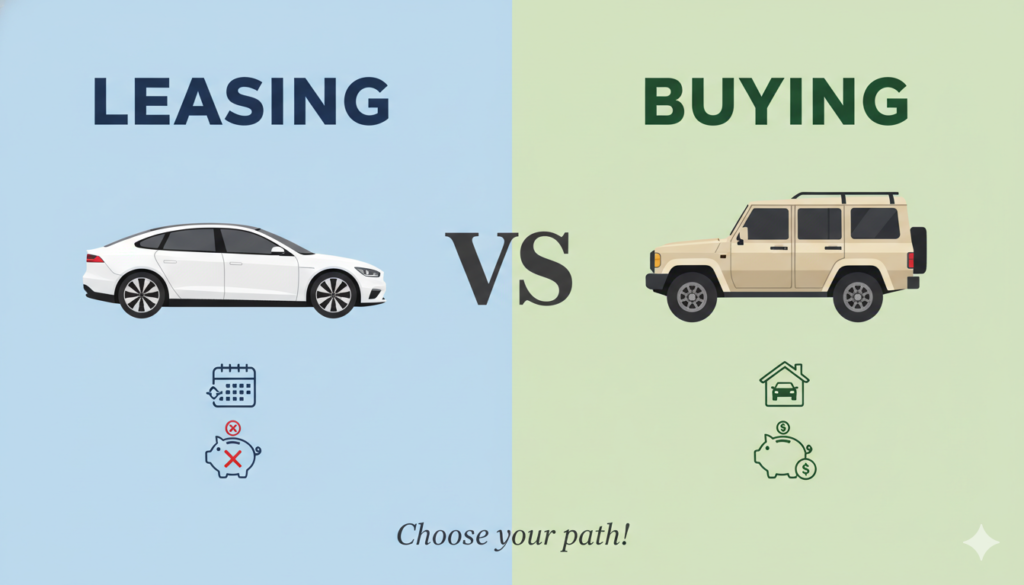
Leasing vs Buying a Car: Which Is Actually Cheaper?
The leasing vs buying question is one of the most debated in personal finance — and it is one of the most frequently answered incorrectly. Most comparisons stop at the monthly payment. Leases almost always have a lower monthly payment, so they appear cheaper on the surface. But comparing monthly payments alone is fundamentally misleading.
The correct comparison is net cost: total amount paid minus what you have left at the end. This guide shows you exactly how that comparison works, when leasing wins, when buying wins, and how to use a free lease vs buy calculator to see the answer for your specific vehicle and situation.
The Monthly Payment Trap
On a $35,000 vehicle, you might lease for $549/month or finance for $693/month. That $144/month difference makes leasing look clearly better. Over 36 months, leasing appears to save $5,184 in payments.
But at the end of 36 months of financing, you own an asset worth approximately $21,000-$24,000 (depending on depreciation). At the end of 36 months of leasing, you own nothing and must either return the car and start a new lease or buy the vehicle at the predetermined residual price.
Factoring in that residual equity changes the comparison completely.
How to Compare Leasing vs Buying Correctly
The correct comparison uses net cost — total amount paid minus the value you retain at the end of the term.
Lease net cost: Down payment + (monthly payment x term) = total paid. Since you own nothing at the end, net cost equals total paid.
Finance net cost: Down payment + (monthly payment x term) – vehicle value at end of term. Since you own a vehicle worth $20,000+ at the end, this amount is subtracted from total payments.
The free lease vs buy calculator runs this comparison automatically. Enter the vehicle price, down payment, lease terms (money factor and residual), and finance terms (APR). The calculator shows the monthly payment and total net cost for both options side by side, and tells you which one costs less for your specific scenario.
When Leasing Wins
Leasing comes out ahead on net cost in specific situations:
- High residual value vehicles: Cars with residual values above 60% of MSRP (common on certain Honda, Toyota, and luxury models) have lower depreciation charges, making leases cheaper
- Low money factor: When the money factor (lease interest rate) is below 0.00200, equivalent to about 4.8% APR, the finance charge portion of the payment is low
- Short terms on fast-depreciating vehicles: A 24-month lease on a vehicle that depreciates 25% in year one lets someone else absorb the steepest depreciation
- Business use: Businesses can deduct lease payments as operating expenses, which can make leasing significantly more tax-efficient than financing
When Buying Wins
Financing a vehicle usually wins on net cost in these situations:
- High mileage drivers: Leases typically cap at 10,000-15,000 miles per year. Each mile over costs $0.15-$0.25. A driver who puts 20,000 miles annually pays $1,500-$2,500 in overage fees per year
- Long-term ownership plans: The most financially efficient car ownership strategy is buying a reliable vehicle, paying it off, and driving it for 8-10+ years. Once the loan is paid off, your transportation cost drops to insurance and maintenance only
- Strong resale value vehicles: Trucks, SUVs, and certain Japanese brands hold their value well. The equity you build by financing can offset the higher monthly payments
- Buyers who modify their vehicle: Leases prohibit modifications. If you want to customize the vehicle, financing is the only option
Understanding Money Factor and Residual Value
Two numbers control whether a lease is good or bad: the money factor and the residual value.
The money factor is the lease equivalent of an interest rate. Multiply it by 2,400 to convert to an approximate APR. A money factor of 0.00200 equals 4.8% APR. A money factor of 0.00400 equals 9.6% APR. Dealers sometimes mark up the money factor to earn additional profit — always ask for the buy rate (the manufacturer base rate) and compare.
The residual value is the estimated value of the vehicle at lease end as a percentage of MSRP. A higher residual means a lower monthly payment. Residuals above 55% are considered strong for new vehicles.
Use the car lease calculator to calculate your exact monthly lease payment using the money factor method — the same formula used by dealers and manufacturers. Enter the cap cost, residual percentage, money factor, term, and acquisition fee for a precise result.
A Real Comparison: $35,000 Vehicle, 36 Months
Lease scenario: $3,500 down, $549/month, 36 months. Total paid: $3,500 + ($549 x 36) = $23,264. Vehicle equity at end: $0. Net cost: $23,264.
Finance scenario: $3,500 down, $693/month, 36 months at 7% APR. Total paid: $3,500 + ($693 x 36) = $28,448. Vehicle worth approximately $21,000 after 36 months (estimated 15% annual depreciation). Net cost: $28,448 – $21,000 = $7,448.
In this example, buying wins by $15,816 on net cost despite the higher monthly payment. The lease feels cheaper every month but ends up significantly more expensive over the full term.
Frequently Asked Questions
Is leasing or buying better for your credit?
Both leasing and buying build credit history as installment loans when payments are made on time. Neither is inherently better for your credit score than the other. The key factor is making every payment on time regardless of which option you choose.
Can I buy my car at the end of the lease?
Yes. Most leases include a buyout option at the residual value stated in your lease agreement. If the market value of the vehicle at lease end is higher than the residual — which happened widely when used car prices spiked — buying out the lease can be an excellent deal. Use the auto loan calculator to estimate financing the buyout amount.
What happens if I want to end my lease early?
Early lease termination is expensive. You typically owe the remaining payments plus an early termination fee. In most cases, the total cost of early termination makes it financially better to continue the lease to its end. Always read the early termination clause before signing any lease agreement.
Compare all your auto finance options with our complete set of free tools at the Auto Finance Tools hub — including the auto loan calculator, refinance calculator, car affordability calculator, and early payoff calculator.