
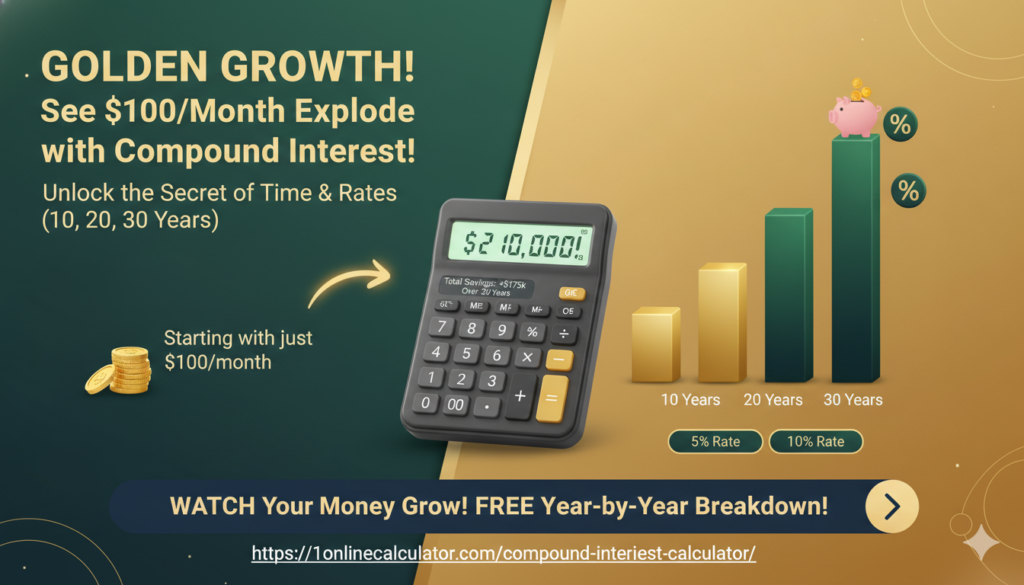
How Much Will 100 Dollars a Month Grow in 10 Years?
$100 per month at 7% annual return for 10 years does not simply total $12,000. It grows to $17,308. The $5,308 above what you contributed is pure compound interest — money that generated itself without any additional work.
The Exact Numbers at Every Rate
$100/month for 10 years ($12,000 contributed):
→ 4% return: $14,726 (earned $2,726)
→ 5% return: $15,528 (earned $3,528)
→ 7% return: $17,308 (earned $5,308)
→ 10% return: $20,484 (earned $8,484)
→ 12% return: $23,234 (earned $11,234)
Over 20 and 30 Years at 7%
10 years ($12,000 in): $17,308 — earnings: $5,308
20 years ($24,000 in): $52,093 — earnings: $28,093
30 years ($36,000 in): $121,997 — earnings: $85,997
Each additional 10 years produces more than all previous periods combined. The compound earnings in years 20-30 alone ($69,904) exceed the entire account value at year 20.
Why Starting Early Beats Investing More
Person A: $100/month from age 25-35 (10 years, $12,000 total), then stops. At 65: $168,514.
Person B: $100/month from age 35-65 (30 years, $36,000 total). At 65: $121,997.
Person A invested 67% less and ends up 38% wealthier. The 10 extra years of compounding in their 20s outweigh 30 years of contributions starting later.
Q: Is $100 a month enough to build wealth?
Yes — over sufficient time. $100/month at 7% for 30 years produces $122,000. At 10% for 30 years: $217,000. The key variables are time and return rate, not contribution size. Starting early and being consistent matters more than starting large.
Q: Where can I invest $100 a month?
Employer 401(k) with match (free money first). Roth IRA (post-tax, tax-free growth, $7,000 annual limit 2026). Brokerage account with S&P 500 index fund. High-yield savings (4-5% APY, fully liquid, lower return).
The Mathematics Behind the Growth — Why the Curve Accelerates
The reason $100/month grows from $17,308 in 10 years to $121,997 in 30 years — rather than simply tripling — is the mathematical structure of compound interest. Each month, your account earns returns not just on your contributions but on all previous returns as well. This creates an exponential rather than linear growth curve.
Year 1: you contribute $1,200, account earns approximately $46 in interest. Total: $1,246.
Year 10: you contribute $1,200 that year, but the account now earns approximately $1,050 in interest during that year alone — nearly as much as your annual contribution.
Year 20: the account earns approximately $3,230 in interest during that year — 2.7 times your annual contribution.
Year 30: the account earns approximately $7,800 in interest during that year — 6.5 times your annual contribution. Each year the account is working harder for you than the previous year. This is why the growth appears to suddenly accelerate in the later decades — it was always accelerating, but the effect becomes dramatic in proportion to contributions.
How Inflation Affects Your $100/Month Growth
The numbers above are nominal — they show the actual dollar amount in your account, not its purchasing power. Inflation reduces the real value of money over time. At 3% annual inflation, $121,997 in 30 years has the purchasing power of approximately $50,000 in today’s dollars.
This does not invalidate the strategy — $50,000 in real purchasing power from $36,000 invested is still a meaningful return. But it does explain why financial planners target returns above inflation (7-10% nominal) rather than simply beating the inflation rate (3%). The real return is what matters for actual wealth building.
High-yield savings accounts currently paying 4.5-5.0% APY produce 1.5-2.0% real returns after 3% inflation — positive, but significantly less than equity investing over long periods.
Dollar-Cost Averaging — Why Monthly Contributions Outperform Lump Sums in Practice
Investing $100 every month rather than $1,200 once per year produces nearly identical mathematical results at the same annual return — but the monthly approach has a practical advantage called dollar-cost averaging.
When you invest a fixed amount every month, you automatically buy more units when prices are low and fewer units when prices are high. Over multiple market cycles, this mechanical behaviour consistently produces a lower average cost per unit than attempting to time the market with larger, infrequent purchases.
For $100/month investors with limited time to monitor markets, this is the primary practical argument for monthly contributions over annual lump sums — consistency compounds the mathematical advantage.
Model your exact growth scenario: 1onlinecalculator.com/compound-interest-calculator/
Disclaimer: All calculations are estimates for educational purposes. Actual rates and terms vary by lender, credit profile, and state. Use the free calculator linked above for your specific numbers.