
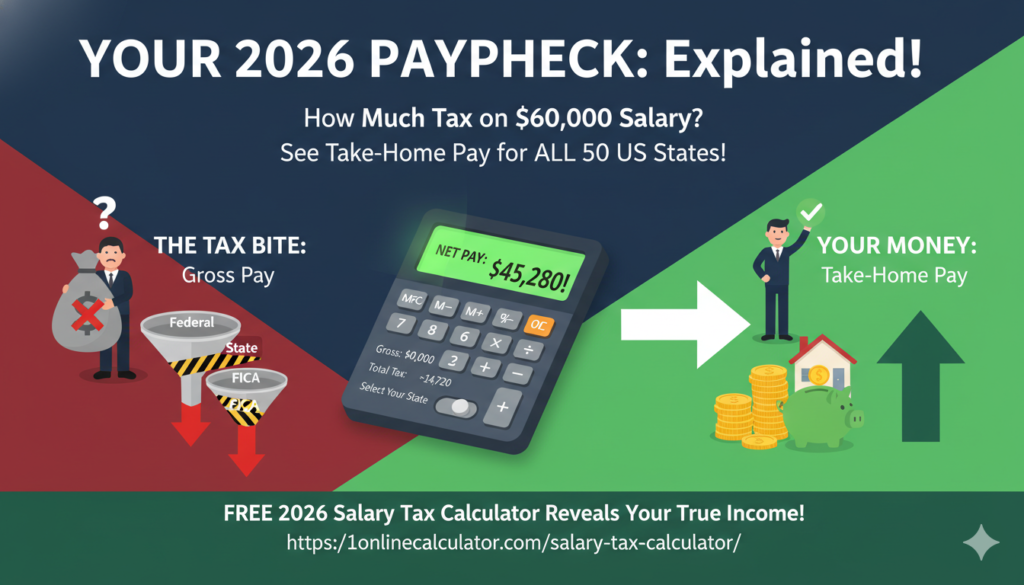
How Much Tax Do I Pay on 60,000 a Year? (2026 Breakdown)
A $60,000 salary is approximately $5,000/month gross — but your actual take-home pay depends heavily on your state, filing status, and pre-tax deductions. Here is the exact 2026 breakdown for a single filer.
Federal Tax on $60,000 — 2026 Single Filer
Gross: $60,000. Standard deduction: $16,100. Taxable income: $43,900.
Federal income tax: 10% on $11,925 = $1,193. 12% on $31,975 = $3,837. Total federal income tax: $5,030.
FICA: Social Security 6.2% = $3,720. Medicare 1.45% = $870. Total FICA: $4,590.
Total federal deductions: $9,620. Monthly take-home (federal only): $4,198.
Take-Home by State
No income tax states (TX, FL, NV, WY, AK, SD, TN): $4,198/month — $50,376/year.
California: ~$3,729/month. New York: ~$3,811/month. Georgia (5.49%): ~$3,923/month. Illinois (4.95%): ~$3,950/month.
The Texas vs California difference: $469/month — $5,628 per year — from the exact same $60,000 salary.
How Pre-Tax Deductions Change Take-Home
$60,000 with $6,000 annual 401(k) contribution: taxable income drops to $37,900. Federal tax drops by ~$720/year. You save $720 in tax while contributing $6,000 to retirement — an immediate guaranteed return.
Q: How much is $60,000 a year per hour?
$60,000 ÷ 2,080 hours (40hr/week × 52 weeks) = $28.85/hour gross. After taxes in a no-tax state: approximately $24.22/hour effective take-home.
Q: Is $60,000 a good salary in 2026?
$60,000 is approximately the 55th percentile of US individual earners. Monthly take-home of $3,700-$4,200 is comfortable in most mid-tier cities. In premium coastal markets (SF, NYC, Seattle), $60,000 provides limited discretionary income after housing.
How the 2026 Federal Tax Brackets Work for a $60,000 Salary
The US uses a progressive marginal tax rate system, which means you do not pay the same rate on your entire income — you pay different rates on different portions. Many people believe their entire income is taxed at their “tax bracket” rate. This is a common and expensive misunderstanding.
On a $60,000 salary with the $16,100 standard deduction, taxable income is $43,900. The 10% bracket applies to the first $11,925 of taxable income. The 12% bracket applies to income from $11,926 to $48,475 — but your taxable income only reaches $43,900, so only $31,975 is taxed at 12%.
Your marginal tax rate (the rate on your last dollar earned) is 12%. Your effective tax rate (total tax ÷ gross income) is 8.38%. The difference is significant: if someone offers you a $5,000 raise, you do not lose 12% of your entire $65,000 in tax — you pay 12% on the additional $5,000 = $600 extra in federal income tax.
Reducing Your Tax Bill on a $60,000 Salary — Legal Strategies
Several legitimate strategies reduce the taxable income on a $60,000 salary and increase monthly take-home pay without a salary increase.
- Traditional 401(k): every dollar contributed pre-tax directly reduces taxable income. At 12% marginal rate, contributing $6,000/year saves $720 in federal income tax. At $60,000 with a $6,000 401(k) contribution, your effective taxable income drops to $37,900 and federal income tax falls to approximately $4,310 — a $720 annual saving while also funding retirement.
- Health Savings Account (HSA): if enrolled in a high-deductible health plan, the 2026 HSA contribution limit is $4,300 for individuals. HSA contributions are fully deductible from taxable income — saving $516 in federal tax at the 12% marginal rate.
- Flexible Spending Account (FSA): pre-tax contributions for healthcare or dependent care expenses. Healthcare FSA limit: $3,300 in 2026. Reduces taxable income by the contributed amount.
- Student loan interest deduction: up to $2,500 of student loan interest is deductible above the line (you do not need to itemise). At 12% marginal rate, the maximum deduction saves $300 in federal tax.
Social Security and Medicare — What FICA Actually Is
The $4,590 in FICA deductions from a $60,000 salary is not income tax — it is a mandatory contribution to two separate federal programmes. Social Security (6.2% on income up to $176,100 in 2026) funds retirement and disability benefits. Medicare (1.45% on all earned income) funds health insurance for people 65 and older.
Unlike income tax, FICA has no deductions, credits, or filing status adjustments. Everyone who earns wages pays the same 7.65% rate on their first $176,100 of income. Your employer also pays a matching 7.65% on your behalf — making the true cost of your employment to your employer $4,590 more than your visible FICA deduction.
Calculate take-home for any salary and state: 1onlinecalculator.com/salary-tax-calculator/
Disclaimer: All calculations are estimates for educational purposes. Actual rates and terms vary by lender, credit profile, and state. Use the free calculator linked above for your specific numbers.