
Loan Amortization Explained: Schedule, Formula & Real Examples
Most people sign a loan agreement, make their monthly payments, and assume the math is working in their favor. It isn’t — at least not at first.
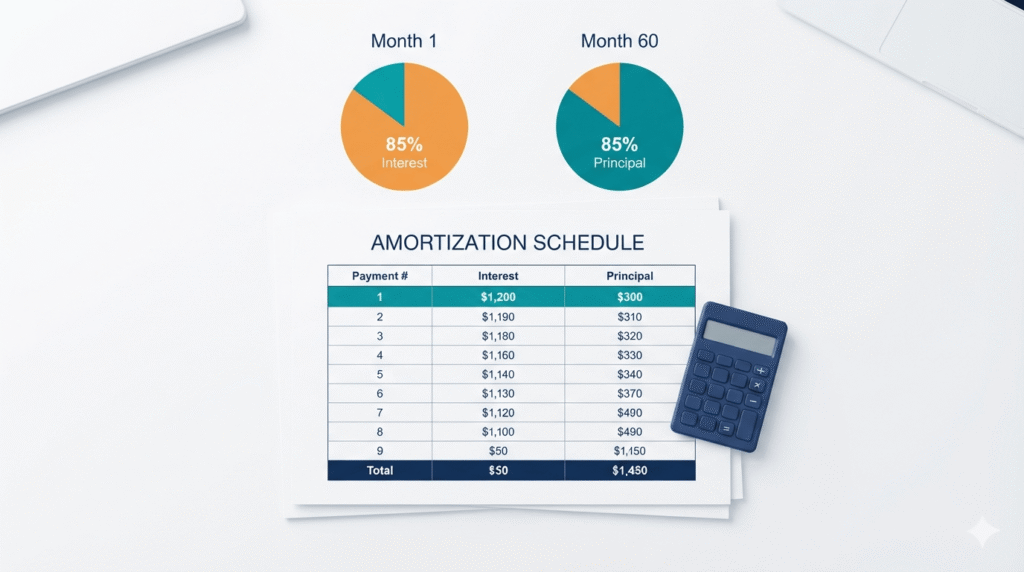
For the majority of any loan’s life, your payments are doing something that surprises nearly every first-time borrower: they’re paying interest first, and principal second. Sometimes the split is dramatic. In the first month of a 30-year mortgage, as little as 15% of your payment reduces what you actually owe. The other 85% goes to the lender as interest.
This is loan amortization — and once you understand how it works, you’ll never look at a loan payment the same way.
This guide explains amortization from the ground up: what it is, how the math works, how to read an amortization schedule, and — most importantly — what you can do to change the equation in your favor. Real examples, real numbers, no financial jargon left unexplained.
If you want to see how your own loan is structured right now, the free Loan Payoff Calculator generates a full amortization breakdown for any loan in under a minute.
What Is Loan Amortization?
Loan amortization is the process of paying off a debt through scheduled, fixed payments over a set period of time. Each payment covers two things: the interest that has accrued since the last payment, and a portion of the original loan balance (the principal).
The word “amortize” comes from the Old French amortir, meaning to kill off or deaden. In finance, it means gradually eliminating a debt over time — payment by payment — until the balance reaches zero.
Loan amortization is the process of repaying a loan through regular fixed payments over a set term. Each payment covers the accrued interest first, with the remainder reducing the principal balance. Early in the loan, most of each payment goes toward interest. As the balance falls, more of each payment shifts to principal. The loan reaches zero at the end of the term.
Amortized loans are the standard structure for mortgages, auto loans, personal loans, and student loans. A non-amortizing loan — such as interest-only periods or balloon loans — works differently and is not the focus of this guide.
How Amortization Works ?
The mechanics of amortization are built on one rule: interest is always calculated on the current outstanding balance.
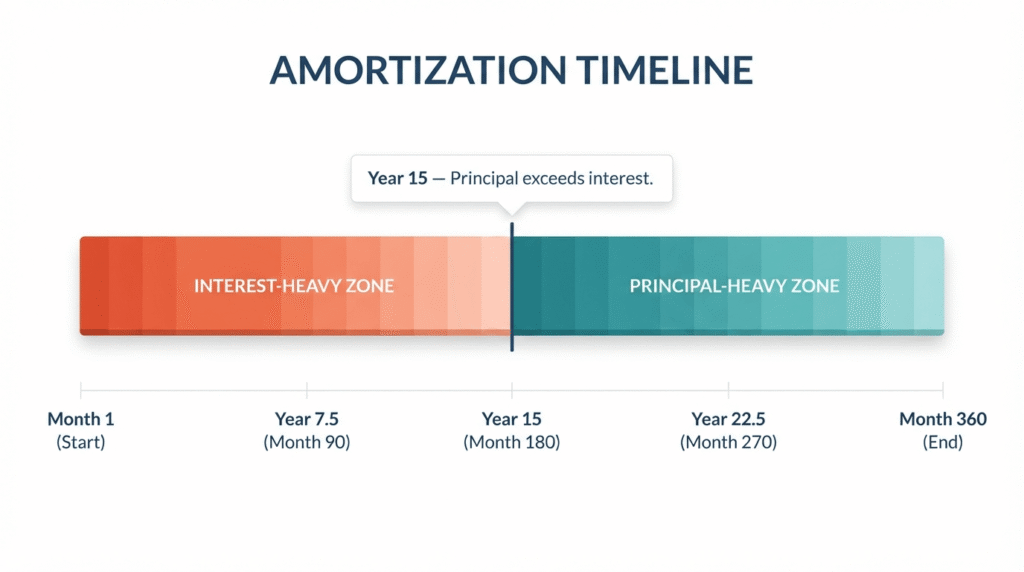
At the start of a loan, your balance is at its highest — so the interest portion of each payment is at its highest too. As you make payments and the balance falls, less interest accrues each month. That means more of each payment goes toward principal. More principal paid means the balance falls faster. The cycle accelerates toward zero.
This is why the last year of a loan feels so different from the first. In the final months, almost every dollar of your payment reduces principal — because your balance is nearly gone and there’s almost no interest left to charge.
Here’s a simplified version of how each payment is calculated:
- Calculate monthly interest — Multiply your outstanding balance by your monthly interest rate (annual rate ÷ 12)
- Subtract from payment — The remainder after interest goes to principal
- Reduce balance — The new balance becomes the starting point for the next month
- Repeat — Until balance = $0
Why Early Payments Mostly Go Toward Interest
This is the part that surprises people most — and it’s worth understanding clearly.
Early loan payments are mostly interest because interest is calculated on the full outstanding balance. At the start of a loan, the balance is at its highest, so a large portion of each payment covers interest. As payments are made and the balance shrinks, interest charges decrease and more of each payment goes toward principal. This is why paying extra early in a loan saves dramatically more than paying extra later.
Take a $300,000 mortgage at 7% APR over 30 years. The monthly payment is $1,995.91.
In month 1:
- Outstanding balance: $300,000
- Monthly interest: $300,000 × (7% ÷ 12) = $1,750
- Principal reduction: $1,995.91 − $1,750 = $245.91
Only $245.91 of that $1,995.91 payment reduced what you owe. The other $1,750 went to the lender as interest — 87.7% of your payment.
By month 180 (year 15), the balance has dropped to around $213,000:
- Monthly interest: $213,000 × 0.5833% = $1,242
- Principal reduction: $1,995.91 − $1,242 = $753.91
Still majority interest, but the split is improving. By month 300 (year 25), the balance is around $93,000 and the principal portion finally exceeds interest.
This front-loading of interest is not a trick or a penalty. It is the mathematical consequence of charging interest on a large outstanding balance. The only way to change it is to reduce the balance faster than the schedule requires.
Principal vs. Interest: What Each Means
Before reading an amortization schedule, it helps to be clear on these two terms.
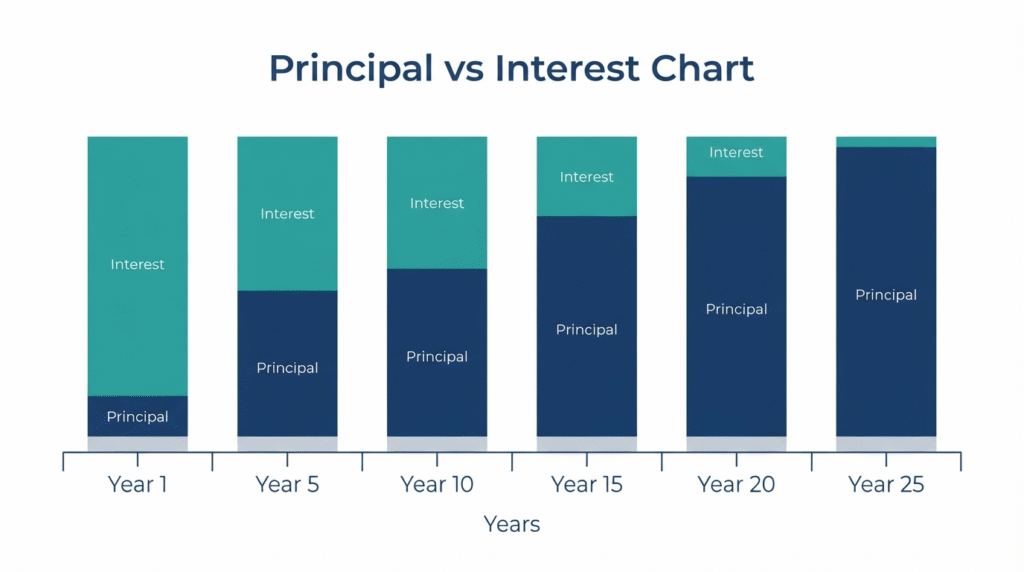
Table 5 — Amortization Terminology
| Term | Definition |
|---|---|
| Principal | The original amount borrowed; the actual debt that must be repaid |
| Interest | The cost of borrowing; charged as a percentage of the outstanding balance |
| Amortization | The process of paying off a loan through fixed scheduled payments |
| Amortization schedule | A table showing every payment, its interest/principal split, and remaining balance |
| Outstanding balance | The remaining principal owed at any point in time |
| Monthly interest rate | Annual interest rate divided by 12 |
| Loan term | Total number of months over which the loan is repaid |
| Payoff date | The date on which the final payment brings the balance to zero |
| Prepayment | Any payment made above the scheduled amount; reduces principal balance |
| Re-amortization | Recalculating the payment schedule after a large principal reduction |
Understanding an Amortization Schedule
An amortization schedule is a complete table of every payment you will make over the life of a loan. Each row shows one payment period (usually one month) and contains:
- Payment number (Month 1, Month 2, etc.)
- Beginning balance — what you owed at the start of that month
- Payment amount — your total monthly payment
- Interest portion — how much of the payment covers interest
- Principal portion — how much reduces your balance
- Ending balance — what you owe after this payment
Table 1 — Principal vs. Interest Over Time Based on $25,000 auto loan, 6.5% APR, 60-month term. Monthly payment: $487.66
| Month | Beginning Balance | Payment | Interest | Principal | Ending Balance |
|---|---|---|---|---|---|
| 1 | $25,000.00 | $487.66 | $135.42 | $352.24 | $24,647.76 |
| 6 | $23,347.22 | $487.66 | $126.47 | $361.19 | $22,986.03 |
| 12 | $21,311.54 | $487.66 | $115.44 | $372.22 | $20,939.32 |
| 24 | $17,040.12 | $487.66 | $92.30 | $395.36 | $16,644.76 |
| 36 | $12,437.80 | $487.66 | $67.37 | $420.29 | $12,017.51 |
| 48 | $7,472.55 | $487.66 | $40.48 | $447.18 | $7,025.37 |
| 60 | $485.03 | $487.66 | $2.63 | $485.03 | $0.00 |
Notice how the interest portion falls from $135.42 in month 1 to just $2.63 in month 60. Every month, as the balance drops, slightly more of your payment goes to work on the actual debt.
An amortization schedule is a complete table showing every loan payment broken down into its interest and principal components, along with the remaining balance after each payment. It shows exactly how much of each payment reduces your debt and how much goes to the lender as interest. Early in the schedule, interest dominates; by the final payments, nearly everything goes to principal.
The Loan Amortization Formula
The standard monthly payment for a fully amortized loan is calculated using this formula:
M = P × [r(1+r)ⁿ] ÷ [(1+r)ⁿ − 1]
Where:
- M = monthly payment
- P = principal (loan amount)
- r = monthly interest rate (annual rate ÷ 12)
- n = total number of payments (years × 12)
Example: $25,000 auto loan at 6.5% APR over 60 months
- P = $25,000
- r = 6.5% ÷ 12 = 0.5417% = 0.005417
- n = 60
M = 25,000 × [0.005417 × (1.005417)⁶⁰] ÷ [(1.005417)⁶⁰ − 1] M = 25,000 × [0.005417 × 1.3851] ÷ [1.3851 − 1] M = 25,000 × [0.007503] ÷ [0.3851] M = 25,000 × 0.019489 M = $487.22 (slight rounding from actual $487.66 due to compounding precision)
You don’t need to calculate this manually. The Loan Payoff Calculator handles this instantly and also generates the full amortization table for any loan.
Real Example 1: Car Loan Amortization
Loan details: $22,000 · 7.2% APR · 48-month term Monthly payment: $529.23 Total interest: $3,403
Maria financed a used car in early 2024. Here’s how her amortization breaks down by year:
Table 4 — Interest Savings by Year (Car Loan)
| Year | Interest Paid | Principal Paid | Balance Remaining |
|---|---|---|---|
| Year 1 | $1,455 | $4,895 | $17,105 |
| Year 2 | $1,082 | $5,268 | $11,837 |
| Year 3 | $672 | $5,678 | $6,159 |
| Year 4 | $194 | $6,159 | $0 |
| Total | $3,403 | $22,000 | — |
In Year 1, Maria paid $1,455 in interest on a $22,000 loan — that’s 6.6% of the loan value in interest alone in the first 12 months. By Year 4, only $194 in interest remains. The same $529.23 monthly payment does dramatically different things depending on which year she’s in.
Real Example 2: Mortgage Amortization
Loan details: $350,000 · 6.75% APR · 30-year term Monthly payment: $2,270.05 Total interest over 30 years: $467,218
James and Patricia bought a home in 2023. The scale of their amortization is staggering when laid out by year:
Table 2 — Mortgage vs. Auto Loan Amortization Comparison
| Metric | Mortgage ($350K, 6.75%, 30yr) | Auto Loan ($22K, 7.2%, 4yr) |
|---|---|---|
| Monthly payment | $2,270.05 | $529.23 |
| Total payments | 360 | 48 |
| Total interest | $467,218 | $3,403 |
| Interest as % of loan | 133.5% | 15.5% |
| Month 1 interest | $1,969 (87%) | $132 (25%) |
| Month 1 principal | $301 (13%) | $397 (75%) |
| Break-even (50/50 split) | Month ~252 (Year 21) | Month ~25 (Year 2) |
The mortgage comparison is striking. James and Patricia will pay $467,218 in interest on a $350,000 loan — they effectively pay for the house 1.33 times over just in interest costs. And they won’t reach the point where principal exceeds interest in each payment until Year 21 of a 30-year loan.
This is why mortgage amortization is discussed so often in the context of extra payments and early payoff. The interest burden on a long-term, high-balance loan is enormous.
For a detailed breakdown of how extra payments change this, see our guide: Do Extra Payments Reduce Loan Interest?
Real Example 3: Personal Loan Amortization
Loan details: $12,000 · 11% APR · 36-month term Monthly payment: $392.86 Total interest: $2,143
David consolidated credit card debt into a personal loan. Personal loans are shorter-term, so the amortization is less dramatic — but the 11% rate still means meaningful front-loading.
Month 1:
- Interest: $12,000 × (11% ÷ 12) = $110
- Principal: $392.86 − $110 = $282.86
- Interest share: 28% of payment
By month 18 (midpoint):
- Balance: ~$6,600
- Interest: ~$60.50
- Principal: ~$332.36
- Interest share: 15.4% of payment
By month 30:
- Balance: ~$1,550
- Interest: ~$14.21
- Principal: ~$378.65
- Interest share: 3.6% of payment
The 36-month timeline compresses the amortization curve significantly compared to a mortgage. David reaches the 50/50 principal-interest split much earlier (around month 20), and the total interest burden is manageable at $2,143 vs. the hundreds of thousands that accumulate on a 30-year mortgage.
How Extra Payments Change Your Amortization Schedule
This is where understanding amortization becomes genuinely useful and actionable.
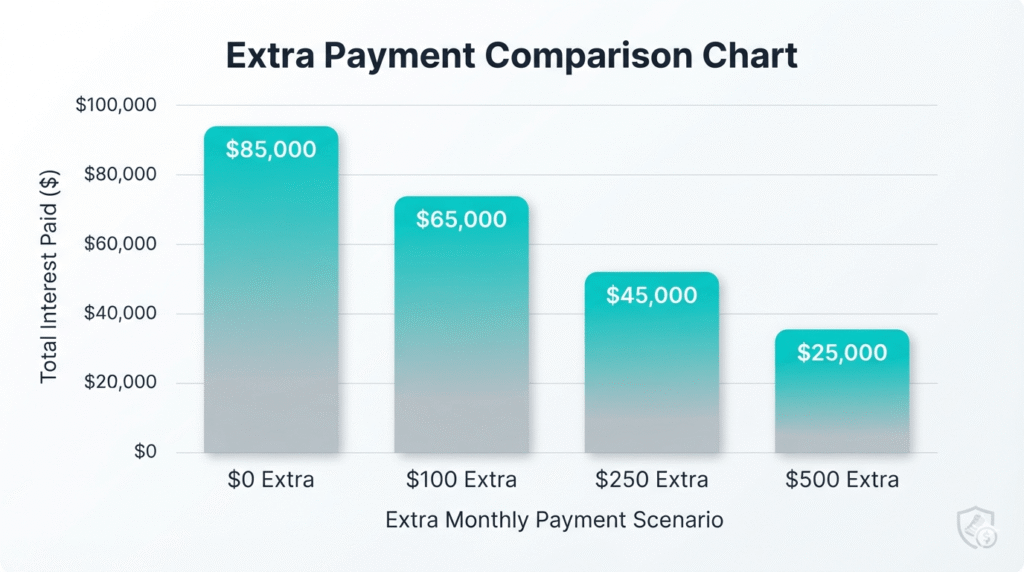
Every extra payment you make goes directly to principal — assuming you designate it correctly with your lender. A reduced principal balance means less interest accrues in the following month, which means more of your next regular payment goes to principal. That accelerates the reduction even further.
The effect compounds. The earlier you make extra payments, the more they benefit you, because they trigger this cascade across more remaining payment periods.
Featured Snippet Answer: Extra payments change amortization by directly reducing the outstanding principal balance. Since interest is calculated on the remaining balance, a lower balance means less interest accrues each month. This causes more of every subsequent regular payment to go toward principal, accelerating payoff. The result: fewer total payments, a shorter loan term, and significantly less total interest paid.
Table 3 — Extra Payment Comparison $300,000 mortgage, 7.0% APR, 30-year term. Base payment: $1,995.91
| Scenario | Extra/Month | Payoff Time | Total Interest | Interest Saved | Months Saved |
|---|---|---|---|---|---|
| No extra payments | $0 | 360 months | $418,527 | — | — |
| +$100/month | $100 | 334 months | $372,408 | $46,119 | 26 months |
| +$250/month | $250 | 290 months | $325,614 | $92,913 | 70 months |
| +$500/month | $500 | 252 months | $271,886 | $146,641 | 108 months |
| +$1,000/month | $1,000 | 198 months | $196,820 | $221,707 | 162 months |
Adding $500/month to a $300,000 mortgage saves $146,641 in interest and cuts the loan from 30 years to 21 years. Adding $1,000/month cuts it nearly in half — 16.5 years instead of 30 — and saves over $221,000.
These numbers assume extra payments are applied directly to principal from the first month. The earlier they start, the more powerful the effect. A $10,000 lump-sum payment in Year 1 of a mortgage saves roughly 6 times more interest than the same payment in Year 20 — because it triggers the cascade across more remaining periods.
For the full breakdown of how and why this works, read: Do Extra Payments Reduce Loan Interest?
And if you’re weighing whether early payoff is worth it in your situation: Is Paying Off a Loan Early Worth It?
Common Amortization Mistakes
1. Assuming all your payment goes to paying off what you owe. Early in a loan, most of your payment is interest. This is not an error or a scam — it is the mathematical consequence of amortization. Understanding it helps you decide when extra payments make the most sense.
2. Making extra payments without designating to principal. Without specifying “apply to principal,” your lender may credit the extra amount toward your next scheduled payment — which covers both interest and principal under the regular schedule. This is less effective than direct principal reduction. Always designate.
3. Confusing a lower payment with a shorter loan. Re-amortization (recasting) after a lump-sum payment lowers your monthly payment but typically keeps the original loan term. If your goal is to pay off faster, keep making the original payment amount — the extra now goes entirely to principal.
4. Not checking how your lender handles extra payments. Some lenders, particularly for federal student loans under income-driven repayment, apply extra payments to future interest or scheduled payments before touching principal. Always verify with your specific lender.
5. Focusing only on monthly payment, not total interest. A longer loan term lowers your monthly payment but dramatically increases total interest paid. A $300,000 mortgage at 7% over 30 years costs $467,218 in interest. The same loan over 15 years costs $186,489 in interest — saving $280,729 at roughly twice the monthly payment.
6. Ignoring the amortization schedule entirely. Your lender is required to provide this. Looking at it once shows you exactly where you are in the loan lifecycle and what the next 12 months of payments actually accomplish. Most people have never looked at one.
7. Treating all loans the same. A 36-month personal loan amortizes very differently from a 360-month mortgage. On the personal loan, you reach the 50/50 principal-interest split relatively quickly. On the mortgage, you may not get there until year 21. Strategy should be calibrated to the actual schedule.
8. Refinancing without comparing amortization schedules. Refinancing restarts the amortization clock. If you refinance a 30-year mortgage after 10 years into a new 30-year mortgage, you now have 40 years of total payments (unless you significantly cut the rate or term). Always model the full amortization before refinancing.
Frequently Asked Questions
What is loan amortization?
Loan amortization is the process of repaying a loan through fixed, scheduled payments over a set term. Each payment covers accrued interest first, with the remainder reducing the principal balance. The loan reaches zero at the scheduled payoff date.
What is an amortization schedule?
An amortization schedule is a complete table showing every payment over a loan’s life — how much goes to interest, how much to principal, and what balance remains after each payment. Most lenders provide this at loan origination.
Why do early payments mostly go to interest?
Because interest is calculated on the outstanding balance, which is highest at the beginning of the loan. As payments reduce the balance, the interest portion shrinks and the principal portion grows — a process that accelerates over time.
How do I read an amortization table?
Each row represents one payment period. Read left to right: payment number → beginning balance → total payment → interest paid → principal paid → ending balance. The interest column decreases each row; the principal column increases each row.
Does making extra payments change the amortization schedule?
Yes. Extra payments applied to principal immediately lower the balance, which reduces future interest charges and shifts more of every subsequent payment toward principal. This shortens the loan term and reduces total interest paid.
What is the amortization formula?
M = P × [r(1+r)ⁿ] ÷ [(1+r)ⁿ − 1], where M is the monthly payment, P is the principal, r is the monthly interest rate (annual rate ÷ 12), and n is the total number of payments. You can also use the free Loan Payoff Calculator at 1onlinecalculator.com/loan-payoff-calculator/.
Is amortization the same for all loan types?
The mathematical process is the same, but the impact varies significantly by loan size and term. A 30-year mortgage front-loads interest much more dramatically than a 3-year personal loan. Longer terms and higher balances create greater interest concentration in early payments.
What is negative amortization?
Negative amortization occurs when a payment doesn’t cover the full interest due, causing the unpaid interest to be added to the principal balance. The loan balance actually increases despite payments being made. This is a feature of certain adjustable-rate and option-ARM mortgages and is generally harmful to borrowers.
What’s the difference between amortization and depreciation?
Amortization (in the loan context) refers to paying off debt over time. Depreciation refers to the reduction in value of a physical asset over time. They’re separate financial concepts that happen to use similar language.
Can I get my amortization schedule from my lender?
Yes. Lenders are required by federal law (under TILA — the Truth in Lending Act) to disclose loan terms, and most provide a full amortization schedule at closing or upon request. You can also generate one instantly using the Loan Payoff Calculator.
What happens to my amortization schedule if I refinance?
Refinancing creates a new loan with a new amortization schedule. If you refinance a 30-year mortgage 10 years in, you reset to a new 30-year clock (unless you choose a shorter term). Always model the full new schedule before refinancing.
How does a 15-year mortgage compare to a 30-year on amortization?
On a 15-year mortgage, the principal-interest balance shifts much faster because the same payoff must happen in half the time. Monthly payments are higher, but total interest paid is dramatically lower — often less than half what a 30-year version accumulates.
Does amortization apply to student loans?
Yes. Federal and private student loans are amortized over their repayment term (10 years under the standard plan, longer under income-driven plans). The same front-loading of interest applies. Extra payments reduce principal and save interest the same way.
What is a fully amortized loan?
A fully amortized loan is one where regular fixed payments are structured so that the balance reaches exactly zero at the end of the term. Most consumer loans — mortgages, auto loans, personal loans — are fully amortized.
What is a partially amortized loan?
A partially amortized loan has a payment schedule that doesn’t fully retire the balance by the end of the term. A final “balloon payment” covers the remaining balance. These are common in commercial real estate but rare in consumer lending.
How do biweekly payments affect amortization?
Biweekly payments (26 half-payments per year) result in the equivalent of 13 full monthly payments per year instead of 12. The extra payment reduces principal faster than the standard schedule, shortening the loan and reducing total interest.
How does an adjustable-rate mortgage (ARM) affect amortization?
ARM loans recalculate the payment when the rate adjusts. Each rate change creates a new amortization schedule for the remaining balance at the new rate. This makes total interest costs harder to predict than on a fixed-rate loan.
Why does my balance feel like it’s barely moving early in my loan?
Because most of your early payments are covering interest, not principal. On a 30-year mortgage in the first year, you may reduce your balance by only $3,000–$4,000 despite making over $24,000 in payments. This is normal amortization — not a malfunction.
How do I use the Loan Payoff Calculator to see my amortization?
Enter your loan balance, interest rate, term, and any extra payment amount. The calculator generates your monthly payment, total interest, and payoff date. Full amortization breakdowns are available at 1onlinecalculator.com/loan-payoff-calculator/.
Can I pay off an amortized loan at any time?
Yes — you can pay the remaining balance (the “payoff amount”) at any time. Request a payoff quote from your lender, which shows the exact amount needed on a specific date. Be aware that some loans carry prepayment penalties; check your agreement first.
Conclusion
Loan amortization is not just a financial term — it’s the mechanism that determines how every dollar of every loan payment is actually spent. Understanding it changes how you think about debt, payments, and the value of acting early.
The key takeaways:
- Interest is charged on your outstanding balance, so early payments are mostly interest — this is math, not deception
- As the balance falls, more of each payment goes to principal — the curve always moves in your favor
- Extra payments applied to principal accelerate this shift and compound over the remaining life of the loan
- The earlier in the loan you make extra payments, the more interest you save
- A 30-year mortgage and a 3-year personal loan amortize very differently — strategy should match the loan type
The most practical next step is to look at your own numbers. The free Loan Payoff Calculator shows your amortization in real time — how your current loan is structured, how extra payments shift the schedule, and exactly what you’d save by paying more each month.
Once you see your own amortization schedule, the abstract math becomes concrete and personal. Most people who look at it once find a reason to act.