
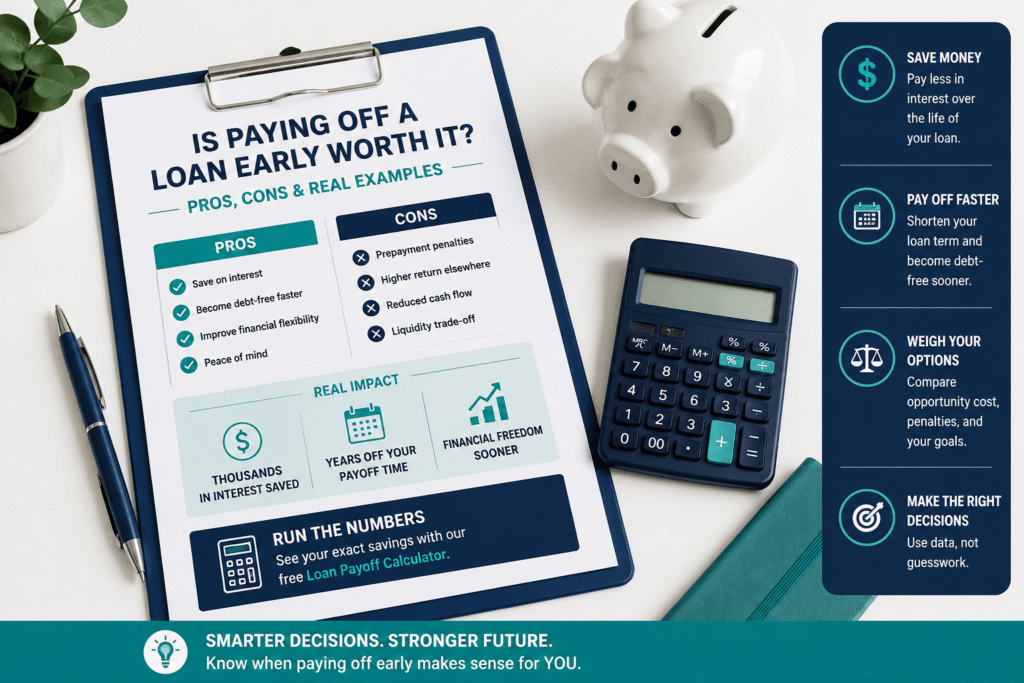
Is Paying Off a Loan Early Worth It?
Millions of people ask this question every year, and for good reason. You’re staring at a loan balance — a car loan, a mortgage, a personal loan, maybe all three — and you’ve got a little extra cash. The impulse is to throw it at the debt and be done with it. But is that actually the smartest move?
The honest answer: it depends. Paying off a loan early is one of those personal finance decisions that genuinely varies by situation. For one person, it’s the single best financial move they can make. For another, it means missing out on thousands in investment returns or triggering a penalty they didn’t see coming.
This guide walks through both sides — with real examples, comparison tables, and a decision framework you can actually use. If you want to see your exact numbers before deciding, the free Loan Payoff Calculator shows how much interest you’d save and when you’d be debt-free under any scenario.
The Short Answer
Paying off a loan early is usually worth it when your interest rate is high, you have no prepayment penalties, and you’ve already built an emergency fund. However, if your loan carries a low interest rate, your employer offers a retirement match you’re not capturing, or you can consistently earn higher investment returns, keeping the loan and investing the difference may come out ahead financially.
There is no one-size-fits-all answer — but there is a right answer for your specific situation.
Benefits of Paying Off a Loan Early
Before getting into the trade-offs, it helps to understand exactly what early payoff delivers.
1. You pay less total interest.
This is the most concrete benefit. Every loan charges interest on the outstanding balance. The faster you reduce that balance, the less interest you owe. On a $30,000 personal loan at 11% interest over 5 years, early payoff by 18 months can save over $4,000 in interest alone. On a mortgage, the savings are often measured in the tens of thousands.
2. You free up monthly cash flow.
Once the loan is gone, that monthly payment stops. A $450/month car payment eliminated 18 months early puts roughly $8,100 back in your pocket during that period, and permanently frees up $450/month going forward for savings, investing, or other goals.
3. Your debt-to-income ratio improves.
Lenders use your debt-to-income (DTI) ratio when evaluating new credit applications. Eliminating a monthly debt obligation improves your DTI, which can help you qualify for a mortgage, better rates on future loans, or increased credit limits.
4. Financial stress decreases.
The psychological weight of carrying debt is real and often underestimated. Research from multiple consumer finance studies — including reports from the Consumer Financial Protection Bureau — has linked high debt levels to elevated stress, reduced sleep quality, and lower life satisfaction. The intangible value of feeling debt-free has genuine worth.
5. You build stronger financial habits.
The discipline required to make extra payments tends to carry over into other areas of financial management — higher savings rates, more deliberate spending, and greater focus on long-term goals.
6. You eliminate counterparty risk.
As long as you carry a loan, the lender has a claim on your income or collateral. Paying off early removes that obligation entirely, which matters especially in uncertain income situations.
When Paying Off a Loan Early Might NOT Be Worth It
Early payoff is not always the optimal move. Here are the situations where it can actually cost you.
Prepayment penalties exist on your loan.
Some personal loans, auto loans, and older mortgage products include prepayment penalty clauses — charges for paying off the loan ahead of schedule. These can range from a flat fee to several months of interest. Always read your loan agreement before making extra payments. If the penalty exceeds your projected interest savings, early payoff is a net loss.
Your interest rate is very low.
A 2.9% car loan or a 3.25% mortgage from 2021 costs less than inflation in many years. Mathematically, that money often earns more in a high-yield savings account, a bond fund, or a diversified investment portfolio than it saves in loan interest. The lower your rate, the weaker the case for early payoff.
You’re missing an employer retirement match.
A 401(k) employer match is an immediate 50–100% return on money contributed, up to the match limit. No loan interest rate comes close to that. If you’re not capturing your full employer match while making extra loan payments, you are leaving guaranteed money on the table.
You have no emergency fund.
Aggressively paying down a loan while keeping no cash reserve can create a dangerous cycle. If an unexpected expense hits — job loss, medical bill, car repair — you may be forced to borrow at higher rates to cover it, undoing your progress. Financial advisors generally recommend keeping 3–6 months of living expenses liquid before making extra loan payments.
Tax deductions apply.
Mortgage interest is deductible for many U.S. homeowners who itemize. If you’re in a high tax bracket and itemizing deductions, the effective interest rate on your mortgage is lower than the stated rate, which changes the calculus on whether paying it down early makes sense.
Your investments reliably outperform the loan rate.
This is the core of the invest-vs-pay-off debate, covered in detail below.
Real-Life Examples: When the Math Plays Out Both Ways
Example 1 — Car Loan ($25,000 at 7.5% APR, 60 months)
Monthly payment: $500.91 | Total interest without extra payments: $5,054
Sarah has $300/month extra. She decides to add it to her car payment.
- New total monthly payment: $800.91
- Loan paid off in: 35 months (instead of 60)
- Interest saved: $2,614
- Verdict: Early payoff wins. 7.5% is a strong guaranteed return, and Sarah has no prepayment penalty.
Example 2 — Personal Loan ($15,000 at 12.5% APR, 48 months)
Monthly payment: $399.11 | Total interest: $4,157
Marcus has $200/month extra and is also considering investing in index funds.
- Historical S&P 500 average return (after inflation): ~7% annually
- His loan rate: 12.5%
- Verdict: Pay off the loan. At 12.5% interest, the loan costs more than realistic investment returns. This is a guaranteed 12.5% return on every dollar paid early.
Example 3 — Mortgage ($350,000 at 3.25% APR, 30 years)
Monthly payment: $1,523 | Total interest: $198,294
Linda and David have $400/month extra. They’re debating paying the mortgage down faster vs. investing.
- Extra $400/month toward mortgage: saves ~$75,000 in interest, pays off 7+ years early
- Extra $400/month in S&P 500 (assuming 7% avg return, 30 years): grows to approximately $484,000
- Verdict: Investing likely wins at 3.25%. The investment return (7%) significantly exceeds the loan rate (3.25%). However, risk tolerance matters — the mortgage payoff is guaranteed; the investment return is not.
Example 4 — Student Loan ($28,000 at 6.5% APR, 10-year repayment)
Monthly payment: $317.96 | Total interest: $10,156
James has $150/month extra.
- Investing at 7% average: slightly ahead over 10 years
- Loan rate at 6.5%: close to estimated investment returns
- Verdict: Toss-up. The rates are close enough that psychological preference, other debt obligations, and liquidity needs should drive the decision. Many advisors suggest splitting — $75/month extra on the loan, $75 invested.
Example 5 — Business Loan ($50,000 at 9% APR, 5 years)
Monthly payment: $1,038 | Total interest: $12,280
A small business owner, Elena, is considering paying it off early with retained business earnings.
- Her business earns 15–20% returns on reinvested capital
- Loan rate: 9%
- Verdict: Keep the loan, reinvest in the business. Business capital earning 15% outperforms a 9% loan payoff. However, if the business environment becomes uncertain, eliminating the loan obligation reduces financial risk.
Pay Off Debt or Invest? The Definitive Comparison
This is the central question for anyone with extra money and existing debt. Here is how to think through it clearly.
Table 4 — Investing vs. Paying Off Debt: Decision Framework
| Loan Interest Rate | Recommended Strategy | Reasoning |
|---|---|---|
| Below 4% | Invest the difference | Historical investment returns significantly exceed loan cost |
| 4% – 6% | Split approach | Returns and loan cost are comparable; balance both |
| 6% – 8% | Lean toward loan payoff | Loan cost approaches or exceeds realistic investment returns |
| Above 8% | Pay off loan first | Guaranteed return exceeds typical market expectations |
| Any rate + no emergency fund | Build emergency fund first | Liquidity takes priority over both |
| Any rate + no employer 401k match | Capture full match first | 50–100% instant return beats any loan rate |
About risk-adjusted returns:
Investment returns are not guaranteed. The stock market has historically averaged 7–10% annually over long periods, but individual years swing dramatically — including years with 30–40% losses. Paying off a loan at 8% is a guaranteed 8% return. An investment expected to return 8% carries real risk of underperforming. For conservative or risk-averse individuals, debt payoff at even moderate interest rates often makes sense on a risk-adjusted basis.
How Much Interest Can You Save? Practical Scenarios
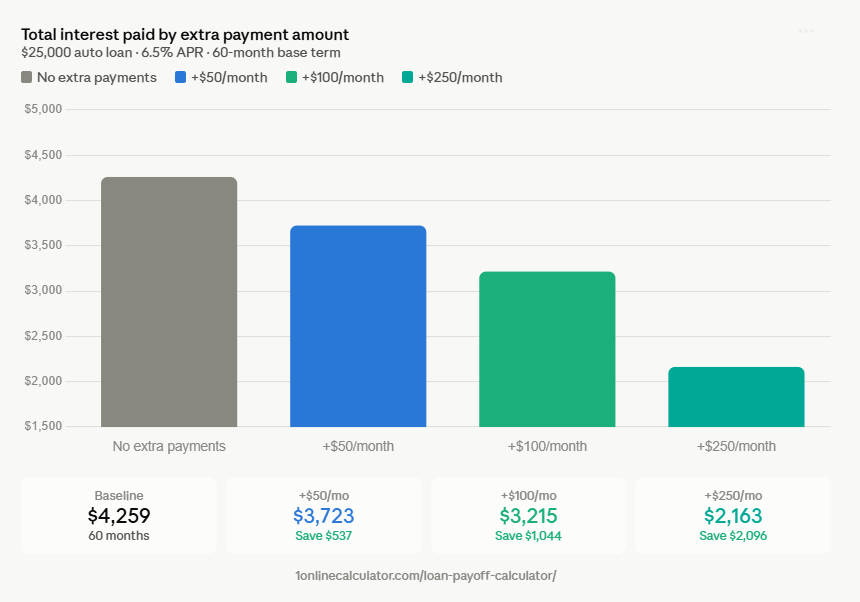
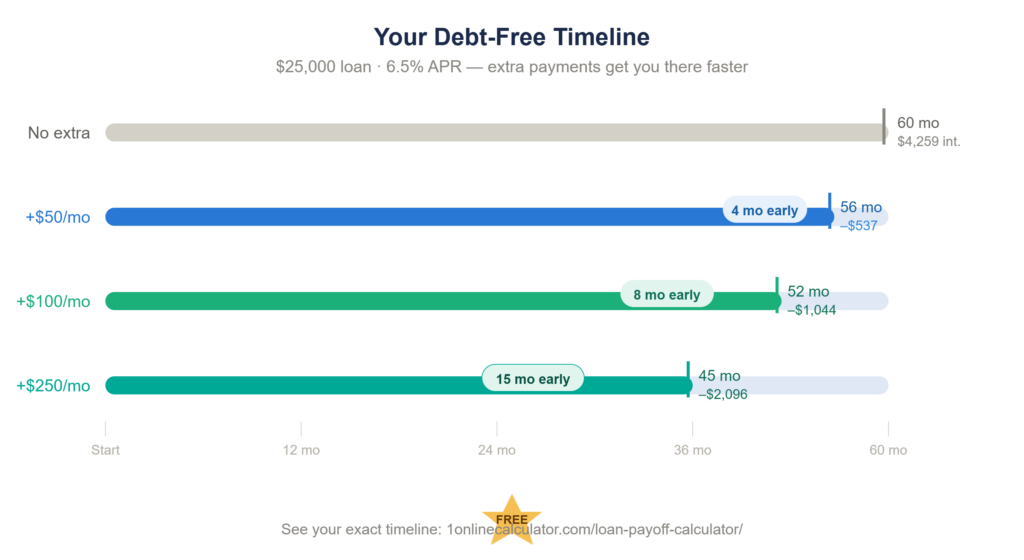
The following examples use a $25,000 auto loan at 6.5% APR, 60-month term (standard monthly payment: $487.66).
Table 5 — Monthly Extra Payment Comparison
| Extra/Month | Months to Payoff | Total Interest | Interest Saved | Time Saved |
|---|---|---|---|---|
| $0 (baseline) | 60 | $4,259 | — | — |
| +$50/month | 56 | $3,723 | $537 | 4 months |
| +$100/month | 52 | $3,215 | $1,044 | 8 months |
| +$250/month | 45 | $2,163 | $2,096 | 15 months |
| +$500/month | 37 | $1,456 | $2,803 | 23 months |
Even $50/month extra — the cost of two fast-food meals — saves $537 and knocks four months off the loan. $500/month extra cuts the loan nearly in half in terms of timeline.
To calculate your exact figures for any loan, use the free Loan Payoff Calculator. Enter your balance, interest rate, remaining term, and any extra payment amount to see your personalized results instantly.
You can also read our detailed guide on how extra payments reduce loan interest for a full breakdown of the mechanics.
The Loan Type Decision Matrix
Not all loans are created equal when it comes to early payoff strategy.
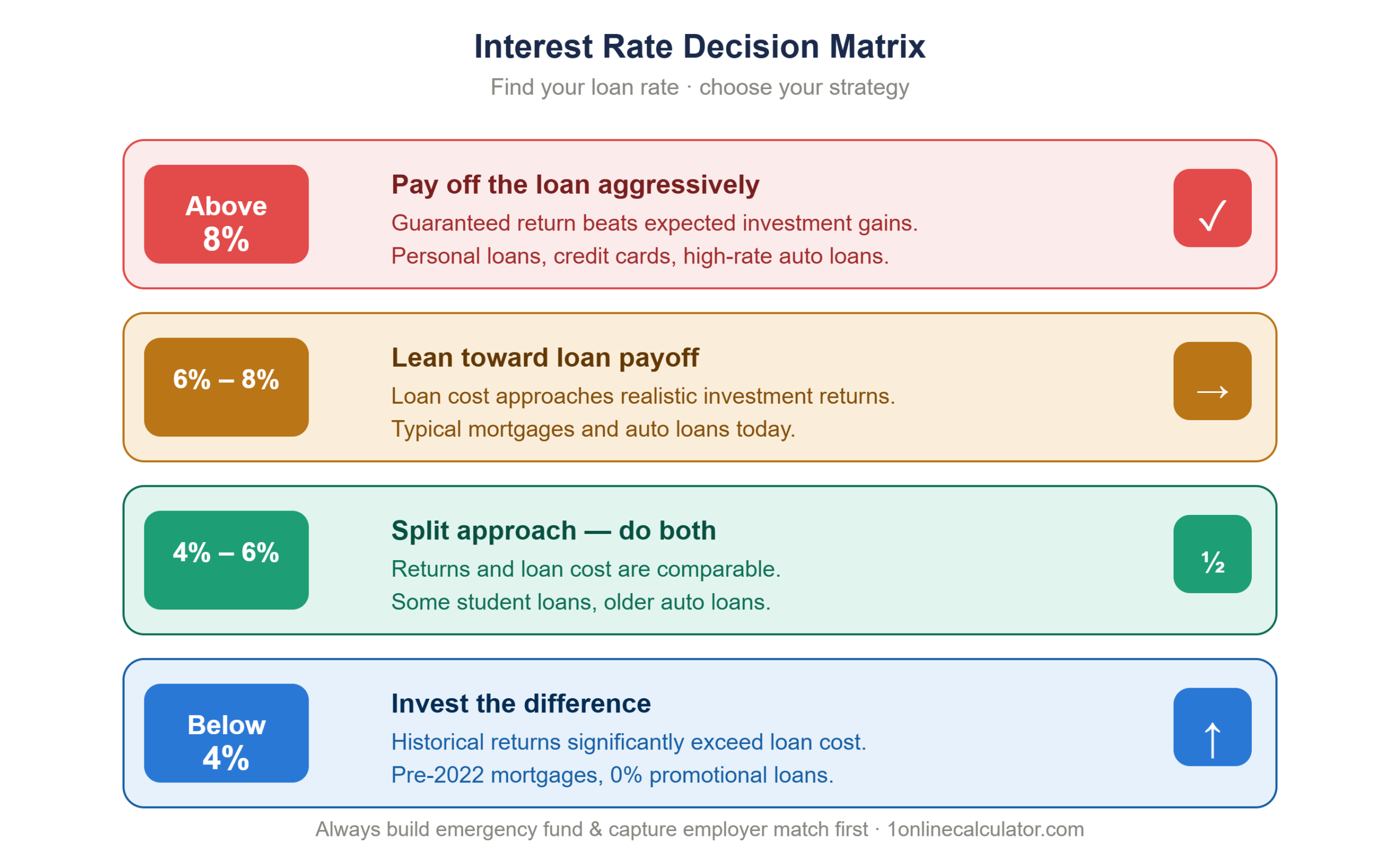
Table 1 — High-Interest vs. Low-Interest Loan Comparison
| Loan Type | Typical Rate (2024–2025) | Early Payoff Priority |
|---|---|---|
| Credit card | 20–29% | Highest priority — pay immediately |
| Personal loan (fair credit) | 14–22% | Very high priority |
| Auto loan (new car) | 6–9% | High priority |
| Student loan (private) | 5–13% | Moderate to high |
| Student loan (federal) | 5–7.5% | Moderate |
| Personal loan (good credit) | 8–13% | High priority |
| Mortgage (30-year fixed) | 6–7.5% | Moderate |
| Mortgage (low-rate, pre-2022) | 2.5–4% | Low priority |
| Business loan (SBA) | 6–10% | Moderate |
Table 2 — Loan Type vs. Should You Pay Early?
| Loan Type | Pay Early? | Key Consideration |
|---|---|---|
| High-rate personal loan (>10%) | Yes — strong case | Guaranteed savings exceed investment expectations |
| Auto loan (>6.5%) | Yes — usually | Check for prepayment penalties |
| Student loan (federal, IDR plan) | Maybe | Extra payments may go to interest first; verify |
| Mortgage (>6%) | Yes — consider it | Balance against tax deduction if itemizing |
| Mortgage (<4%) | Probably not | Investment returns likely exceed this rate |
| 0% promotional loan | No | Zero cost to carry; invest the difference |
| Business loan with ROI > rate | No | Capital earns more in the business |
Table 3 — Interest Rate Decision Matrix
| Your Loan Rate | Emergency Fund? | Employer Match Captured? | Recommendation |
|---|---|---|---|
| >8% | Yes | Yes | Pay loan early aggressively |
| >8% | No | Yes | Build emergency fund first, then accelerate |
| 6–8% | Yes | Yes | Pay extra on loan; consider modest investing too |
| 4–6% | Yes | Yes | Split: some extra to loan, some invested |
| <4% | Yes | Yes | Invest the extra; carry the loan |
| Any | No | No | Emergency fund → employer match → then decide |
Does Paying Off a Loan Early Improve Your Credit Score?
This is a commonly misunderstood area. The short answer: it might, but not necessarily right away, and sometimes there’s a temporary dip.
Payment history (35% of your FICO score):
Paying off a loan doesn’t retroactively change your payment history — it stays on your report for up to 10 years as a positive account. No negative impact here.
Credit mix (10% of your score):
Lenders like to see a variety of credit types — credit cards, installment loans, mortgages. Closing an installment loan reduces your mix. This can cause a small, temporary score dip, particularly if it was your only installment loan.
Credit utilization:
Utilization applies to revolving credit (credit cards), not installment loans. Paying off a personal loan or auto loan has no direct impact on your utilization ratio.
Length of credit history (15% of your score):
Paying off and closing an account can reduce your average account age over time, which can slightly lower your score.
The practical reality:
Most people see either no change or a small temporary dip of 5–15 points after paying off an installment loan. This typically recovers within a few months. If you plan to apply for a mortgage or other large credit within 3–6 months, timing your payoff to allow score recovery is worth considering.
The credit score impact should rarely be the deciding factor. The interest savings and financial flexibility from early payoff almost always outweigh a minor temporary score change.
10 Mistakes to Avoid When Paying Off a Loan Early
1. Not checking for prepayment penalties.
Read your loan agreement before making any large extra payments. Some lenders charge fees for early payoff — particularly on personal loans and older mortgages.
2. Paying off a 0% or very low-rate loan early.
A 0% promotional loan costs nothing to carry. Paying it off early is giving up free money. Invest the difference or build savings instead.
3. Depleting your emergency fund to pay off debt.
If a $1,000 emergency hits and you have no cash cushion, you’ll likely borrow again at higher rates — undoing your progress.
4. Skipping the employer 401(k) match.
No loan interest rate beats a 50–100% instant return from an employer match. Always capture the full match before making extra loan payments.
5. Not specifying “apply to principal.”
Extra payments submitted without this designation may be applied to your next scheduled payment, not your principal balance. Always designate extra payments to go directly toward principal.
6. Paying off a low-rate mortgage while carrying high-rate credit card debt.
Prioritize by interest rate. A 3.5% mortgage should wait behind a 22% credit card. Always attack the highest rate first.
7. Assuming early payoff automatically lowers your monthly payment.
Most loans keep the monthly payment fixed — extra payments shorten the timeline, not the payment. Some lenders offer re-amortization, but you usually have to request it specifically.
8. Confusing “being ahead” with being debt-free sooner.
If your lender applies extra payments as “payment in advance,” you may just be buying yourself a skipped payment — not reducing your principal. Verify how your lender handles this.
9. Ignoring tax implications.
Mortgage interest deductions, student loan interest deductions, and business loan write-offs all affect the real cost of your debt. Factor in the after-tax rate before deciding.
10. Making emotional decisions without running the numbers.
The desire to be debt-free is completely valid — but put actual numbers behind the decision before committing your cash. The Loan Payoff Calculator takes 60 seconds and removes the guesswork.
10 Expert Tips for Paying Off a Loan Early
1. Use windfalls strategically.
Tax refunds, bonuses, and inheritances applied as lump-sum principal payments early in the loan term produce the highest possible interest savings. A $5,000 payment in Year 1 of a mortgage saves dramatically more than the same amount in Year 15.
2. Try the biweekly payment strategy.
Instead of 12 monthly payments, make 26 half-payments per year — effectively 13 full payments. On a 30-year mortgage, this alone typically saves $20,000–$30,000 in interest and cuts 3–4 years off the term.
3. Round up your payment.
If your payment is $347, round it to $400. That extra $53/month adds up to $636/year with no noticeable lifestyle impact. Over a 5-year auto loan, this saves several hundred dollars in interest.
4. Automate extra payments.
Manual extra payments are easy to skip. Setting up an automated additional transfer ensures consistency without relying on monthly willpower.
5. Apply raises and cost reductions to loan payoff.
If your car insurance premium drops by $60/month, redirect that $60 to your loan. Lifestyle inflation is the enemy of debt payoff — keep your payment where it was before the savings kicked in.
6. Verify your statements after every extra payment.
Check the following month’s statement to confirm the extra payment reduced your principal balance by the full extra amount. If not, call your lender and clarify how payments are being applied.
7. Consider refinancing before paying off aggressively.
If you have a high-rate loan, refinancing to a lower rate and then making extra payments is often more effective than extra payments at the original rate. The two strategies work well together.
8. Prioritize by psychological impact, not just math.
The debt avalanche (highest rate first) is mathematically optimal. But the debt snowball (smallest balance first) produces faster emotional wins. Research shows the snowball method can sustain motivation better for many people. Pick the approach you’ll actually stick with.
9. Don’t underestimate the value of flexibility.
Liquidity — having cash available — has real value that spreadsheets undercount. Before committing to aggressive loan payoff, make sure you’d have enough cash to handle likely disruptions without borrowing.
10. Calculate your break-even point on prepayment penalties.
If your loan has a penalty, calculate how many months of interest savings it takes to recover that cost. If break-even is under 12–18 months, early payoff usually still makes financial sense.
Frequently Asked Questions
Is paying off a loan early always a good idea?
Not always. It depends on your interest rate, whether prepayment penalties apply, whether you have an emergency fund, and what else you could do with the money. At rates above 7–8%, early payoff is almost always beneficial. Below 4%, investing often wins.
What happens if I pay off a loan early?
Your lender closes the account, you stop accruing interest immediately, your monthly payment obligation ends, and the loan is reported as paid in full on your credit report.
Do I save money by paying off a loan early?
Yes — you save the interest that would have accrued during the months you’re cutting off the loan term. The higher the rate and the more time remaining, the more you save.
Is it better to pay off debt or invest?
At rates above 7–8%, paying off debt usually wins on a risk-adjusted basis. Below 4–5%, investing the difference typically outperforms. Between 5–7%, consider splitting your extra cash between both goals.
Does paying off a loan early hurt your credit score?
It can cause a small, temporary dip of 5–15 points due to reduced credit mix or account age. Most scores recover within a few months. The long-term impact is neutral to positive.
Can I pay off any loan early?
Technically yes, but some loans have prepayment penalties. Check your loan agreement first. Most consumer loans originated after 2014 are penalty-free, but always verify.
What is a prepayment penalty?
A fee charged by lenders when you pay off a loan before the scheduled end date. It compensates lenders for lost interest income. It can be a flat fee or a percentage of the remaining balance.
Should I pay off my car loan early?
If your rate is above 5–6% and there’s no prepayment penalty, early payoff is usually a strong financial move. If your rate is under 3%, you’re better off investing the difference.
Is it worth paying off a mortgage early?
It depends on your rate. At today’s rates (6–7.5%), extra payments are generally beneficial. At pre-2022 rates (2.5–4%), the math usually favors investing over early payoff — especially if you itemize deductions.
How much can I save by paying off a loan early?
It varies enormously by loan size, rate, and how early you pay off. Use the Loan Payoff Calculator to get your personalized savings figure in under a minute.
What is the best strategy for paying off a loan early?
Designate all extra payments to principal, pay biweekly instead of monthly, apply windfalls early in the loan term, and automate the process for consistency.
Does early loan payoff affect my tax return?
For mortgages, you’ll have less interest to deduct if you itemize. For student loans, there’s a federal deduction on interest paid (up to $2,500/year) that phases out at higher incomes. Consult a tax professional if these deductions are material for you.
Can I ask my lender to re-amortize after extra payments?
Some lenders offer re-amortization (recasting), which recalculates your monthly payment based on the lower balance. This lowers your required monthly payment while keeping the original loan term. It’s useful for cash flow flexibility, though it doesn’t save as much interest as continuing to pay the original amount.
How do I make sure my extra payment goes to principal?
Use your lender’s online portal and select “apply to principal.” If paying by check, write it in the memo field. Verify the next statement shows your balance dropped by the full extra amount.
What’s the difference between paying off a loan early and making extra payments?
Extra payments reduce your balance and save interest but keep the loan open until fully paid. Early payoff refers specifically to paying the entire remaining balance at once — usually with a formal payoff quote from your lender.
Should I pay off student loans or save for retirement?
If your student loans carry rates below 6%, funding your emergency fund and capturing employer 401(k) matches should come first. Then consider splitting additional funds between loan payoff and investing.
What is a loan payoff quote?
A formal statement from your lender showing the exact amount needed to pay off the loan in full by a specific date, including accrued interest and any fees. Always request a payoff quote before sending a final payment.
Is paying off a personal loan early worth it?
Personal loans typically carry rates of 8–22%. At those rates, early payoff almost always makes financial sense — the guaranteed interest savings outperform most investment alternatives after accounting for risk.
Can paying off debt early free up money for other goals?
Yes. Eliminating a monthly loan payment permanently frees up that cash for saving, investing, or other priorities. A $500/month car payment eliminated 18 months early returns $9,000 to your budget during that period.
How do I use the Loan Payoff Calculator to decide?
Enter your current balance, interest rate, remaining term, and any extra monthly payment you’re considering. The calculator instantly shows your new payoff date, total interest under each scenario, and exact dollar savings — giving you the data to make a fully informed decision.
Conclusion
Paying off a loan early is one of those decisions where the right answer is hidden inside your specific numbers — your interest rate, your loan type, your emergency fund balance, your investment alternatives, and your risk tolerance.
At high rates — personal loans, auto loans above 7%, credit cards — the case for early payoff is nearly always strong. The guaranteed interest savings outperform most investment alternatives on a risk-adjusted basis, and the monthly cash flow relief is immediate and real.
At low rates — mortgages below 4%, 0% promotional loans, subsidized student loans — the math often favors investing the difference, especially over long time horizons.
In the middle, it comes down to personal preference, your stage of life, and how much you value the psychological peace of being debt-free versus the potential upside of invested capital.
The one thing you shouldn’t do is guess. Run the actual numbers for your loan before deciding. The free Loan Payoff Calculator gives you exact interest savings and payoff dates for any extra payment scenario — it takes less than a minute and removes the guesswork entirely.
Once you know your numbers, the decision gets a lot easier.