
Do Extra Payments Reduce Interest? Yes — Here’s Exactly How Much You Save
If you’ve ever wondered whether throwing an extra $50 or $100 at your loan each month actually makes a dent — or whether it’s mostly wishful thinking — you’re asking the right question. The answer is a clear yes. Extra payments reduce your interest, sometimes by thousands of dollars and years off your repayment timeline. But the how and how much depends on timing, loan type, and where exactly that money goes.
This guide breaks down the mechanics with real U.S. examples, five comparison tables, and every detail you need to make an informed decision.
Want to estimate your own savings? Try our Loan Payoff Calculator to compare different repayment strategies.
The Short Answer: Yes, Extra Payments Always Reduce Interest
Every loan you carry — auto, mortgage, student, or personal — is structured so that interest accrues on the outstanding principal balance. The lower your balance, the less interest you owe each month. Extra payments directly shrink that balance, which means less interest accumulates going forward. It’s a compounding effect that works in your favor.
Why Interest Is Frontloaded at the Start of a Loan
This is the part most borrowers don’t see clearly. When you make a regular monthly payment, your lender splits it between interest owed for that month and the remaining amount goes toward reducing principal. Early in a loan, the interest portion is large — sometimes 80–90% of your payment on a mortgage — because your outstanding balance is at its highest.
As the balance falls, the interest portion of each payment shrinks and the principal portion grows. This is called amortization.
The practical implication: extra payments made early in a loan term have a dramatically higher impact than those made later, because they trigger this shift earlier.
What “Applying to Principal” Actually Means
When you make an extra payment and specify it goes toward principal, you are not making your next monthly payment early. You are reducing the outstanding balance immediately, which causes every subsequent payment to carry less interest. The loan doesn’t recalculate your monthly payment (usually) — instead, more of each future regular payment now goes to principal, accelerating payoff.
Always confirm with your lender that extra payments are applied to principal, not future interest. More on this below.
How Loan Amortization Works (And Why It Matters)
Amortization is the scheduled process of paying off a loan through regular fixed payments over a set period. Each payment covers the interest that has accrued since the last payment, and the remainder reduces the principal.
A Simple Amortization Example
Take a $10,000 personal loan at 8% annual interest over 36 months:
- Monthly payment: $313.36
- Month 1 interest: $10,000 × (8% ÷ 12) = $66.67
- Month 1 principal: $313.36 − $66.67 = $246.69
- Remaining balance: $10,000 − $246.69 = $9,753.31
Month 2 interest accrues on $9,753.31, not the original $10,000. Every payment inch you make shifts this calculation in your favor.
How Each Payment Is Split Over Time
| Month | Payment | Interest Portion | Principal Portion | Remaining Balance |
|---|---|---|---|---|
| 1 | $313.36 | $66.67 | $246.69 | $9,753.31 |
| 6 | $313.36 | $55.36 | $258.00 | $8,038.47 |
| 12 | $313.36 | $42.74 | $270.62 | $6,340.47 |
| 24 | $313.36 | $18.04 | $295.32 | $2,411.37 |
| 36 | $313.36 | $2.07 | $311.29 | $0.00 |
Notice how the interest portion drops from $66.67 to $2.07 by month 36. Extra payments accelerate this shift.
Real Examples: What Extra Payments Do to a $25,000 Auto Loan
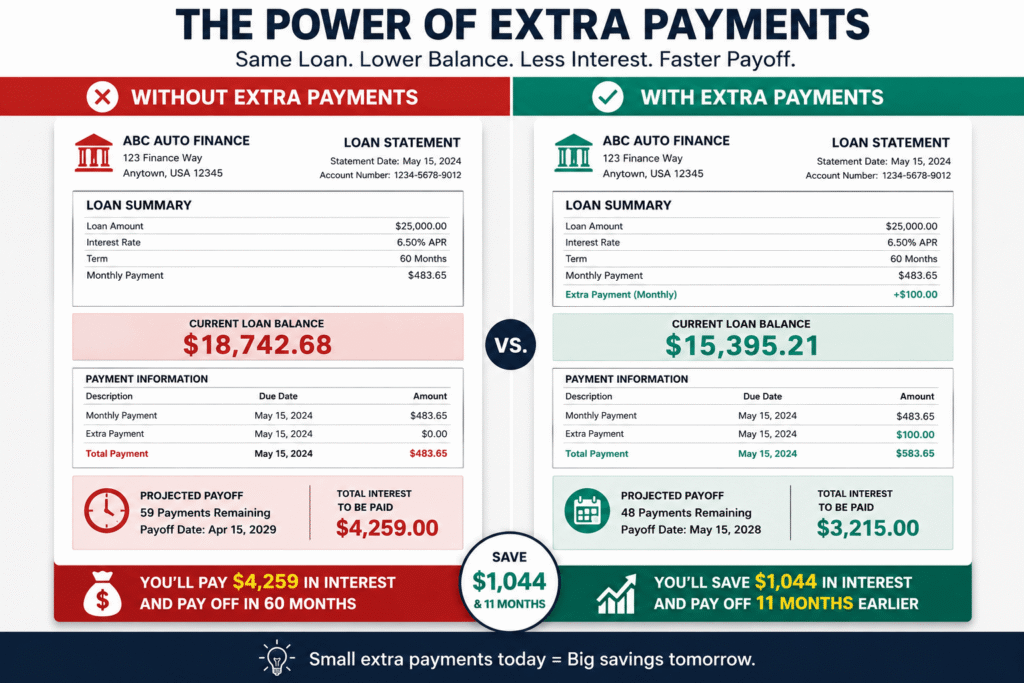
Loan parameters: $25,000 principal, 6.5% APR, 60-month term, monthly payment $487.66
Comparison Table 1 — Auto Loan Extra Payment Impact
| Scenario | Extra/Month | Total Paid | Total Interest | Interest Saved | Months Saved |
|---|---|---|---|---|---|
| No extra payments | $0 | $29,259.60 | $4,259.60 | — | — |
| +$50/month | $50 | $28,722.00 | $3,722.00 | $537.60 | 4 months |
| +$100/month | $100 | $28,215.00 | $3,215.00 | $1,044.60 | 8 months |
| +$250/month | $250 | $27,163.00 | $2,163.00 | $2,096.60 | 15 months |
An extra $100/month on a $25,000 auto loan cuts over $1,000 in interest and gets you out of debt 8 months early. The $250/month scenario saves more than $2,000 and shortens the loan by over a year.
Real Examples: What Extra Payments Do to a $300,000 Mortgage
Mortgages are where extra payments generate their most dramatic results, because the loan term is long and the balance stays high for years.
Loan parameters: $300,000, 7.0% fixed rate, 30-year term, monthly payment $1,995.91
Comparison Table 2 — 30-Year Mortgage Extra Payment Impact
| Scenario | Extra/Month | Total Interest | Interest Saved | Years Saved |
|---|---|---|---|---|
| No extra payments | $0 | $418,527.00 | — | — |
| +$50/month | $50 | $394,120.00 | $24,407.00 | 1.4 years |
| +$100/month | $100 | $372,408.00 | $46,119.00 | 2.8 years |
| +$250/month | $250 | $325,614.00 | $92,913.00 | 5.8 years |
Adding just $50 to a mortgage payment saves over $24,000. An extra $250/month saves nearly $93,000 in interest and almost 6 years of payments.
What About One Extra Payment Per Year?
Making one lump-sum extra mortgage payment annually (equal to one full monthly payment) is a popular strategy:
- Extra payment: $1,995.91/year
- Interest saved: ~$57,400
- Time saved: ~4.7 years
This is roughly equivalent to the biweekly payment strategy, where you make 26 half-payments per year (= 13 full payments instead of 12).
Comparison Table 3 — $30,000 Student Loan Impact
Loan parameters: $30,000, 6.0% rate, 10-year repayment, monthly payment $333.06
| Scenario | Extra/Month | Total Interest | Interest Saved | Months Saved |
|---|---|---|---|---|
| No extra payments | $0 | $9,967.00 | — | — |
| +$50/month | $50 | $8,520.00 | $1,447.00 | 17 months |
| +$100/month | $100 | $7,289.00 | $2,678.00 | 28 months |
| +$250/month | $250 | $5,346.00 | $4,621.00 | 42 months |
Comparison Table 4 — Lump Sum vs. Monthly Extra Payments
Which is better: one large lump sum or consistent monthly additions? Using a $200,000 mortgage at 6.5%, 30-year term:
| Strategy | Amount | Interest Saved | Time Saved |
|---|---|---|---|
| One-time lump sum, Year 1 | $5,000 | $21,300 | 1.8 years |
| One-time lump sum, Year 10 | $5,000 | $8,640 | 0.9 years |
| $50/month for full term | $50/mo | $23,500 | 2.1 years |
| $100/month for full term | $100/mo | $43,600 | 4.0 years |
Consistent monthly extra payments generally outperform a single lump sum made mid-loan. But a lump sum made early (Year 1) rivals ongoing smaller payments.
Comparison Table 5 — Early vs. Late Extra Payments
Same $200,000 mortgage, 6.5%, 30 years. One-time $10,000 extra payment:
| Timing | Interest Saved | Time Saved |
|---|---|---|
| Year 1 | $42,400 | 3.6 years |
| Year 5 | $31,200 | 2.7 years |
| Year 10 | $20,100 | 1.8 years |
| Year 20 | $6,800 | 0.7 years |
This is the single most important insight in this article. The same $10,000 payment saves six times more interest when applied in Year 1 versus Year 20. The earlier you act, the higher the return.
Do Extra Payments Go Toward Principal or Interest?
This is a critical question, and the answer varies by lender and loan type.
By default, most U.S. lenders apply extra payments to the next scheduled payment, which includes both principal and interest. This is less effective than applying directly to principal.
What you should do:
- When submitting an extra payment (online, by check, or by phone), include a note or use the lender’s “apply to principal” option
- Verify the following month’s statement shows the balance dropped by the full extra amount
- If your lender doesn’t offer this, call and ask to speak with their payoff department
Federal student loans (under income-driven repayment) may apply extra payments to future interest charges first, then principal. Always verify.
Auto loans and most personal loans from banks and credit unions typically allow direct principal designation without issue.
When Are Extra Payments Most Effective?
Early in the Loan Term
As shown in the comparison tables, extra payments made early produce the largest savings. This is because you are redirecting money that would have otherwise paid interest on the full original balance — a multiplier effect plays out over many years.
If you can only make extra payments for a limited period (e.g., during a bonus year at work), front-load them. Even 12–24 months of extra payments early can save tens of thousands over the life of a mortgage.
Lump Sum vs. Monthly
Monthly extra payments work well for budgeting consistency. A lump sum (tax refund, bonus, inheritance) applied as a single principal reduction can produce an immediate, visible drop in your amortization schedule.
Neither is inherently superior — what matters is making some extra payment as early as possible.
Common Mistakes When Making Extra Payments
1. Not specifying “apply to principal.” Lenders may credit extra funds as an advance on the next payment, which includes scheduled interest. Always designate.
2. Prepayment penalties. Some personal loans and mortgages include prepayment penalties, especially in the first few years. Check your loan agreement before making large extra payments.
3. Extra payments on high-rate loans last. If you have a 3.5% mortgage and a 19% credit card balance, paying extra on the mortgage first costs you money. Target highest-rate debt first (the avalanche method).
4. Skipping an emergency fund. Throwing everything at loan principal while keeping no cash buffer can force you to borrow again at higher rates if an emergency hits. Keep 3–6 months of expenses liquid.
5. Making extra payments on a loan you plan to refinance. If you’re refinancing in 6 months, your extra payments may not survive the process. Confirm with your new lender how your current principal balance will carry over.
6. Confusing extra payments with skipping a future payment. Some lenders let you “skip” a payment if you’re ahead. This is not the same as being debt-free sooner — skipping a payment can cost you interest.
Should You Make Extra Payments or Invest Instead?
This is a legitimate debate, and the answer depends on your loan interest rate versus expected investment returns.
Rule of thumb:
- If your loan rate is above 6–7%, extra payments likely beat average market returns on a risk-adjusted basis
- If your loan rate is below 4–5%, investing the difference in a diversified portfolio historically outperforms
- Between 5–6%, it’s a genuine toss-up — consider your risk tolerance and psychological value of being debt-free
This calculation changes in high-rate environments. With auto loans now averaging 7–8% and personal loans at 10–12%+, extra payments are often the highest guaranteed return available.
How to Calculate Your Own Extra Payment Savings
The tables above use fixed assumptions. Your situation — your balance, your rate, your remaining term — will produce different numbers.
The fastest way to see exactly how much you’d save is to use the Loan Payoff Calculator. Enter your current loan balance, interest rate, and remaining term, then add any extra monthly payment amount. The calculator shows your new payoff date, total interest under each scenario, and the exact dollar savings.
You can also try:
- The Mortgage Calculator for home loan scenarios
- The Debt Payoff Calculator for prioritizing multiple debts
- The Interest Calculator to understand how interest compounds
- The Savings Calculator to compare what the same money earns when invested
15 Frequently Asked Questions
Do extra loan payments reduce monthly payment amounts?
Typically, no. Most loans keep the monthly payment fixed; extra payments shorten the loan term and reduce total interest instead. Some lenders do allow re-amortization upon request — ask yours if that option is available.
Do extra payments go toward principal or interest first?
If properly designated, extra payments go entirely to principal. If not designated, your lender may apply them to the next scheduled payment (which covers both). Always specify “apply to principal.”
Is there a minimum extra payment that makes a difference?
Even $20–$25 extra per month adds up over a multi-year loan. On a mortgage, $25/month extra over 30 years saves thousands. There is no extra payment too small.
What happens to my amortization schedule when I make extra payments?
The schedule recalculates from the new lower balance. Each subsequent payment carries less interest and more principal, compressing the timeline.
Can I make one large lump-sum extra payment?
Yes. Apply it as a principal payment (verify with your lender). A lump sum early in the loan term has the highest impact — see Comparison Table 5 above.
Do extra payments work the same on all loan types?
The mechanics are the same (lower balance = less interest), but the impact varies. Mortgages benefit most because of their size and long term. Student loans sometimes have rules about how extra payments are applied under income-driven plans.
How does the biweekly payment strategy work?
Instead of 12 monthly payments, you make 26 biweekly half-payments. This equals 13 full payments per year instead of 12 — effectively one extra payment annually — without a noticeable budget change.
Will my lender tell me how extra payments are applied?
Your monthly statement should show the split. If it doesn’t clearly show a principal reduction equal to your extra payment, call your lender.
Does making extra payments hurt my credit score?
No. Paying more than the minimum on installment loans either has no effect or slightly improves your credit score over time by reducing your debt-to-income ratio.
What if my loan has a prepayment penalty?
Check your loan agreement. If a penalty exists, calculate whether the interest savings still exceed the penalty cost. Most consumer loans originated after 2014 are penalty-free under federal regulations, but some private lenders still include them.
Should I tell my lender in advance that I’m making extra payments?
Not usually required, but you should always designate the payment as going to principal. Online payment portals often have a specific field for this.
Do extra payments on a car loan reduce the payoff amount if I sell early?
Yes. Your payoff amount equals the remaining principal balance (plus any fees). Extra payments directly reduce this, so you build equity faster.
Is it better to make extra payments every month or save up for a large annual payment?
Monthly extra payments are slightly better mathematically because they reduce the balance earlier in each month. But an annual lump sum is far better than no extra payments at all.
Can I use the Loan Payoff Calculator to test different scenarios?
Yes. The Loan Payoff Calculator lets you compare scenarios side by side — enter your loan details once and adjust the extra payment field to see real-time changes in interest and payoff date.
Does this strategy work internationally, outside the U.S.?
Yes. The math of amortization is universal. Interest rate terminology and prepayment rules vary by country and lender, but the core principle — extra payments reduce principal and therefore future interest — applies globally.
Conclusion
Extra payments work, and they work well. Whether you’re adding $50 to a car payment or $250 to a mortgage, the interest savings compound in your favor every single month. The key variables are:
- How much extra you pay
- How early in the loan you start
- Whether it’s properly applied to principal
The examples in this article show savings ranging from $537 on a 5-year auto loan to nearly $93,000 on a 30-year mortgage. Your own numbers will depend on your specific loan — and the only way to know exactly what you’d save is to run the calculation.
Use the free Loan Payoff Calculator to enter your loan balance, rate, and extra payment amount. In about 30 seconds, you’ll have your exact interest savings and new payoff date. There’s no signup required.
10 People Also Ask Questions
- Do extra mortgage payments reduce interest?
- What happens if I pay extra on my car loan?
- Do extra payments go to principal or interest?
- How much does one extra mortgage payment per year save?
- Is it better to pay extra on principal or make extra payments?
- Does paying extra on a student loan reduce interest?
- How do I make sure extra payments go to principal?
- Is it worth making extra loan payments?
- How much can I save by paying $100 extra on my mortgage?
- What is the best time to make extra loan payments?