
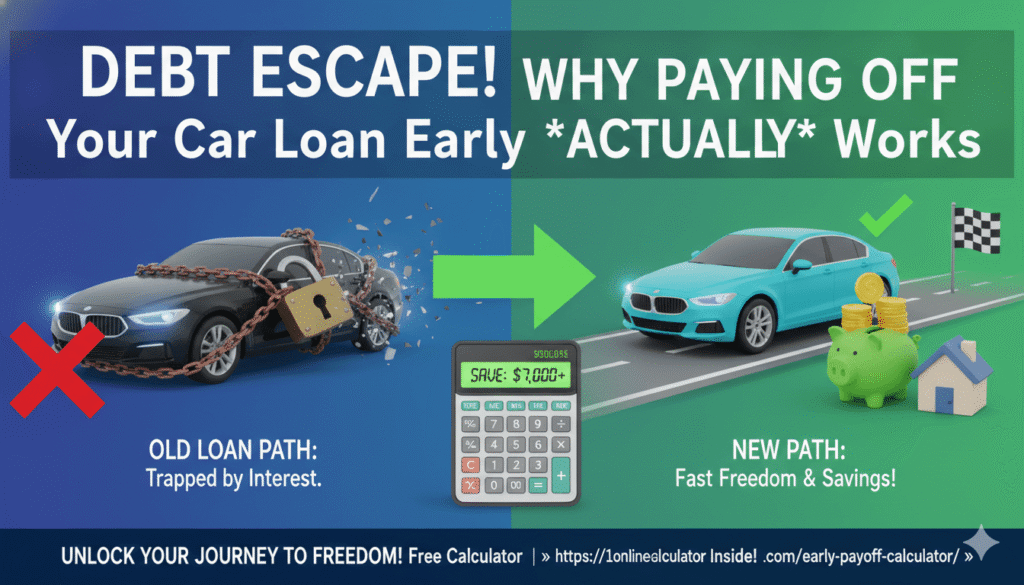
Why Paying Off Your Car Loan Early Actually Works — The Math Behind It
Every auto loan payment splits into two parts: interest (the lender’s fee for lending you money) and principal (the actual debt reduction). In the early months of a loan, the split is skewed heavily toward interest — because interest is calculated on the full outstanding balance.
Here is exactly how a $25,000 loan at 8% APR over 60 months breaks down payment by payment:
| Month | Payment | Interest Portion | Principal Portion | Balance Remaining |
|---|---|---|---|---|
| 1 | $507 | $167 (33%) | $340 | $24,660 |
| 6 | $507 | $158 (31%) | $349 | $23,311 |
| 12 | $507 | $148 (29%) | $359 | $21,811 |
| 24 | $507 | $125 (25%) | $382 | $18,475 |
| 36 | $507 | $99 (20%) | $408 | $14,500 |
| 48 | $507 | $69 (14%) | $438 | $9,800 |
| 60 | $507 | $3 (1%) | $504 | $0 |
This front-loading is why paying extra early in the loan saves dramatically more than paying the same amount later. When you add $200 to month 3’s payment, you eliminate $200 of principal that would have accumulated interest for the remaining 57 months. The same $200 added in month 55 eliminates only 5 months of interest on that $200.
Every extra dollar applied to principal eliminates all future interest that would have accrued on that dollar. At 8% APR, that is a guaranteed, risk-free 8% annual return — no investment account guarantees that. This is why early payoff is mathematically compelling for most borrowers.
Use the Early Payoff Calculator — What It Shows and How to Read It
The early payoff calculator runs two loan schedules simultaneously — standard payments and accelerated payments — then compares them to show your exact savings. Here is how to use each mode:
Exact Savings by Extra Payment Amount — Real Numbers for 2026
The table below shows the exact interest saved and months eliminated for the most common US auto loan scenarios. All calculations assume simple interest amortisation — the loan type used by the vast majority of US banks, credit unions, and manufacturer lenders.
| Remaining Balance | APR | Months Left | Extra/Month | Months Saved | Interest Saved |
|---|---|---|---|---|---|
| $15,000 | 7% | 48 | +$100/mo | 8 months | $608 |
| $15,000 | 7% | 48 | +$200/mo | 15 months | $1,050 |
| $22,000 | 8% | 48 | +$150/mo | 10 months | $1,127 |
| $25,000 | 8% | 48 | +$100/mo | 8 months | $838 |
| $25,000 | 8% | 48 | +$300/mo | 17 months | $2,052 |
| $30,000 | 9% | 60 | +$200/mo | 18 months | $3,060 |
| $35,000 | 9% | 72 | +$150/mo | 14 months | $2,800 |
| $22,000 | 7% | 48 | $3K lump sum mo.1 | 7 months | $764 |
| $25,000 | 8% | 48 | Biweekly payments | 4–5 months | $427 — zero extra $ |
The biweekly row (highlighted) is particularly noteworthy — switching to biweekly payments on the same loan produces savings without any additional money. You simply pay half your monthly payment every two weeks instead of once a month. Because there are 26 two-week periods per year, you make 13 full payments instead of 12 — the equivalent of one extra payment annually, all going to principal.
The 3 Payoff Strategies — Which One Is Right for You
Add a consistent dollar amount to every payment. Even $50–$100 extra creates meaningful savings over a multi-year loan. The compounding principal reduction means each month saves slightly more than the last.
Pay half your monthly amount every two weeks. Results in 13 full payments per year instead of 12. Saves $300–$600 on a typical loan with no additional spending — just restructured timing.
Apply a tax refund, bonus, or savings windfall directly to principal. A $2,000–$5,000 lump sum early in the loan can eliminate $1,500–$4,000 in remaining interest depending on your rate.
Apply a lump sum to kick-start principal reduction, switch to biweekly payments for the free extra annual payment, and add $50–$100/month fixed extra. On a $25,000 loan at 8%: $2,000 lump sum + biweekly + $100/month extra cuts the loan by approximately 14 months and saves over $2,400 in interest — achieved with a manageable combination of strategies rather than one large payment.
The Critical Warning: Simple Interest vs Precomputed Interest
This is the section that most car loan guides skip — and it is the most important thing to verify before making any extra payment.
There are two ways lenders calculate interest on auto loans, and they produce completely different results when you pay extra:
Interest is calculated on your current outstanding balance each month. When you make extra payments and reduce the principal, the interest charge the following month is lower.
Extra payments go directly toward reducing principal, which eliminates future interest charges. The more you pay and the earlier you pay it, the more you save.
Used by: Most major US banks, credit unions, Toyota Financial Services, Honda Financial, Ford Motor Credit, Chase Auto, Capital One Auto. The vast majority of US auto loans.
Total interest for the entire loan term is calculated upfront at signing and divided into fixed monthly amounts. The interest does not change based on your remaining balance.
Extra payments may not save the full expected amount because the lender already knows total interest will be collected. You may receive a partial “unearned interest” rebate, but it is far smaller than simple interest savings.
Used by: Some Buy Here Pay Here dealers, some subprime lenders, certain older credit union loans. Less common than simple interest but not rare in the subprime market.
Check your original loan agreement for the words “precomputed interest,” “add-on interest,” or “Rule of 78s.” If none of these appear, you almost certainly have a simple interest loan. If in doubt, call your lender and ask: “Is my auto loan a simple interest loan or a precomputed interest loan?” They are required to tell you. This takes two minutes and can save you from a significant miscalculation.
The CFPB (Consumer Financial Protection Bureau) notes that simple interest is the far more common structure for US auto loans — but precomputed interest is still used by some lenders, particularly in the subprime and buy-here-pay-here segments. If you financed through a traditional dealership, bank, or credit union, you almost certainly have simple interest.
The “Payment Application” Trap That Wastes Your Extra Payments
This is the second thing most guides fail to explain: making an extra payment is not enough. You must also specify how that payment is applied.
When you pay more than your scheduled monthly payment, many lenders — particularly larger auto finance companies — will automatically advance your next payment due date rather than applying the excess to principal. In practical terms: if your payment is $500 and you pay $700, the lender books $500 as your current month’s payment and holds the $200 as a credit toward next month’s payment due date. Your principal balance does not decrease by $200 — it decreases only by whatever your standard payment’s principal portion would have been.
“Please apply any amount above my scheduled payment directly to the principal balance of my loan, effective today’s date.”
Put this in writing — via email or secure message — and request written confirmation that your instruction has been noted on the account. For large lump sum payments, call first to confirm the process and then follow up in writing.
This single instruction is the difference between a $200 overpayment saving $200 × (remaining months × monthly rate) in interest — versus saving almost nothing because it was applied as a future payment credit rather than a principal reduction.
| Lender Type | Default Application Method | What You Must Do |
|---|---|---|
| Major banks (Chase, BoA, Wells) | Often advance due date by default | Specify “apply to principal” in writing every time |
| Credit unions | Usually apply to principal | Confirm with your specific CU first |
| Toyota/Honda/Ford Financial | Varies — check your servicer portal | Look for “principal payment” option in portal |
| Online lenders (Capital One, etc.) | Usually have separate “principal only” option | Use the dedicated principal payment field |
| Buy Here Pay Here dealers | Most variable — verify individually | Get written confirmation every payment |
Does Paying Off a Car Loan Early Hurt Your Credit Score?
The credit factors affected:
- Payment history (35% of FICO): Unaffected — every on-time payment you made is permanently in your history.
- Credit utilisation (30%): Unaffected — utilisation only applies to revolving credit (credit cards), not instalment loans.
- Length of credit history (15%): Slightly affected if this was a long-standing account — closing it reduces average account age marginally.
- Credit mix (10%): Slightly affected if this was your only instalment loan — you temporarily lose the instalment-account diversity component.
- New credit (10%): Completely unaffected.
If you are planning to apply for a mortgage, business loan, or another major credit application within the next 60–90 days, consider completing the car loan payoff after that application is approved. The temporary score dip is most relevant in the 60–90 days immediately following payoff. After that window, the financial benefit of eliminating interest far outweighs the minor credit impact.
Should You Pay Off Your Car Loan Early or Invest the Money?
This is the most common question in personal finance communities about car loan payoff — and it has a specific, data-based answer that depends on your interest rate.
Decision guide: what to do at each rate level (2026)
One rule applies at every rate level: always maintain an emergency fund of 3–6 months of essential expenses in a liquid account before making extra loan payments. Extra car loan payments are not liquid — you cannot get that money back if you face an unexpected expense. The emergency fund prevents the cycle of paying down the car loan, then going back into higher-rate credit card debt to cover emergencies.
The Real Savings Numbers — What Getting Debt-Free Means for Your Wealth
The interest savings from early payoff are only half the financial story. The other half is what happens with the money after the loan is paid off. When you eliminate a car payment 10 months early, you have 10 months of payments you no longer need to make. Redirected to investing, those payments compound.
The interest savings ($838) matter. The freed cash flow redirected to investing ($42,600–$88,200 over 5–10 years) is orders of magnitude larger. The real financial case for early loan payoff is not just the interest saved — it is the investment trajectory that becomes possible when the monthly obligation ends earlier.
Related Tools and Guides
Paying off your car loan early is one part of a broader auto finance strategy. These related calculators and guides on this site cover the adjacent decisions:
- Early Payoff Calculator — run your specific extra payment scenarios in real time
- Auto Loan Calculator — see the full amortisation schedule for any car loan
- Auto Refinance Calculator — if your current rate is above 8%, check whether refinancing saves more than extra payments
- How to Pay Off a Car Loan in 2 Years — detailed strategy for aggressive payoff
- How Much Does It Cost to Pay Off a Car Loan Early? — prepayment penalties explained with real numbers
Pay Off Car Loan Early — Every Question Answered
The questions people search most — answered with real numbers and 2026 data.
The key variables are the interest rate (higher = more savings from early payoff), the remaining balance (larger = more savings), and how early in the loan you make extra payments (earlier = exponentially more savings due to the amortisation front-loading effect). Use the early payoff calculator to get exact figures for your specific loan.
Even if a prepayment penalty exists, it is usually worth paying if the remaining interest savings exceed the penalty amount. A 2% penalty on $15,000 = $300. If paying off early saves $1,800 in remaining interest, the net benefit is $1,500. The full breakdown of early payoff costs covers this in detail.
Always specify “apply excess payment to principal only” in writing when making any extra payment. Use your lender’s online portal principal payment field, write it in the memo line of any check, or send a secure message to your lender. Request written confirmation that the instruction was applied.
If you are planning to apply for a mortgage or major loan within 60–90 days, consider timing the payoff after that application. Otherwise, the financial benefit of eliminating interest payments is almost always worth the minor temporary score dip.
On a $22,000 loan at 7% APR over 60 months: standard monthly = $435/month × 12 = $5,220/year. Biweekly = $217.50 × 26 = $5,655/year. The $435 difference = one extra payment per year, all principal. This cuts approximately 4–5 months off the loan and saves $430 in interest with no extra spending.
Critical check: confirm your lender applies biweekly payments on the day received, not held until the monthly due date. If they hold payments, biweekly scheduling provides no interest benefit.
The CFPB notes that simple interest is far more common for US auto loans. You are most likely to encounter precomputed interest with Buy Here Pay Here dealers and some subprime lenders. To check yours: look for “precomputed,” “add-on interest,” or “Rule of 78s” in your loan contract. If absent, you almost certainly have simple interest. Confirm by calling your lender and asking directly.
One rule applies regardless of rate: capture any employer 401k match before directing money to early loan payoff. A 100% match is an instant 100% guaranteed return — it mathematically beats even a 25% APR loan payoff.
Also maintain a 3–6 month emergency fund before making large extra loan payments. The loan balance reduction is not liquid — if you need the money for an emergency, you cannot get it back without borrowing at potentially higher rates.
For early payoff calculator purposes, use the balance shown on your most recent statement — it is accurate enough for planning purposes. For an actual payoff, always request a formal “10-day payoff quote” which gives you the exact amount valid for a specific date window, including all fees.
On a $25,000 balance at 8% APR with 48 months remaining, the impact of different extra payment levels: $50/month saves $445 and cuts 4 months. $100/month saves $838 and cuts 8 months. $200/month saves $1,475 and cuts 15 months. The jump from $50 to $100 extra effectively doubles the savings. Consistency matters more than amount — a reliable $75/month beats an occasional $300 followed by months of nothing.
Before paying in full: confirm there is no prepayment penalty (check your loan agreement). If a penalty exists, it is stated as either a flat fee or a percentage of the remaining balance. For most simple interest loans from major lenders, there is no penalty. Pay the quoted amount, confirm receipt with your lender, and follow up on the title 30 days later if not received.
Great content! Keep up the good work!
Все подробности: взять займ быстро