
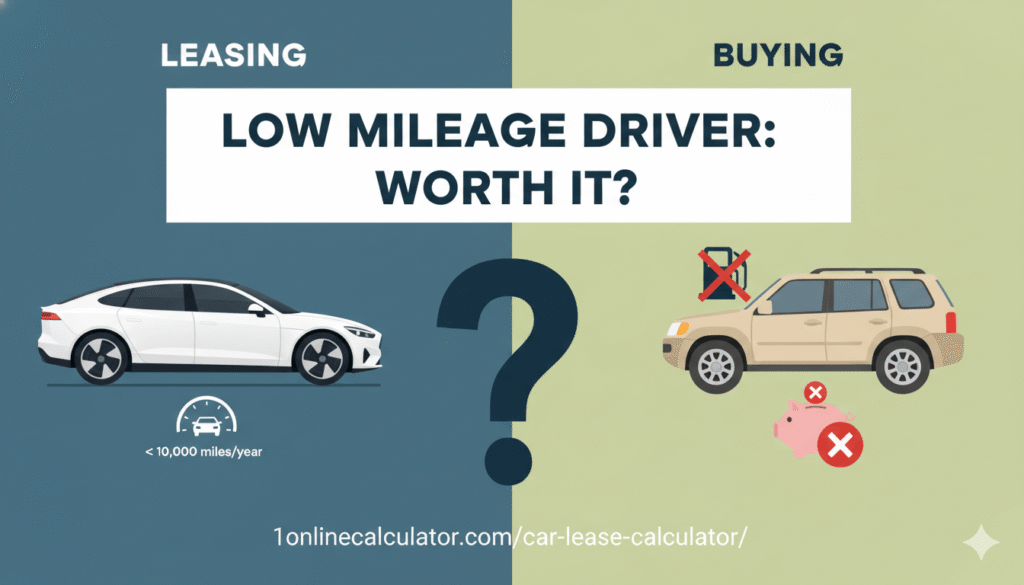
Is Leasing a Car Worth It for Low Mileage Drivers?
Low mileage drivers are frequently told leasing is ideal for them. Avoiding overage penalties is real. But avoiding a penalty is not the same as getting the best financial deal. Here is the net cost analysis.
The Standard Case for Leasing Low Mileage
Lease contracts cap mileage at 10,000-12,000 miles/year with $0.15-$0.25/mile overages. Low mileage drivers never pay overages. Additionally, a low-mileage vehicle has higher residual value at return.
Net Cost Comparison: Low Mileage Driver
Scenario: $38,000 SUV, 36 months, 7,000 miles/year.
Lease: $449/month + $3,500 down = $19,664 total. Equity at end: $0. Net cost: $19,664.
Finance (7%): $805/month + $3,500 down = $32,480 total. Vehicle worth ~$26,000 (low miles = high value). Net cost: $32,480 – $26,000 = $6,480.
Financing wins by $13,184 despite $356/month higher payment.
Key insight: your low mileage preserves the vehicle’s value. You only benefit from that value if you OWN the car. In a lease, the high residual primarily benefits the manufacturer’s financial arm.
When Leasing DOES Make Sense
1. You change vehicles every 2-3 years regardless — leasing simplifies the process and transaction costs erode financing advantage.
2. Business use for tax deductions — lease payments can be deducted more straightforwardly.
3. Vehicle with very high residual (65%+) AND low money factor — manufacturer-subsidised leases can beat financing.
Q: Does low mileage reduce lease payment?
Not if you stay within the standard cap. Driving 7,000 miles on a 12,000-mile lease saves you from overage fees but does not reduce your payment — the depreciation component is fixed to the contracted cap. You are paying for mileage you do not use.
Q: How to calculate real lease vs buy cost?
Net cost = total paid minus vehicle equity at end of term. Monthly payment comparisons alone are misleading. The free lease vs buy calculator computes net cost for both options correctly.
How to Find the Current Money Factor for Your Target Vehicle
The money factor is the single most important number in any lease negotiation — and manufacturers do not publish it in marketing materials. There are two ways to find the current manufacturer base money factor before visiting any dealership.
Method 1: Lease forum communities. Sites like Leasehackr, Edmunds Forums, and dedicated lease deal communities maintain crowdsourced monthly spreadsheets of manufacturer money factors and residual values, updated when new programme periods begin (typically the 1st of each month). Search “[vehicle model] money factor [month] [year]” and cross-reference at least two sources.
Method 2: Ask the dealer directly for the “buy rate” money factor on the specific vehicle. Phrase it as: “What is the base money factor from [manufacturer financial arm] on this vehicle this month?” A transparent dealer will provide it. A dealer who deflects this question is almost certainly planning to mark up the money factor.
Once you have the manufacturer base money factor, use the car lease calculator to compute the correct monthly payment at that factor. If the dealer’s quoted payment is higher than your calculated figure, the difference indicates a money factor markup — a direct cost to you that you can negotiate.
Negotiating the Capitalized Cost on a Lease
Unlike the money factor and residual value, the capitalized cost (the agreed vehicle selling price) is fully negotiable on a lease — exactly as it would be on a purchase. Many lessees accept MSRP as the cap cost without negotiating, leaving significant savings on the table.
Every $1,000 reduction in cap cost reduces your total lease cost by approximately $1,000 ÷ 36 = $27.78 per month (on a 36-month lease), multiplied by the number of months in the lease. A $2,000 cap cost reduction saves $55.56/month and $2,000 over the lease term. The same negotiation techniques that work for vehicle purchases — competing dealer quotes, month-end timing, model-year-end incentives — work identically for reducing the cap cost on a lease.
The Lease Buyout Option for Low Mileage Drivers
At lease end, most agreements give you the right to purchase the vehicle for the residual value stated in the original contract. For low mileage drivers, this option can be particularly valuable. A vehicle that was driven 7,000 miles/year over 3 years (21,000 total) versus the standard 12,000 miles/year (36,000 total) is typically worth $2,000-$5,000 more at the end of the lease than the contractual residual value assumed at signing.
This equity gap — the difference between actual market value and contracted residual — represents value you can capture by exercising the purchase option. Finance the residual for a few years, drive the already-depreciated vehicle, and sell it when ready. This strategy effectively converts the lease into an equity-building position retrospectively.
Verify any dealer lease quote using the money factor method: 1onlinecalculator.com/car-lease-calculator/
Disclaimer: All calculations are estimates for educational purposes. Actual rates and terms vary by lender, credit profile, and state. Use the free calculator linked above for your specific numbers.