
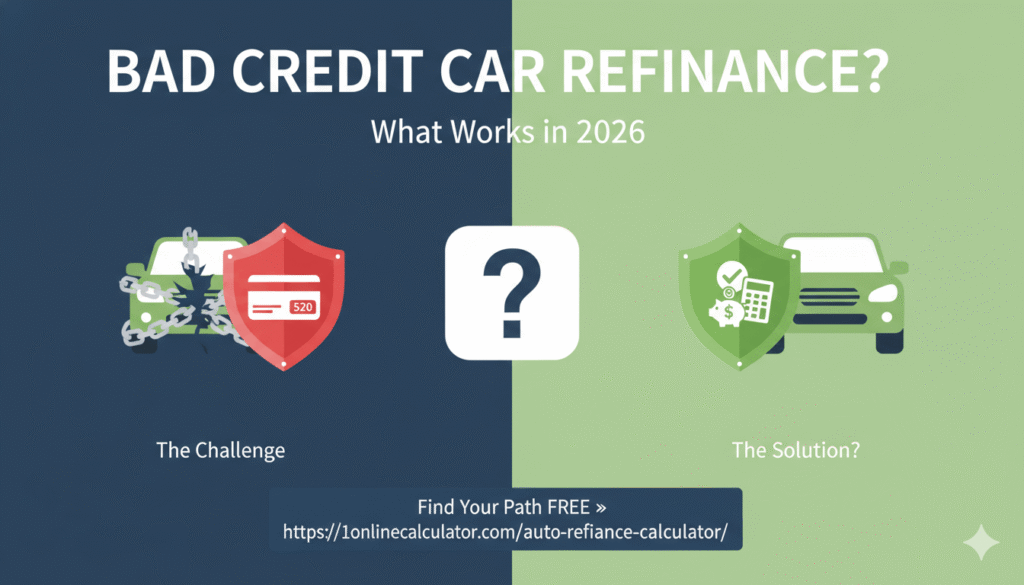
Can You Refinance a Car Loan With Bad Credit?
Yes — you can refinance with bad credit. Whether it saves you money depends on how your score compares to when you first took the loan, which lenders you approach, and your current balance and rate.
What “Bad Credit” Means for Auto Refinancing
580-619: subprime. 500-579: deep subprime. Below 500: very limited options. Most mainstream refinance lenders require 550-580 minimum. Capital One Auto Finance accepts as low as 500. RefiJet (marketplace) works with 525+.
Below 550: options are limited to specialised subprime lenders charging 18-24%+ APR — potentially higher than your original loan, making refinancing counterproductive.
When Refinancing With Bad Credit Still Helps
Scenario 1: Your credit improved since origination. 540 → 620 after 18 months of on-time payments. 16% → 12% APR on $15,000 remaining over 48 months saves ~$1,400 in interest.
Scenario 2: You accepted dealer financing without comparison. Dealers mark up rates by 2-4%. Even with a bad score, a credit union may beat the dealer’s marked-up rate.
Scenario 3: Current loan is very high (24%+). Any lender offering 18% represents real savings.
Lenders to Try With Bad Credit
Credit unions: most require 550-580 minimum, offer rates below banks at same credit tier. Join before applying — membership takes minutes.
Capital One Auto Finance: accepts 500+ credit scores.
RefiJet, RateGenius: marketplaces that submit to multiple lenders simultaneously, accept 525+.
Avoid: “guaranteed approval” online lenders — typically 22-30%+ APR regardless of score.
Q: How much can I save refinancing with bad credit?
On $15,000 remaining: 16% → 12% APR over 48 months saves ~$1,400 and reduces payment by ~$29/month. Smaller than prime-credit savings, but real.
Q: Does refinancing hurt credit score?
Small temporary dip (5-10 points) from the hard inquiry. Applies to multiple lenders within a 14-day window as a single pull. Recovers within 2-4 months. Rate saving typically outweighs credit impact significantly.
How to Improve Your Credit Score Before Applying for Refinancing
If your credit score is currently too low for the refinancing rate you want, a targeted 3-6 month improvement programme can meaningfully change your options. Credit scores are primarily driven by five factors, two of which you can move quickly.
Payment history (35% of score): every on-time payment is a positive data point. Set up autopay for the minimum on every account to ensure no missed payments. If you have missed payments in the last 12 months, their negative impact fades significantly after 12-24 months of clean history.
Credit utilisation (30% of score): this is the fastest lever available. Pay your credit card balances below 10% of your credit limit — ideally below $500 on a $5,000 limit — before applying for refinancing. Utilisation is reported monthly, so a paydown today can improve your score within 30-45 days.
A 60-point score improvement (from 560 to 620, for example) can move you from the deep subprime tier (16%+ APR) to the near-prime tier (9-12% APR) on an auto refinance. On a $15,000 remaining balance over 48 months, this rate improvement saves approximately $2,800 in total interest — significantly worth the 3-6 month wait to build the score.
The Refinancing Application Process — Step by Step
Step 1: Check your current rate and remaining balance on your most recent loan statement. Note the payoff amount (which may differ slightly from the balance due to accrued interest).
Step 2: Check your credit score for free via your bank, Credit Karma, or AnnualCreditReport.com. This soft pull does not affect your score.
Step 3: Apply to 2-3 lenders within a 14-day window. Multiple hard inquiries within this window count as a single pull under most scoring models. Apply to a credit union first — they consistently offer the lowest rates within any credit tier.
Step 4: Compare APR (not just interest rate) across all offers. The APR includes any origination or administrative fees, making it the accurate comparison figure.
Step 5: Accept the best offer and confirm the new lender will pay off the existing loan directly. Continue making payments on the original loan until you receive written confirmation that it has been paid off.
When the Math Does Not Work — Alternatives to Refinancing
If your credit score is too low for a meaningful rate improvement or your remaining term is too short for refinancing fees to break even, two alternatives can still reduce your total car loan cost without refinancing: extra principal payments (which reduce interest even on a high-rate loan) and bi-weekly payment switching (which produces one extra annual payment and eliminates 1-2 months from the term).
Both strategies work on any loan regardless of credit score and require no lender application, no fees, and no credit check.
See your exact savings at any new rate: 1onlinecalculator.com/auto-refinance-calculator/
Disclaimer: All calculations are estimates for educational purposes. Actual rates and terms vary by lender, credit profile, and state. Use the free calculator linked above for your specific numbers.