
How to Pay Off Car Loan Early: 6 Strategies That Save Thousands
The average auto loan term in the United States has reached 68 months — nearly 6 years. On a $30,000 loan at 7% APR, that means paying $7,800 in total interest before the vehicle is fully paid off. And because auto loans use simple interest amortization, paying off the loan even a few months early eliminates the highest-interest payments at the end of the loan and guarantees a risk-free return equal to your APR.
This guide covers six practical strategies to pay off your car loan early, shows you the exact interest savings each strategy produces, and explains how to use a free early payoff calculator to find the optimal approach for your specific loan.
Why Paying Off Your Car Loan Early Is Almost Always Worth It
Auto loans in the United States use simple interest — meaning each month’s interest charge is calculated on the current outstanding balance. Unlike some mortgages, most US auto loans have no prepayment penalty. Any extra payment you make goes entirely toward reducing your principal balance, which immediately reduces every future interest charge for the remainder of the loan.
This structure means early payoff on an auto loan is a guaranteed, risk-free investment return equal to your loan’s APR. If your loan is at 8% APR, every extra dollar you pay down earns you an effective 8% return — better than most savings accounts and with zero risk.
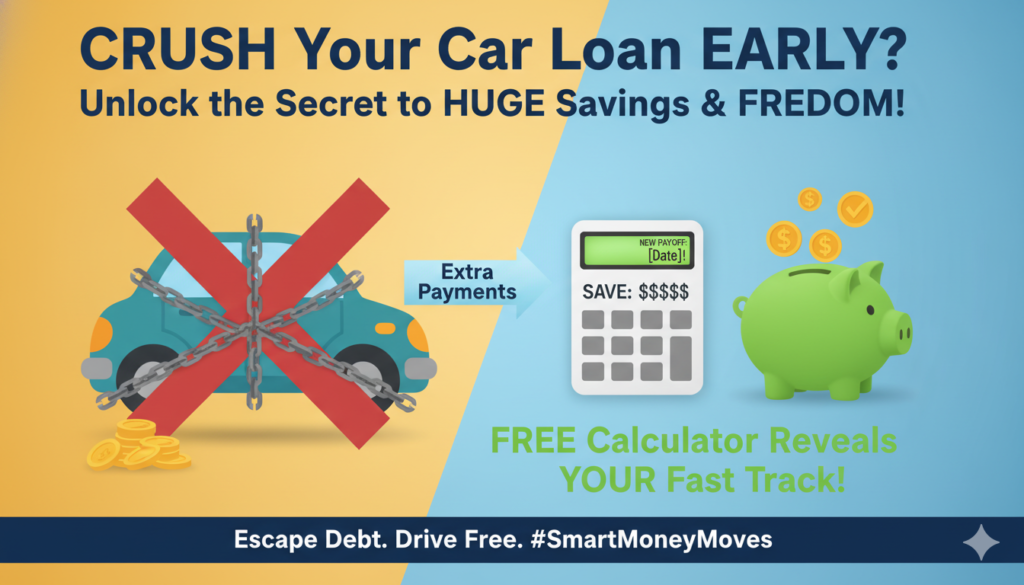
Calculate your exact savings with the free early payoff calculator — enter your current balance, rate, months remaining, and extra payment amount to see your interest savings, new payoff date, and full amortization comparison.
6 Strategies to Pay Off Your Car Loan Early
Strategy 1 — Round Up Your Monthly Payment
The simplest early payoff strategy requires almost no conscious effort: round your monthly payment up to the next $50 or $100 increment. If your payment is $487, pay $500 or $550 instead. On a $22,000 loan at 7% APR with 48 months remaining, adding $50/month saves approximately $400 in interest and cuts 3 months off the loan. Adding $100/month saves $750 in interest and cuts 5 months.
Strategy 2 — Make Bi-Weekly Payments
Instead of making one monthly payment, pay half your monthly amount every two weeks. Because there are 52 weeks in a year, this produces 26 half-payments — equivalent to 13 full monthly payments instead of 12. That one extra annual payment reduces a 60-month loan to approximately 55 months and saves meaningful interest, with zero change to your month-to-month budget.
Note: Contact your lender before switching to bi-weekly payments to ensure they process payments correctly. Some lenders hold bi-weekly payments until the full month’s amount is received, which defeats the purpose.
Strategy 3 — Apply Your Tax Refund
The average US federal tax refund is approximately $3,000. Applying even half of this as a lump sum to your car loan principal can cut 6–10 months off a typical auto loan and save $600–$1,500 in interest depending on your rate and remaining balance.
The key is to commit to this decision before the refund arrives — if the money enters your checking account without a plan, it tends to disappear into daily spending within 90 days.
Strategy 4 — Put Work Bonuses and Side Income Toward the Loan
Any unplanned income — work bonuses, freelance income, overtime pay, or side gig earnings — is ideal for lump sum loan paydown. Because this money was not factored into your regular budget, applying it to the loan requires no lifestyle adjustment. Call your lender and ask specifically that the payment be applied to principal only — some lenders default to applying extra payments toward future months rather than immediate principal reduction.
Strategy 5 — Refinance to a Shorter Term
If your credit has improved since your original loan, refinancing to a shorter term — say from 60 months to 48 months — forces faster payoff at potentially a lower interest rate. The monthly payment increases, but total interest paid drops significantly. Use the refinance calculator alongside the early payoff calculator to compare both approaches.
Strategy 6 — Make One Extra Payment Per Year
If other strategies feel too aggressive, committing to one extra full payment per year is a low-commitment approach that still produces meaningful results. On a $22,000, 7% APR, 60-month loan, one extra payment per year reduces the term by approximately 5 months and saves roughly $800 in interest.
Real Example: How Much You Save on a $22,000 Car Loan
Loan: $22,000 at 7% APR with 48 months remaining. Standard monthly payment: $527.
- No extra payments: Paid off in 48 months, $3,310 total interest
- $50 extra/month: Paid off in 44 months, $2,890 total interest — saves $420 and 4 months
- $100 extra/month: Paid off in 41 months, $2,530 total interest — saves $780 and 7 months
- $200 extra/month: Paid off in 36 months, $1,970 total interest — saves $1,340 and 12 months
- $3,000 lump sum in month 1: Paid off in 40 months, $2,440 total interest — saves $870 and 8 months
Does Paying Off a Car Loan Early Hurt Your Credit?
Paying off a car loan early can cause a small, temporary dip in your credit score — typically 5–15 points — because it closes an installment loan account. This effect is minor and typically recovers within 6 months. The financial benefit of eliminating interest payments vastly outweighs this temporary credit impact for the vast majority of borrowers.
Frequently Asked Questions
Is there a penalty for paying off a car loan early?
Most US auto loans have no prepayment penalty. However, a small percentage of loan agreements include early termination clauses. Check your loan agreement or call your lender before making a large extra payment. If a prepayment penalty exists, calculate whether the interest savings outweigh the penalty cost using the early payoff calculator.
Should I pay off my car loan or invest the extra money?
If your car loan rate is above 6–7% APR, paying it down provides a guaranteed return equal to that rate. If your loan rate is below 5%, investing the extra money in diversified index funds may produce higher expected returns over the long term. The right answer depends on your risk tolerance, tax situation, and how much you value guaranteed versus probabilistic returns.
What happens if I double my car payment?
Doubling your monthly car payment dramatically accelerates payoff. On a $22,000, 7% APR loan with $527/month, paying $1,054/month instead reduces the payoff from 48 months to approximately 22 months and cuts total interest from $3,310 to approximately $1,500 — saving $1,800. Use the early payoff calculator to see the exact impact for your specific loan.
See all six auto finance calculators in one place at the Auto Finance Tools hub — loan calculator, lease calculator, refinance calculator, affordability calculator, lease vs buy, and early payoff.
Disclaimer: All calculator results and financial figures are estimates for educational purposes only. Tax rules mentioned reflect information current as of May 2026 and are subject to change. Consult a qualified tax advisor or financial professional before making significant financial decisions.