
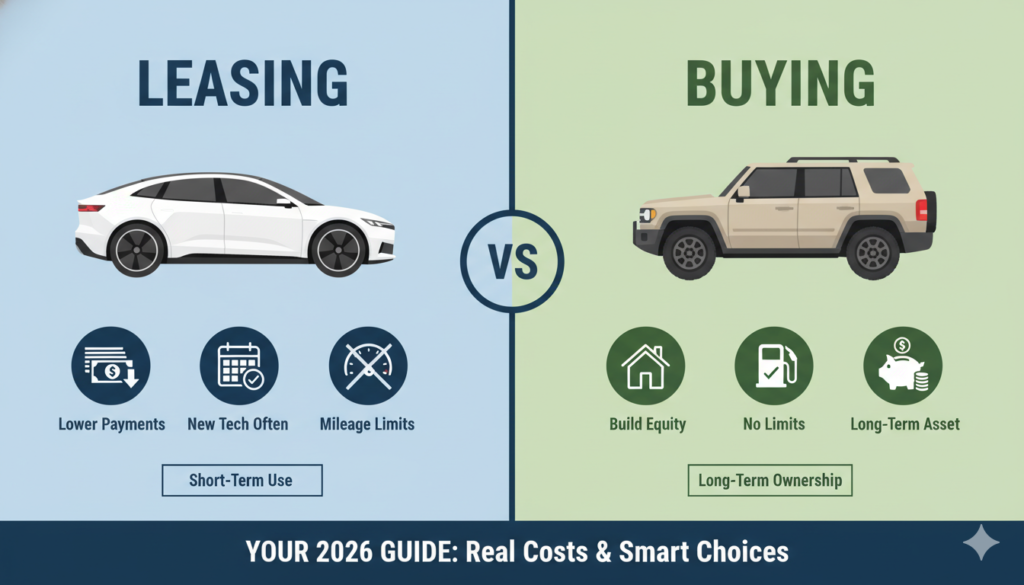
Is Leasing a Car Worth It in 2026? Pros, Cons & Real Cost Breakdown
With nearly 20% of new car loan payments now exceeding $1,000 per month, leasing has surged in appeal as an alternative to financing. The lower monthly payment of a lease is genuinely attractive when vehicle prices remain at record highs and interest rates are elevated. But is leasing actually worth it financially — or is it one of those deals that looks better than it is?
The honest answer is: it depends on the vehicle, the lease terms, and how you plan to use the car. This guide gives you the complete picture — how car leasing actually works, when it genuinely saves money, when it costs more, and exactly how to evaluate any lease deal using a free lease calculator.
How Car Leasing Actually Works
When you lease a vehicle, you are not buying it — you are paying for the depreciation the car experiences during your lease term, plus a finance charge. At the end of the lease, you return the vehicle to the manufacturer or leasing company with no further obligation (assuming you stayed within the mileage limit and maintained the vehicle).
A lease payment has two components: the depreciation charge (how much value the car loses during the lease period) and the finance charge (interest on the leasing company’s capital, calculated using a money factor). These two amounts, plus applicable sales tax, equal your monthly payment.
The key variables that determine your monthly lease payment are: the negotiated cap cost (selling price), the residual value (what the car is worth at lease end, set by the manufacturer), the money factor (the lease interest rate), the acquisition fee, and the lease term.
The free car lease calculator uses the exact money factor method that manufacturers and dealers use. Enter your cap cost, residual percentage, money factor, and term to verify any dealer quote to the penny.
When Leasing Is Worth It
High-Residual Vehicles
The residual value is the biggest determinant of whether a lease deal is good or bad. Vehicles with high residual values (typically 55–65% of MSRP for 36-month leases) depreciate slowly during the lease term, meaning you finance a smaller portion of the car’s value. Honda Accord, Toyota RAV4, Honda CR-V, and most German luxury vehicles consistently command strong residuals from manufacturers.
Low Money Factor Months
Manufacturers use artificially low money factors as promotional tools — particularly on model-year-end vehicles and new model introductions. A promotional money factor of 0.00050 (equivalent to about 1.2% APR) on a normally financed vehicle is a genuinely excellent deal. Current money factors are published monthly on manufacturer financial services websites.
Drivers Who Value Always Having a New Vehicle
If you genuinely want a new vehicle every 2–3 years with the latest safety technology, warranty coverage on everything, and no trade-in hassle, leasing delivers all three with lower monthly payments than financing. The convenience premium has real value for many drivers.
Business Use
Business owners and self-employed individuals can deduct the business-use portion of lease payments as an operating expense. This can make leasing significantly more tax-efficient than purchasing — a factor worth discussing with a tax advisor.
When Leasing Is Not Worth It
High-Mileage Drivers
Standard lease contracts cap annual mileage at 10,000–15,000 miles. Overage fees of $0.15–$0.25 per mile can add thousands of dollars at lease return. A driver who typically puts 20,000 miles per year on a vehicle with a 12,000-mile cap incurs $1,200–$2,000 in overage fees annually — significantly reducing the apparent payment advantage of leasing.
Buyers Who Keep Vehicles Long-Term
The most economically efficient car ownership strategy is buying a reliable vehicle, paying it off, and driving it for 8–10 years. Once the loan is paid off, your transportation cost drops to insurance and maintenance only — often $200–$400 per month. A lessee always has a payment. Long-term ownership always beats leasing on total cost over any 10-year period.
Buyers Who Want to Modify the Vehicle
Leases prohibit modifications. Any alteration — aftermarket audio, window tinting, suspension changes — can trigger charges at lease return. If you want to customize your vehicle, financing is the only viable option.
Real Lease vs Finance Comparison: $40,000 SUV, 36 Months
Lease: $3,000 down, $550/month, 36 months, 12,000 miles/year. Total paid: $3,000 + ($550 × 36) = $22,800. Vehicle equity: $0. Net cost: $22,800.
Finance: $3,000 down, $730/month, 36 months at 7% APR. Total paid: $3,000 + ($730 × 36) = $29,280. Vehicle worth approximately $26,000 after 36 months. Net cost: $29,280 − $26,000 = $3,280.
Buying cost less by $19,520 on a net basis — despite the $180/month higher payment. The lease felt dramatically cheaper every month. The true cost of choosing to lease in this scenario is $19,520 over three years.
Frequently Asked Questions
What is the average car lease payment in 2026?
The average monthly lease payment in the US is approximately $550–$600 for a mid-size sedan or compact SUV. Luxury vehicles typically range from $750–$1,200 per month. These averages depend heavily on the manufacturer residual values and money factors in effect each month, which vary with economic conditions.
How do I know if a lease deal is good?
Ask the dealer for the cap cost, residual value, and money factor. Look up the current base money factor on the manufacturer’s financial services website. If the dealer is marking up the money factor above the base rate, negotiate it down. Use the lease calculator to verify that the quoted monthly payment matches what the math produces. Any unexplained difference is a hidden charge.
Can I buy the car at the end of my lease?
Yes. Most leases include a purchase option at the residual value stated in the contract. If the market value of the vehicle at lease end exceeds the residual — which happens when used car prices are elevated — buying out the lease can be an excellent financial move. Use the auto loan calculator to estimate financing the buyout amount.
Compare the exact net cost of leasing vs buying for your specific vehicle with the free lease vs buy calculator — the only comparison that accounts for equity built and gives you the true answer instead of just comparing monthly payments.
Disclaimer: All calculator results and financial figures are estimates for educational purposes only. Tax rules mentioned reflect information current as of May 2026 and are subject to change. Consult a qualified tax advisor or financial professional before making significant financial decisions.