
How to Save Money Faster: Proven Strategies With a Free Savings Calculator
Nearly 80% of Americans live paycheck to paycheck, according to recent financial surveys. Yet saving money is consistently rated the top financial priority for US households — a contradiction that stems from one problem: most people try to save whatever is left over at the end of the month. That approach almost never works, because there is rarely anything left over.
The most effective approach to saving money faster is deceptively simple: decide how much to save before you spend anything else, automate it, and use a savings calculator to stay accountable to a specific goal and timeline. This guide shows you exactly how to do all three.
Why “Save What Is Left Over” Always Fails
Human spending naturally expands to fill available income. If you earn $4,500 per month and plan to save whatever remains after expenses, your expenses will drift upward to consume most of that $4,500. This is not a lack of discipline — it is a predictable behavioral pattern that affects the vast majority of people regardless of income level.
The fix is to treat savings as a non-negotiable fixed expense — the first line item in your budget, not the last. The moment your paycheck clears, a predetermined amount moves automatically to a separate savings account before you have the opportunity to spend it. This single change consistently produces better savings outcomes than any level of willpower or manual tracking.
How to Use the Savings Goal Calculator
The savings goal calculator answers two questions: How long will it take to reach my goal? And: How much do I need to save each month to hit my goal by a specific date?
For the timeline question: Enter your current savings balance, monthly contribution, and target amount. The calculator instantly shows how many months until you reach your goal.
For the monthly target question: Enter your current balance, target amount, and deadline (number of months). The calculator shows the exact monthly savings amount required.
Open the savings goal calculator now. Enter your savings goal — whether it is a $1,000 emergency fund, a $6,000 vacation fund, or a $30,000 down payment — and your current monthly savings capacity. You will have a specific plan in under 30 seconds.
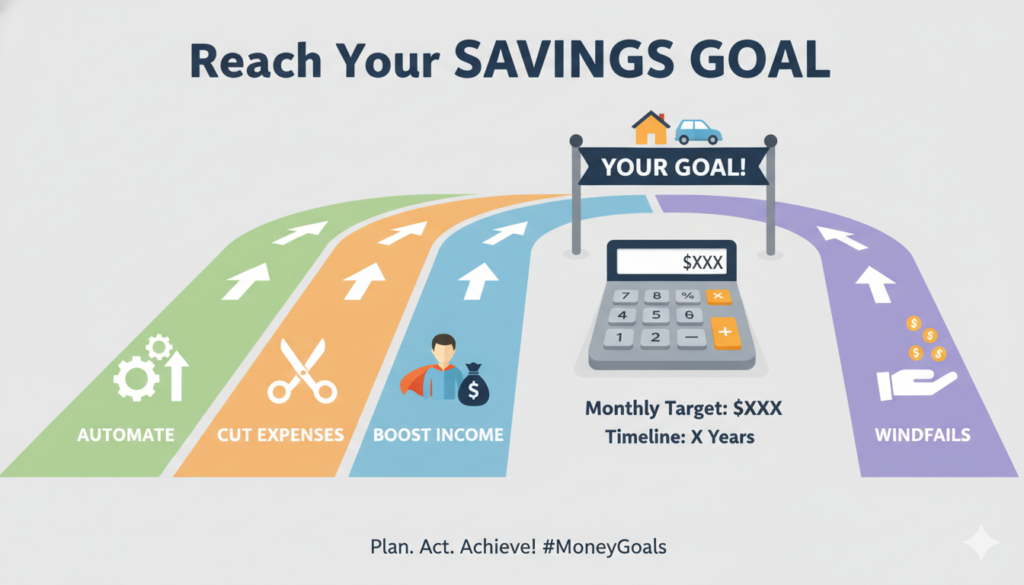
The Five Fastest Ways to Reach Any Savings Goal
1. Automate on Payday
Set up an automatic transfer from your checking account to a dedicated savings account on the same day your paycheck hits — or better, the day after. Savings that are moved before you see them in your spending balance are savings you never miss. Most banks and credit unions offer free automatic transfers with any checking account.
2. Open a High-Yield Savings Account
Traditional bank savings accounts still pay 0.01–0.10% APY at most major banks. High-yield savings accounts at online banks currently pay 4.0–5.0% APY — 40 to 100 times more. On a $10,000 savings balance, the difference is $400–$500 per year in interest earned rather than a few cents. Ally Bank, Marcus by Goldman Sachs, and SoFi consistently offer competitive rates.
3. The $1,000 Emergency Fund First
If you have no savings cushion, start with a single goal: $1,000 in an emergency fund. This prevents one unexpected expense — a car repair, a medical bill, a broken appliance — from forcing you into high-interest debt. At $250/month, you reach $1,000 in four months. Once this buffer exists, financial emergencies stop derailing your broader savings plan.
4. Apply Windfalls Directly to Goals
The average US federal tax refund is approximately $3,000. A work bonus, inheritance, or side income windfall applied entirely to a savings goal can compress a 12-month timeline to 4–6 months. The key is to commit to a rule before the money arrives: any unplanned income goes directly to the savings goal before it enters daily spending.
5. Cut One Recurring Cost, Save the Difference
Identify one subscription or recurring expense you barely use — a streaming service, a gym membership, a magazine. Cancel it. Immediately set up an automatic savings transfer for the same dollar amount. This strategy requires no net reduction in your lifestyle budget because you are only redirecting money you were already spending.
How Long Does It Take to Save Common US Goals?
At $300/month in a 4.5% high-yield savings account:
- $1,000 emergency fund: 3.3 months
- $3,000 starter emergency fund (1 month expenses): 9.8 months
- $6,000 full emergency fund (2 months): 19.2 months
- $10,000 car down payment: 31.5 months
- $20,000 home down payment: 59.1 months
At $500/month:
- $1,000 emergency fund: 2 months
- $6,000 emergency fund: 11.7 months
- $20,000 home down payment: 37.9 months
- $30,000 home down payment: 55.3 months
Use the savings calculator with your actual monthly contribution to see the exact timeline for your specific goal.
Frequently Asked Questions
How much should I have in savings?
Financial advisors recommend a three-to-six-month emergency fund as the baseline — enough to cover all essential expenses if you lost your income. For a household with $4,000 in monthly expenses, that means $12,000–$24,000 in a liquid savings account. Beyond the emergency fund, savings goals depend on individual priorities: home purchase, retirement, education, or major purchases.
Is a savings account better than investing?
Savings accounts are appropriate for money you will need within 1–3 years — emergency funds, down payments, planned purchases. For money you will not need for 5+ years, investing in diversified index funds historically produces far higher returns than savings accounts. The right answer is usually both: build a savings foundation first, then invest for longer-term goals.
How much should I save each month?
The standard recommendation is to save at least 20% of your take-home pay, with 10% going toward an emergency fund and the rest toward longer-term goals. If 20% is not currently achievable, start at 5% and increase by 1–2% every three months. The habit of saving consistently at any percentage is more valuable than an optimal savings rate you cannot maintain.
Not sure of your real take-home pay? Use the salary tax calculator to calculate your exact net pay after federal tax, state tax, and FICA — then run your savings timeline based on real take-home numbers rather than gross salary estimates.
Disclaimer: All calculator results and financial figures are estimates for educational purposes only. Tax rules mentioned reflect information current as of May 2026 and are subject to change. Consult a qualified tax advisor or financial professional before making significant financial decisions.