
How to Calculate ROI: Formula, Examples & Free Investment Calculator
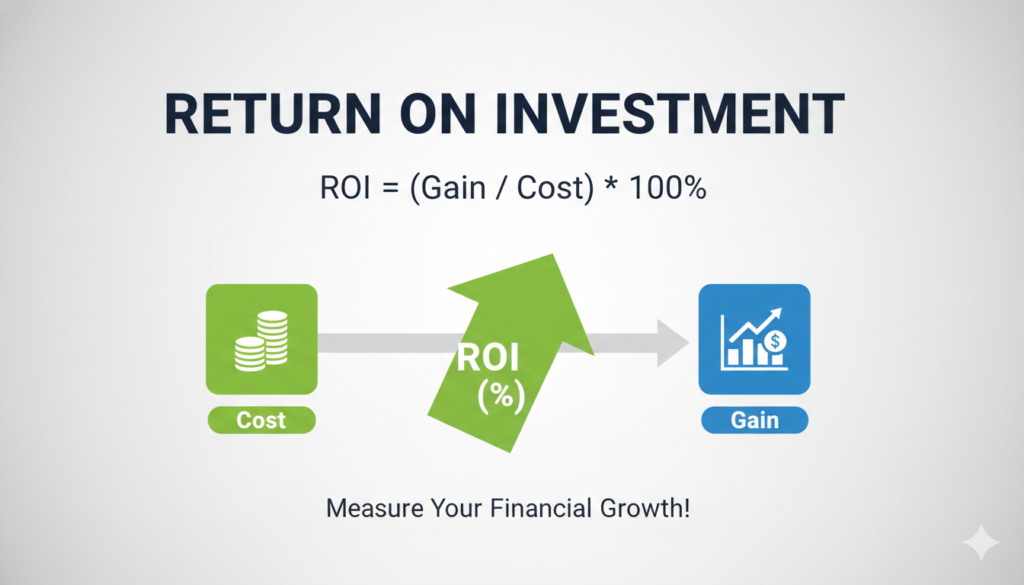
Return on investment — ROI — is the most fundamental measure of whether any investment is performing. It tells you what percentage return you earned on every dollar you put in, expressed in a consistent format that makes otherwise incomparable investments directly comparable. A $5,000 stock gain and a $50,000 real estate gain cannot be compared without ROI. A two-year investment and a ten-year investment cannot be compared without annualized ROI.
This guide covers the simple ROI formula, the more powerful annualized ROI formula, and three fully worked examples — including how to use a free ROI calculator to analyze any investment in seconds.
The Simple ROI Formula
Simple ROI = [(Final Value − Initial Investment) ÷ Initial Investment] × 100
This gives you the total percentage return for any investment, regardless of how long it took. It is the correct formula when comparing investments over the same time period.
Example: You invest $10,000 in a stock. Three years later it is worth $14,500. ROI = [($14,500 − $10,000) ÷ $10,000] × 100 = 45%.
A 45% ROI sounds excellent. But without knowing the time period, you cannot compare it to anything else. That is where annualized ROI comes in.
Annualized ROI: The Only Fair Way to Compare Investments
Annualized ROI = [(1 + Simple ROI/100)^(1/Years) − 1] × 100
This converts any total return into a per-year equivalent, allowing fair comparison between investments with different time horizons.
Using the same example: 45% total ROI over 3 years. Annualized ROI = [(1 + 0.45)^(1/3) − 1] × 100 = 13.2% per year.
Now compare to a second investment: $5,000 that grew to $8,200 over 7 years. Simple ROI = 64%. Annualized ROI = [(1 + 0.64)^(1/7) − 1] × 100 = 7.3% per year.
The second investment had a higher total return (64% vs 45%) but a lower annualized return (7.3% vs 13.2%). On an annual basis, the first investment significantly outperformed.
Use the free ROI investment calculator to calculate both simple and annualized ROI instantly. Enter your initial investment, final value, and time period for an immediate comparison-ready result.
Three Real Investment ROI Examples
Example 1 — S&P 500 Index Fund
$10,000 invested in an S&P 500 index fund in January 2015. Value in January 2025: $34,100. Simple ROI: 241%. Annualized ROI: 13.0% per year. This aligns with the historical average S&P 500 annual return of approximately 10–13% over long periods.
Example 2 — Rental Property
$50,000 down payment on a $250,000 rental property in 2020. Property value in 2025: $310,000. Capital gain: $60,000. Simple ROI on the $50,000 investment: 120%. Annualized ROI: 17.0% per year. Note: This does not include rental income (which would increase ROI) or maintenance, taxes, and insurance costs (which reduce it).
Example 3 — Savings Account vs Paying Off Debt
$5,000 sitting in a high-yield savings account at 4.5% APY for 2 years earns $459. ROI: 9.2%. The same $5,000 used to pay off a credit card at 22% APR saves $2,200 in interest over 2 years. ROI: 44%. Paying off high-interest debt almost always provides a higher guaranteed return than savings. The ROI calculator makes this comparison clear.
Common Mistakes When Calculating ROI
- Forgetting to include all costs — transaction fees, taxes on gains, maintenance costs, and management fees all reduce real ROI. A real estate investment with a 20% gross ROI may deliver a 12% net ROI after all expenses.
- Comparing total returns without annualizing — a 100% return over 10 years sounds impressive but equals only 7.2% annualized — roughly equal to a basic index fund.
- Ignoring reinvested dividends — total return on stocks includes dividends reinvested. An S&P 500 fund that shows 10% annual price appreciation might deliver 12–13% total return when dividends are included.
- Comparing pre-tax and after-tax returns — always compare investments on the same tax basis. A 7% return in a tax-advantaged Roth IRA is worth more than a 7% taxable account return for most investors.
What Is a Good ROI?
ROI benchmarks depend entirely on the asset class and risk level:
- Savings accounts / CDs: 4–5% is currently strong (May 2026)
- US Treasury bonds (10-year): approximately 4.3–4.5%
- S&P 500 index funds: historical average of 10–13% annually over 30-year periods
- Real estate: varies widely by market — 8–15% total return in many US markets over the past decade
- Small business investment: 15–30%+ is typical for successful ventures, but risk is substantially higher
Any investment offering guaranteed returns above 8–10% with minimal risk should be scrutinized carefully — those returns rarely exist without proportionally higher risk.
Frequently Asked Questions
What does a 20% ROI mean?
A 20% ROI means you earned 20 cents for every dollar you invested. On a $10,000 investment, a 20% ROI means you made $2,000 in profit. Whether that is good depends on the time period — 20% over one year is excellent, 20% over ten years (1.8% annually) is poor.
How do you calculate ROI in Excel?
In Excel, use the formula: =((Final_Value – Initial_Investment) / Initial_Investment) * 100. For annualized ROI: =((Final_Value/Initial_Investment)^(1/Years) – 1) * 100. Or use the free ROI calculator on this page for instant results without any formula entry.
Can ROI be negative?
Yes. A negative ROI means the investment lost money. If you invested $10,000 and the final value is $8,500, the ROI is -15%. Negative ROI is a reality for any risky investment and is exactly why diversification — spreading investments across multiple asset classes — is a core principle of sound investment strategy.
See how compound interest grows your investments over time with the compound interest calculator — model any starting amount, monthly contribution, and expected annual return to see your year-by-year investment growth.
Disclaimer: All calculator results and financial figures are estimates for educational purposes only. Tax rules mentioned reflect information current as of May 2026 and are subject to change. Consult a qualified tax advisor or financial professional before making significant financial decisions.