
How to Calculate Take-Home Pay After Taxes in 2026
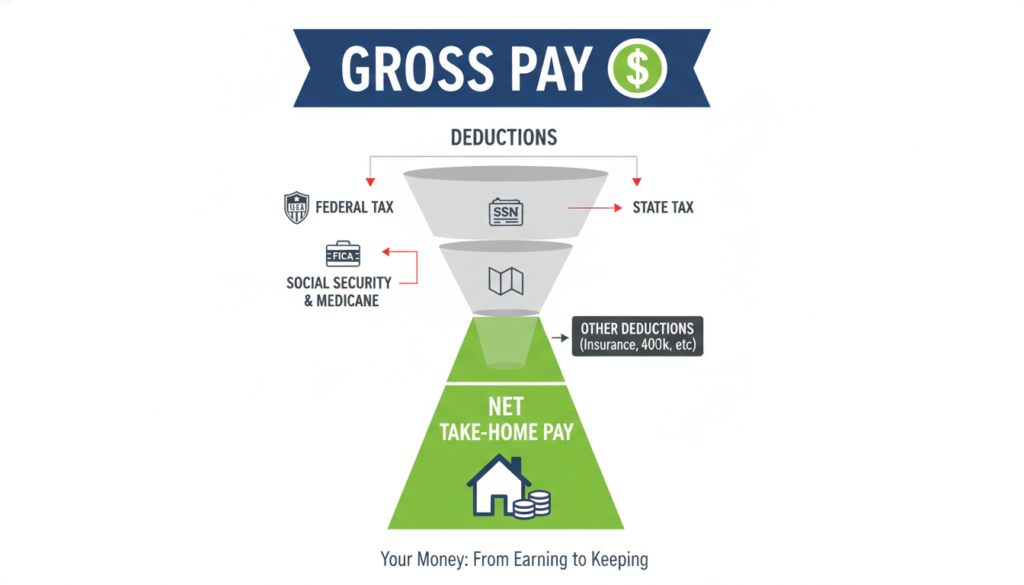
Your gross salary and your actual take-home pay are two very different numbers — and the gap between them is larger than most people realize. A $70,000 annual salary does not mean $5,833 per month in the bank. After federal income tax, state income tax, Social Security, and Medicare, that $5,833 can shrink to approximately $4,200–$4,600 depending on where you live. Budgeting based on gross income rather than net pay is one of the most common and costly financial planning mistakes Americans make.
This guide explains exactly how to calculate your real take-home pay for 2026, covers the updated federal tax brackets under the extended Tax Cuts and Jobs Act, and shows you how a free salary tax calculator eliminates the guesswork instantly.
2026 Federal Income Tax Brackets
The Tax Cuts and Jobs Act (TCJA) — including its lower rates and nearly doubled standard deduction — was extended beyond its original 2025 sunset. For 2026, the following federal income tax brackets apply for single filers:
- 10%: Taxable income up to $11,925
- 12%: $11,926 to $48,475
- 22%: $48,476 to $103,350
- 24%: $103,351 to $197,300
- 32%: $197,301 to $250,525
- 35%: $250,526 to $626,350
- 37%: Over $626,350
The standard deduction for 2026 is $16,100 for single filers and $32,200 for married filing jointly — an increase from 2025. This means single filers with income below $16,100 pay no federal income tax at all.
Important: Federal income tax is progressive and marginal. A single filer earning $60,000 does not pay 22% on all $60,000. They pay 10% on the first $11,925, 12% on income from $11,926 to $48,475, and 22% only on income above $48,475. The effective (average) tax rate is much lower than the marginal rate.
FICA Deductions: Social Security and Medicare
In addition to income tax, every employee in the US pays FICA payroll taxes regardless of income level:
- Social Security: 6.2% of gross wages up to $176,100 (the 2026 wage base)
- Medicare: 1.45% of all gross wages, with no income cap
- Additional Medicare: An extra 0.9% on wages above $200,000 for single filers
Combined, FICA deductions take 7.65% of every dollar you earn up to the Social Security wage base. On a $70,000 salary, that is $5,355 per year — or $446 per month — before any income tax is applied.
Real Example: $70,000 Salary in Texas (No State Tax)
Gross annual salary: $70,000. Standard deduction: $16,100. Taxable income: $53,900.
Federal income tax: 10% on $11,925 = $1,193. 12% on $36,550 = $4,386. 22% on $5,425 = $1,194. Total federal tax: $6,773. Effective tax rate: 9.7%.
Social Security (6.2%): $4,340. Medicare (1.45%): $1,015. Total FICA: $5,355.
Total deductions: $12,128. Annual take-home pay: $57,872. Monthly take-home: $4,823.
The $70,000 salary delivers $4,823 per month in Texas — about 83 cents for every dollar of gross pay. In a high-tax state like California, the same salary nets approximately $4,300–$4,500 after state income tax.
Use the free salary tax calculator to get your exact net pay instantly. Enter your salary and state and it calculates all federal and state deductions — essential before budgeting, accepting a job offer, or applying for any loan.
Why Take-Home Pay Matters for Every Financial Decision
Mortgage and Loan Affordability
Every loan affordability guideline — whether for mortgages (28% of gross income) or car payments (15% of take-home pay) — depends on knowing the right income figure. Using gross income for car payment affordability overstates what you can actually afford. Always calculate your net pay first, then apply the relevant percentage guideline.
Salary Negotiations
When evaluating a job offer or raise, knowing your net pay helps you understand the actual value of any increase. A $5,000 gross salary raise at a 22% marginal rate nets approximately $3,850 after federal tax and FICA — useful context when considering whether to accept an offer or negotiate further.
State Tax Comparison
Nine US states have no state income tax: Alaska, Florida, Nevada, New Hampshire, South Dakota, Tennessee, Texas, Washington, and Wyoming. For a $70,000 salary, moving from California (13.3% top marginal rate) to Texas saves approximately $3,500–$5,000 per year in state income taxes — a factor worth calculating when considering relocation.
How to Increase Your Take-Home Pay
- Maximize 401(k) contributions: Pre-tax 401(k) contributions reduce your taxable income. The 2026 contribution limit is $23,500. Every dollar contributed reduces your federal tax bill by your marginal rate.
- Contribute to an HSA if eligible: HSA contributions are triple-tax-advantaged — pre-tax, tax-free growth, and tax-free withdrawals for medical expenses. The 2026 limit is $4,300 for individuals.
- Claim all eligible deductions: Home mortgage interest, charitable donations, and state taxes (up to $40,000 in 2026 under the extended SALT cap) can push your taxable income below the standard deduction threshold.
- Adjust your W-4 withholding: If you consistently receive a large tax refund, you are over-withholding — the government is holding your money interest-free. Adjust your W-4 to reduce withholding and increase your monthly take-home.
Frequently Asked Questions
How much tax do I pay on $50,000 in 2026?
On $50,000 gross income as a single filer in 2026 with the standard deduction: taxable income = $33,900. Federal tax ≈ $3,900 (effective rate ~7.8%). FICA (Social Security + Medicare) = $3,825. Total deductions ≈ $7,725. Annual take-home ≈ $42,275 ($3,523/month). State income tax is additional and varies.
What is the SALT deduction cap in 2026?
The SALT (state and local tax) deduction cap was increased to $40,000 in 2026 under the One Big Beautiful Bill Act — up from the $10,000 cap that applied from 2018 to 2025. This benefits homeowners in high-tax states (California, New York, New Jersey) who pay significant property and state income taxes. The $40,000 cap phases out for incomes above $500,000.
Is Social Security tax calculated on my full salary?
Social Security tax of 6.2% applies to wages up to the 2026 wage base of $176,100. Income above this threshold is not subject to Social Security tax. Medicare tax of 1.45% applies to all wages with no cap, plus an additional 0.9% on wages above $200,000 for single filers.
Once you know your take-home pay, use the savings goal calculator to plan how long it takes to reach any financial goal — emergency fund, down payment, or retirement milestone — based on your real monthly income.
Disclaimer: All calculator results and financial figures are estimates for educational purposes only. Tax rules mentioned reflect information current as of May 2026 and are subject to change. Consult a qualified tax advisor or financial professional before making significant financial decisions.