
How to Calculate ROI on Rental Property (The Right Way)
Simple ROI on rental property consistently overstates returns by 30-50% because it misses expenses. Three metrics give the complete picture.
The 3 Metrics Every Rental Investor Needs
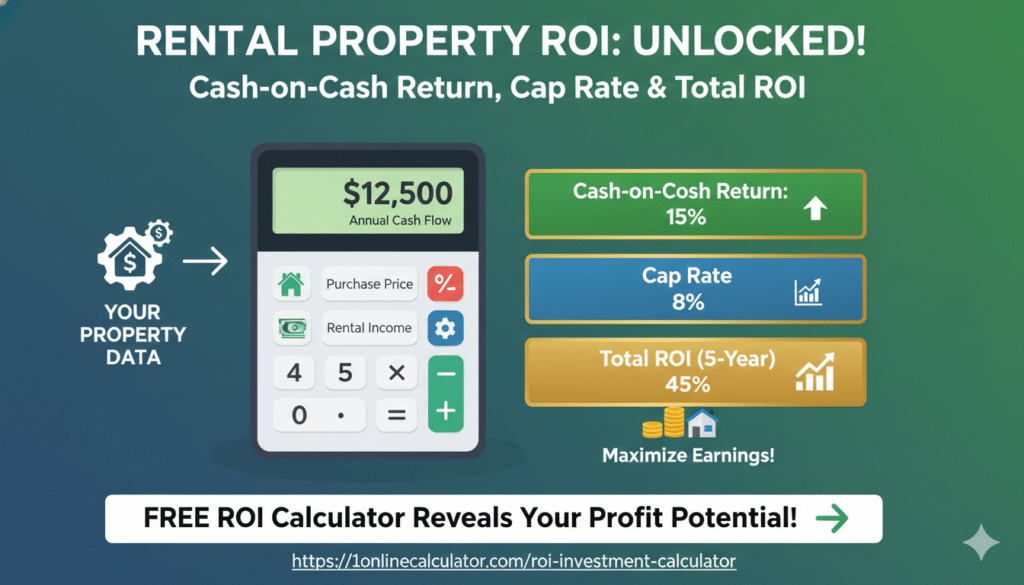
Cash-on-Cash Return = Annual Net Cash Flow ÷ Total Cash Invested. Measures how efficiently your out-of-pocket money produces annual income. The most useful short-term metric.
Cap Rate = Annual Net Operating Income ÷ Property Value. Measures property performance independent of financing. Use to compare properties and market values.
Total ROI = (Cash Flow + Appreciation + Principal Paydown) ÷ Cash Invested. The comprehensive view of all wealth-building components.
Worked Example: $250,000 Rental
Purchase: $250,000. Down payment (20%): $50,000. Mortgage (6.5%, 30yr): $1,264/month.
Annual gross rent: $24,000 ($2,000/month).
Annual expenses: Mortgage $15,168 + Property tax $2,750 + Insurance $1,200 + Maintenance $2,500 + Vacancy (5%) $1,200 + Management (8%) $1,920 = $24,738 total.
Annual net cash flow: $24,000 – $24,738 = -$738 (negative).
Cash-on-cash: -$738 ÷ $50,000 = -1.5%. This property does not cash flow. But is it a bad investment?
Total ROI Including Appreciation and Equity
Year 1 principal paydown: ~$2,400. Conservative 3% appreciation: $7,500.
Total annual return: -$738 + $2,400 + $7,500 = $9,162.
Total ROI: $9,162 ÷ $50,000 = 18.3%.
A negative cash flow property can still return 18%+ annually. Cash flow is liquid; appreciation is paper gain until sale — know the difference.
Q: What is a good rental property ROI?
Cash flow investors: cash-on-cash above 6-8% minimum. Appreciation-focused (high-growth markets): breakeven or negative cash flow acceptable with 3-5%+ annual appreciation. Typical US cap rates: 4-7% residential, 2-4% premium urban, 8%+ secondary markets.
Q: Rental property vs stocks?
Rental property offers leverage, cash flow, inflation hedge, and tax benefits. Stocks offer liquidity, diversification, and lower management burden. Most advisors recommend both rather than choosing exclusively.
Expenses Most New Landlords Underestimate
The most common error in rental property ROI calculation is underestimating ongoing expenses. Using a realistic expense framework consistently produces ROI figures closer to actual investor experience.
- Vacancy allowance: even in strong rental markets, plan for 5-8% vacancy per year. A property that sits empty for 3 weeks between tenants loses $1,500 in rent on a $2,000/month property. Many beginner calculations assume 100% occupancy and consistently overstate cash flow.
- Maintenance and capital expenditure: the 1% rule (1% of property value annually for maintenance) is a useful starting estimate — $2,500/year on a $250,000 property. However, properties with aging roofs, HVAC systems, or plumbing require larger reserves. Budget separately for capital expenditures (roof replacement: $8,000-$15,000, HVAC: $4,000-$8,000, water heater: $800-$1,500) over a 10-15 year cycle.
- Property management fees: if you use a professional manager (typically 8-12% of gross rent), this is a real expense that meaningfully affects ROI. Self-managing saves this cost but requires time and availability. Budget the fee regardless of whether you initially self-manage — it clarifies whether the property is viable if your circumstances change.
- Insurance: landlord insurance (not standard homeowners insurance) is required for rental properties. It typically costs 15-25% more than standard homeowners insurance. Budget $150-$250/month for a single-family rental.
The Leverage Effect on ROI
One of the most powerful features of real estate investing that distinguishes it from stocks is leverage. When you buy a $250,000 property with $50,000 down (20%), you are controlling a $250,000 asset with $50,000 of your own capital.
If the property appreciates 3% in year 1: the asset gains $7,500 in value. Your ROI from appreciation alone: $7,500 ÷ $50,000 = 15%. A 3% appreciation rate on the full property value produces a 15% return on your invested equity — the leverage ratio amplifies returns proportionally.
The same leverage amplifies losses. A 5% price decline costs $12,500 in asset value — a 25% loss on your $50,000 equity. This asymmetry — large potential gains and large potential losses — is why rental property investing requires greater financial resilience than stock investing and should only be undertaken with adequate emergency reserves separate from the investment.
Annualised ROI — The Correct Way to Compare Rental Returns Over Time
A rental property held for 10 years with a total gain of 180% has an annualised ROI of 10.8% per year — not 18% per year. Using the ROI investment calculator to annualise your returns allows fair comparison between your rental property, an S&P 500 index fund, and any other investment you are evaluating.
Enter the total initial investment (down payment + closing costs), the total gain over the holding period (cumulative cash flow + appreciation + principal paydown, minus all expenses), and the number of years held. The calculator returns both simple and annualised ROI figures.
Calculate annualised ROI for any investment: 1onlinecalculator.com/roi-investment-calculator/
Disclaimer: All calculations are estimates for educational purposes. Actual rates and terms vary by lender, credit profile, and state. Use the free calculator linked above for your specific numbers.