
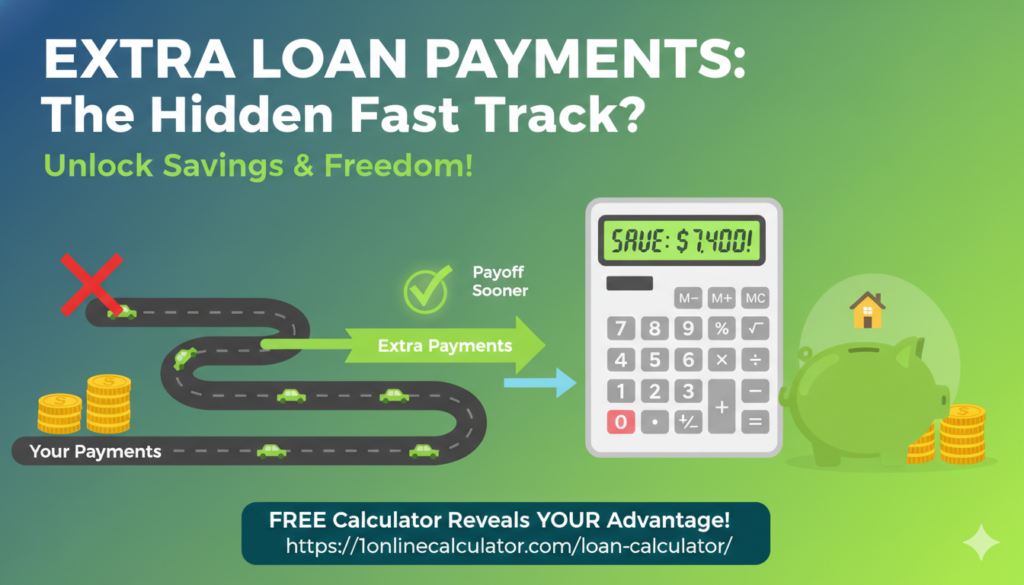
What Happens If You Pay Extra on a Personal Loan?
When you make an extra payment on a personal loan — whether $50 over your minimum or a full extra month’s payment — something specific and mathematically predictable happens. US personal loans use simple interest: every extra dollar reduces your principal balance immediately, which reduces every future interest charge for the remainder of the loan. But some lenders apply extra payments incorrectly — here is what you need to know.
How the Interest Calculation Works
Monthly Interest = Outstanding Balance × (APR ÷ 12 ÷ 100). On a $10,000 loan at 9% APR, month 1 interest = $75. Your $304 payment covers $75 interest + $229 principal, leaving $9,771. Month 2 interest is calculated on $9,771 — not $10,000. Paying extra in early months eliminates high-interest periods.
Exactly What Happens — 3 Possible Outcomes
1. Principal reduction (correct): extra amount reduces balance, every future interest charge decreases, loan pays off early. Always request this from your lender in writing.
2. Next payment advance (incorrect): lender applies excess to next scheduled payment date — balance does not decrease, no interest saving. Common default at some lenders.
3. Fee payment: lender applies excess to outstanding fees before principal.
Real Savings Example
$12,000 loan at 9% APR, 48 months. Standard payment: $298/month. Total interest: $3,321.
Add $100/month extra: pays off in 37 months. Interest: $2,423. Saves $898 and 11 months.
One $2,000 lump sum in month 3: pays off in 41 months. Saves $741 and 7 months.
Are There Penalties?
Most US personal loans from banks, credit unions, and major online lenders have no prepayment penalties. Check your agreement for “prepayment penalty” or “early payoff fee” before making large extra payments. If none exists, extra payments earn a guaranteed return equal to your loan’s APR — at 9% APR, this beats a HYSA at 4.5-5.0%.
Q: Does paying extra improve your credit score?
Not directly. It reduces your balance faster and may modestly improve credit utilisation. Paying off the loan completely causes a small temporary dip (5-15 points) from closing the account — minor and recovers in a few months.
Q: When is the best time to make an extra payment?
As early as possible. A $500 extra payment in month 1 eliminates interest on $500 for every remaining month. The same $500 in month 36 eliminates interest for only 12 remaining months. Early extra payments produce disproportionately larger savings.
How to Make Extra Payments Correctly — Step by Step
Most lenders have a simple process for extra principal payments, but the exact steps vary by lender type. Follow this sequence to ensure your extra payment actually reduces your balance and saves interest.
Step 1: Review your loan agreement for prepayment penalties before sending any extra amount. Search the document for the word “prepayment” — if the clause does not exist or says “no prepayment penalty,” proceed.
Step 2: Contact your lender before or at the time of payment. Email, secure message, or phone call — state clearly: “I am making an additional payment of $[amount] to be applied to the principal balance, not to advance the next scheduled payment date.” Keep a record of this instruction.
Step 3: Make the payment through the same channel you normally use — online account, bank transfer, or cheque. Include a memo line that reads “principal only” if you are mailing a cheque.
Step 4: Confirm the application after the payment posts. Log into your account within 3-5 business days and verify the balance decreased by the extra amount. If it did not, contact your lender immediately with your confirmation of the principal-only instruction.
The Compounding Effect of Consistent Extra Payments
The mathematics of simple interest means that every dollar of principal you eliminate today reduces not just this month’s interest, but every future month’s interest for the life of the loan. This creates a compounding savings effect even on a simple interest loan.
Illustrated on a $10,000 loan at 9% APR, 48 months: in month 1, the balance is $10,000 and interest charges $75. In month 2 (standard schedule), the balance is $9,771 and interest charges $73.28 — a saving of $1.72 from the month 1 principal reduction. If you paid $100 extra in month 1, the balance drops to $9,671. Month 2 interest: $72.53. The $0.75 difference seems tiny, but it continues reducing every single future payment for 47 more months. The total saving from one $100 extra payment in month 1 is approximately $93 — nearly equal to the extra payment itself, just spread across future months.
This is why financial planners describe extra loan payments as one of the highest guaranteed returns available to ordinary borrowers — the savings materially exceed the nominal value of the extra dollar paid.
When NOT to Make Extra Loan Payments
Extra loan payments are not always the optimal financial move. Three situations where the money is better used elsewhere:
- You have no emergency fund. Without a liquid cash cushion, any unexpected expense forces you to borrow again — often at a higher rate than the loan you were paying down. Build at least one month of expenses in a HYSA before accelerating loan payoff.
- Your employer offers a 401(k) match you are not maximising. A 50% or 100% employer match represents a guaranteed 50-100% return on your contribution — far exceeding any loan interest rate. Always capture the full employer match before making extra loan payments.
- Your loan rate is below 5% and you have a long investment horizon. At rates under 5%, the expected long-term return from a diversified index fund historically exceeds the guaranteed return from paying off the debt. This comparison becomes more nuanced as loan rates rise above 6-7%.
Calculate your exact savings at any extra payment amount: 1onlinecalculator.com/loan-calculator/
Disclaimer: All calculations are estimates for educational purposes. Actual rates and terms vary by lender, credit profile, and state. Use the free calculator linked above for your specific numbers.